
Solar Power on Railway Tracks
Railway tracks span thousands of kilometers across countries, often lying idle between train passages. Imagine transforming these underutilized spaces into renewable energy powerhouses by installing solar panels directly on or alongside them. Solar on railway tracks combines sustainable energy generation with efficient land use, addressing global demands for clean power while enhancing rail operations. This innovative approach, pioneered in nations like India and explored worldwide, promises reduced carbon emissions, cost savings, and energy independence for rail networks.
The Concept and Global Initiatives
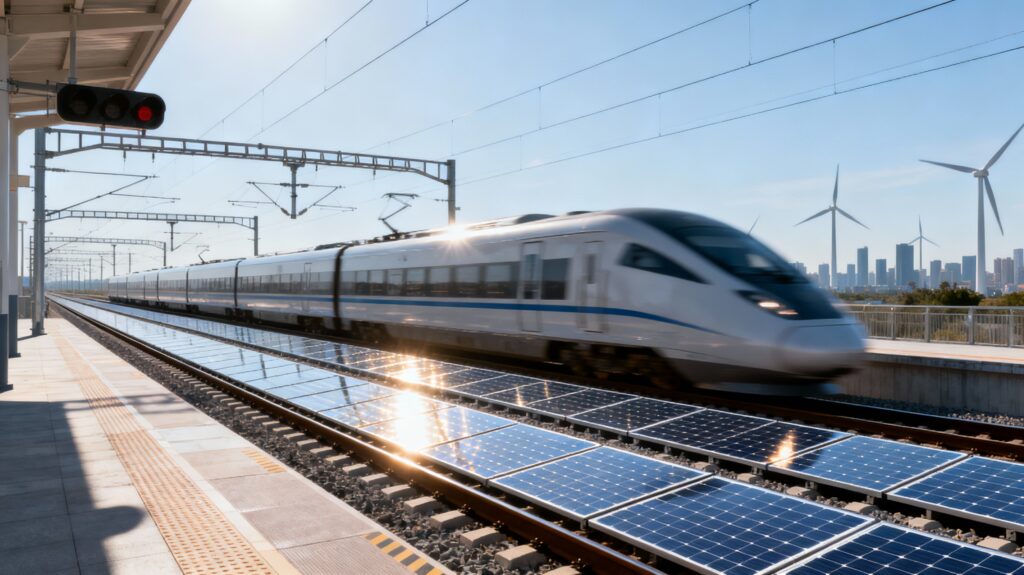
The idea involves mounting solar photovoltaic (PV) panels between or over railway tracks, where they capture sunlight without obstructing train movement. In India, the Railway Energy Management Company Limited (REMCL) launched a pilot in 2018 at Bhopal’s Valmiki Nagar station, installing 1 MW panels on 2.5 acres between tracks. By 2023, this expanded to over 5 MW, generating enough power for station lighting and signaling. Similar projects thrive in the UK, where Network Rail tested panels at Station Approach in Wiltshire, producing 172 kWh daily. Australia’s Aurizon and the US’s Brightline high-speed rail are evaluating trackside solar to power electrified lines. These initiatives leverage tracks’ south-facing alignment in the northern hemisphere for optimal sun exposure.
Technical Feasibility and Design Innovations
Solar panels on tracks must withstand vibrations, weather, and safety standards. Engineers use elevated, transparent, or semi-transparent modules that allow visibility for track inspections. Gapless mounting between tracks minimizes shading, while overhead gantry systems span wider areas. Bifacial panels capture light from both sides, boosting efficiency by 20-30%. Integration with rail power systems enables direct supply to overhead catenary wires or stations, reducing transmission losses. Advanced inverters and battery storage ensure stable output during cloudy periods or peak train times. Maintenance employs drones for cleaning and AI monitoring to predict faults, keeping downtime minimal.
Environmental and Economic Benefits
This setup maximizes land efficiency—rail corridors occupy 1-2% of national land but offer vast solar potential. A single kilometer of tracks could host 1-2 MW, powering thousands of homes annually. Environmentally, it cuts reliance on fossil fuels; India’s rail solar target of 20 GW by 2030 could offset 25 million tons of CO2 yearly. Economically, levelized costs drop to $0.03-0.05/kWh, cheaper than coal. Rail operators save on electricity bills—Indian Railways spends $2 billion annually—and generate revenue by selling surplus power. It also creates jobs in installation, maintenance, and tech R&D.
Challenges and Future Prospects
Obstacles include high upfront costs ($1-2 million/MW), wildlife interference, and regulatory hurdles for right-of-way. Dust accumulation in arid regions and seismic resilience demand ongoing innovation. Yet, falling panel prices (80% drop since 2010) and government subsidies accelerate adoption. Future hybrids could blend solar with wind or hydrogen for 24/7 power. By 2040, global rail solar might reach 100 GW, per IRENA estimates, electrifying more lines and supporting net-zero goals.
Solar on railway tracks exemplifies smart infrastructure, turning passive assets into active energy sources. For nations with extensive networks like India (68,000 km electrified), it’s a game-changer for sustainability. As technology evolves, expect widespread rollout, powering trains and communities alike.
Indian Railways Pilot
Banaras Locomotive Works in Varanasi launched India’s first 70-meter removable solar setup in August 2025, using 28 panels for 15 kWp capacity. This generates 67 units daily per section, or 880 units per km, secured with epoxy and rubber pads to handle train vibrations.
Discover how solar panels on railway tracks revolutionize energy generation and infrastructure. Sustainable power for trains, reduced costs, and green transit innovation awaits!