
How to Write an Opinion Essay: an Ultimate Guide
IELTS opinion essays, come up frequently in the writing exam. In this lesson, I’m going to show you how to plan and write them step-by-step.
Here’s what we’ll be covering:
- Basics
- Structure
- Basic Expressions to use
- What to do & What not to do
- Vocabulary
- Sample Essay
Writing an Opinion Essay: Basics
You may be wondering: how to write an opinion essay? How is it different from persuasive, argumentative or pros and cons essay?
It’s simple:
When you write an argumentative or persuasive essay, you should provide counterpoints and describe the essay topic from different points of view. In opinion paper, you don’t have to focus on advantages and disadvantages comparison, but only in your opinion about the issue.
There’s nothing to worry about if your arguments based on well-researched data.
Speaking about the topic, some students find it difficult enough to choose the perfect one. But it’s not so hard: think about something that engages you most; that you feel strongly about.
The next steps are to pick up few reasons supporting your point of view and gather the facts that you’ll use as evidence.
Opinion Essay Structure
The next step is to writу an opinion essay outline. First of all, it will help you to overcome the fear of the blank page. Second, you’ll have a broken-down list of ideas and an organized place for your random thoughts so that you can write an assignment faster.
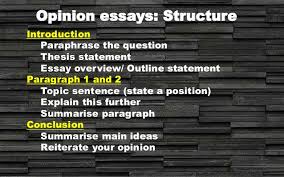
Here’s an opinion paper outline example:
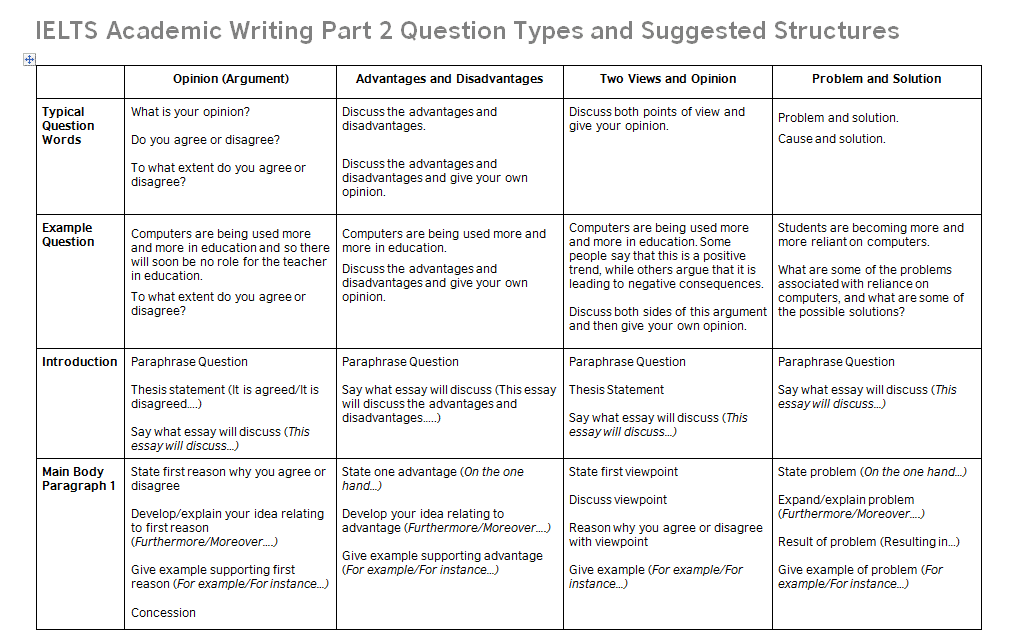
- An introduction. Write a thesis statement and the reasons for your opinion. Give your readers a hook to engage them with the topic.
A good introduction has a simple 3 part structure:
1) Paraphrased question
2) Thesis statement
In IELTS opinion essays, the thesis statement is where you state your opinion. For example,
If you decided to agree with the statement, you would write:
‘This essay completely in favour with that statement.’
3) Outline statement
An introduction should:
- Have 2-3 sentences
- Be 40-60 words long
- Take 5 minutes to write
This introduction achieves three important functions:
- It shows the examiner that you understand the question.
- It acts as a guide to the examiner as to what your essay is about.
- It also helps to keep you focused and on track as you write.
- The main body. Broke it in several paragraphs where you provide arguments and supporting examples, statements, and facts.
The structure of a good main body paragraph has 3 parts:
- Topic sentence
- Explanation
- Example
If you can’t think of an example, you can add further supporting ideas but we already have our two examples so that’s not an issue here.
A common problem when writing main body paragraphs for IELTS opinion essays is having too many ideas. Again, we have already chosen the two ideas we are going to develop, so we are all set to start writing.
You can see how important the planning stage is and how it make the actual writing of the essay far quicker and easier.
Main Body Paragraph
The topic sentence summarises the main idea of the paragraph. That’s all it needs to do so it doesn’t have to be complicated.
It plays an important role in ensuring that your ideas flow logically from one to another. It does this by acting as a signpost for what is to come next, that is, what the paragraph will be about.
If you maintain a clear development of ideas throughout your essay, you will get high marks for task achievement and cohesion and coherence.
We’ll now take the idea for our first main body paragraph and create our topic sentence.
- A conclusion. Ending a paper, restate the main thesis and summarize central points of the essay.
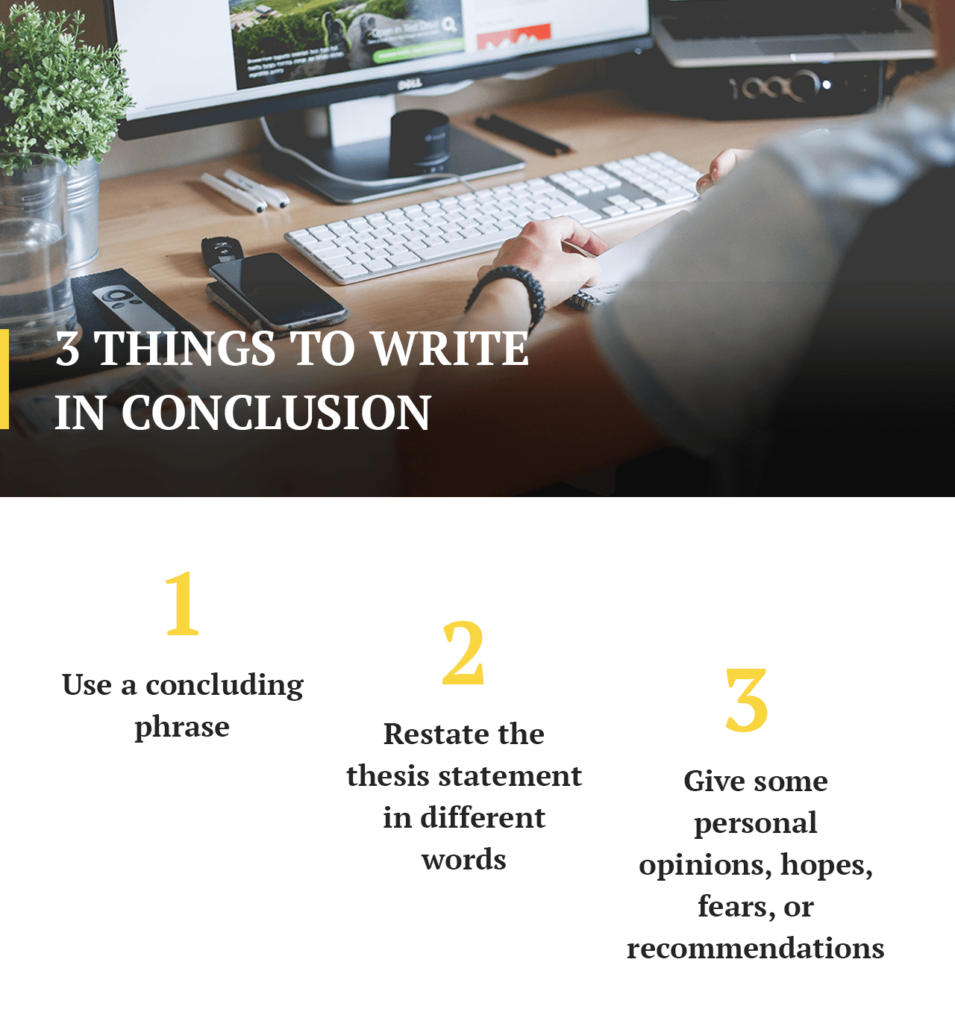
Conclusions to IELTS opinion essays should do two things:
- Summarise the main points
- State your opinion
This can generally be done in a single sentence.
If you are below the minimum 250 words after you’ve written your conclusion, you can add an additional prediction or recommendation statement.
Our essay currently has 233 words so we’re on target and don’t need this extra sentence but you can learn more about how to write a prediction or recommendation statement for IELTS opinion essays on the Task 2 Conclusions page.
The conclusion is the easiest sentence in the essay to write but one of the most important.
A good conclusion will:
- Neatly end the essay
- Link all your ideas together
- Sum up your argument or opinion
- Answer the question
If you achieve this, you’ll improve your score for both task achievement and cohesion and coherence which together make up 50% of the overall marks. Without a conclusion, you’ll score below band 6 for task achievement.
You can start almost any final paragraph of an IELTS opinion essay with the words:
- In conclusion
or
- To conclude
Now all you need to do is briefly summarise the main ideas into one sentence.
Here’s a top tip. Go back and read the introduction to the essay because this is also a summary of the essay. It outlines what you are going to write about.
To create a great conclusion, you simply have to paraphrase the introduction. Let’s give it a go.
Develop an outline while you’re researching the topic and place evidence where they make the most sense. You don’t have to write whole assignment – just put stand-alone examples and facts in the place where they should go.
Well-prepared outline for opinion essay makes almost 70 percent of success. All you left to do is merely join your arguments by bridging language.
Check These Useful Tips for Writing an Opinion Essay:
- State your opinion as to the topic discussed.
- Make a list of viewpoints and reasons supporting your point of view.
- Construct well-developed paragraphs.
- Use linking words and phrases to join the sentences and the paragraphs within the text.
- Start each paragraph with a topic sentence.
Essay Introduction and Conclusion
After you’ve finished an outline, you will have all of your facts organized. It’s time to develop an introduction to opinion writing. Its primary goal is to prepare your readers to dip into the essay.
The opening paragraph is a kind of a roadmap describing the path you’re your paper will take. An opinion essay introduction secret is to give a hook to your readers, grab their attention and make the rest of writing irresistible.
After giving a hook to your audience, introduce the topic and briefly describe supporting reasons that you will expand in body paragraphs.
Similar to an introduction, the opinion essay conclusion wraps up your paper. It’s a summary that broadly covers your ideas and allows your readers to understand your arguments.
Apply the Following Techniques to Start and Finish Your Opinion Essays:
- Address the reader directly.
- Start with a quote.
- Start with a thought-provoking or rhetorical question.
- Refer to some striking or unusual fact, idea or situation.
When it comes to opinion writing, a lot of students can’t provide their point of view. This shows a lack of critical thinking skills and leads to low grades.
If you need a quick fix for your assignment, check our list of basic expressions to help you start putting your opinions:
- As far as I am concerned, …
- I am (not) convinced that …
- In my opinion/view …
- My opinion is that …
- I (firmly)believe that …
- I (definitely) feel/think that …
- I am inclined to believe that …
- Personally, I believe that…
- It is clear that…

- It seems to me that…
- In my mind…
- As I see it…
- My principal reason is…
- Another reason is…
- It is widely known that…
- It could be argued that…
- The well-known fact is…
- Research has shown that…
- For instance/for example…
- This suggests that…
- It would seem that…
- This proves that…
- This supports the …
- Even though / Although…
- In contrast…
- Despite the fact that…
- In spite of…
- In order to…
- To sum up…
- In conclusion…
And don’t forget to use nouns, adjectives and adverbs, or make your own phrases.
What to do & What not to do?
Do you need more expert advice on how to write a great essay?
Keep reading!
What to do?
- Write in a formal style. Write your assignment as if you are giving an important speech.
- Avoid slang and jargon.
- Introduce the topic clearly. Avoid unnecessary phrases and useless facts that do not relate directly to the topic.
- Start each paragraph with clear topic sentences; outline the main ideas
- Use generalizations
- Use present tense when writing an opinion article
- Cite your sources in a proper way
- Stay brief
- Make sure that there is a logical sequence that allows your readers easy to follow
What not to do?
- Don’t use colloquial expressions. Even though slang language is expressive and vivid, jargon words come and go quickly.
- Don’t use short forms. Replace the contractions with the non-contracted versions of the words.
- Don’t use over-generalizations
- Don’t use statistics without proper referencing
- Don’t give personal examples
- Don’t repeat arguments. If you have few similar facts, group them as a single argument.
- Avoid abbreviations
- Don’t overuse simple and short sentences
- Don’t use imperative voice
- Avoid exclamation marks, parentheses, dashes
- Don’t address your readers as “you”
- Don’t use emotive vocabulary

The final piece of advice: don’t forget to proofread your paper. Revise your content, grammar, vocabulary, spelling, etc. Make sure that your essay answers the main question. Check if the evidence you provided is accurate and up-to-date.
Thank you for reading! Our free tips will help you get through any kind of essay. Still, if you’re stuck with your essay, you can always count on the tips and recommendations from professional writers!
With the help of the tips above, you’ll be able to create the most unbelievable papers in a blink of an eye. Now that you know the secrets of professional writers. Try writing your own opinion essay!
Vocabulary
In an IELTS essay, it’s important to be able to say the same things in different ways, either by paraphrasing and/or using synonyms. During the planning stage, quickly jot down a few synonyms of key words you could use to save you having to stop and think of the right language while you’re writing.
For example:
satisfaction – fulfilment, achievement, sense of accomplishment, content, sense of well-being
salary – income, wages, pay, earnings
important – significant, valued, has more meaning
job – work, employment, position
With that done, we can focus on the first paragraph of the essay – the introduction.
IELTS Writing Task 2: Opinion Essay with Sample Answer
IELTS Writing Task 2 Question
Try this opinion essay question about the animals. It’s best to state a clear opinion for or against it in your introduction.
A growing number of people feel that animals should not be exploited by people and that they should have the same rights as humans, while others argue that humans must employ animals to satisfy their various needs, including uses for food and research.
Discuss both views and give your opinion.
Animal Rights Essay – Model Answer
Some people believe that animals should be treated in the same way humans are and have similar rights, whereas others think that it is more important to use them as we desire for food and medical research. This essay will discuss both points of view.
With regard to the exploitation of animals, people believe it is acceptable for several reasons. Firstly, they think that humans are the most important beings on the planet, and everything must be done to ensure human survival. If this means experimenting on animals so that we can fight and find cures for diseases, then this takes priority over animal suffering. Furthermore, it is believed by some that animals do not feel pain or loss as humans do, so if we have to kill animals for food or other uses, then this is morally acceptable.
However, I do not believe these arguments stand up to scrutiny. To begin, it has been shown on numerous occasions by secret filming in laboratories via animal rights groups that animals feel as much pain as humans do, and they suffer when they are kept in cages for long periods. In addition, a substantial amount of animal research is done for cosmetics, not to find cures for diseases, so this is unnecessary. Finally, it has also been proven that humans can get all the nutrients and vitamins that they need from green vegetables and fruit. Therefore, again, having to kill animals for food is not an adequate argument.
To sum up, although some people argue killing animals for research and food is ethical, I would argue there is sufficient evidence to demonstrate that this is not the case, and, therefore, steps must be taken to improve the rights of animals.
(Words 290)