
Supreme Court’s 2025 Aravali Hills Demolition Order: A Wake-Up Call for India’s Green Legacy
Imagine waking up one morning to the rumble of bulldozers tearing down your home, all in the name of saving a fragile ecosystem that’s been standing for millions of years. This heartbreaking reality faces thousands in the Aravali Hills, as the Supreme Court of India ramps up its crackdown on illegal encroachments. In a landmark ruling on November 20, 2025, the court not only accepted the Centre’s new definition of Aravali Hills—classifying elevations over 100 meters as protected forest land—but also ordered urgent demolitions and a comprehensive management plan to halt the region’s rapid degradation. Building on decades-old cases like T.N. Godavarman Thirumulpad (1995), this 2025 directive feels like a desperate plea from the judiciary to preserve what little remains of this ancient mountain range spanning Haryana, Rajasthan, Delhi, and Gujarat.
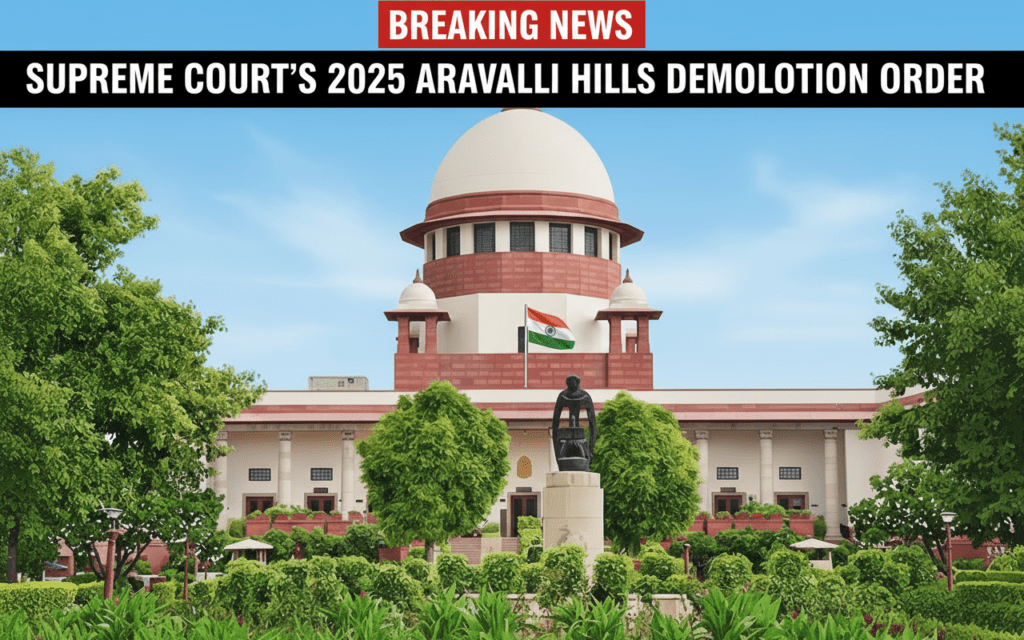
The Heartbreaking Human Side of the Order
Behind the legal jargon are real families—daily wage earners, migrant workers, and lifelong residents—who’ve built lives on what they thought was safe land. Take the residents of Faridabad’s Khori village, where echoes of the 2021 demolition of 10,000 homes still linger; now, the 2025 order threatens even more, including unauthorized farmhouses and government outposts. One can’t help but feel the pain of a mother clutching her child’s hand as machines approach, wondering where tomorrow’s shelter will come from. Protests erupt, pleas for rehabilitation flood the courts, yet justices remain resolute: “Encroachers cannot claim equity,” they’ve ruled time and again. It’s a tough love approach, prioritizing the Aravali’s role as Delhi-NCR’s lifeline against dust storms, pollution, and water scarcity.
Evolution of the 100-Meter Threshold Controversy
The 2025 order’s centerpiece is the contentious 100-meter elevation rule, proposed by the Environment Ministry and greenlit by the Supreme Court. Hills rising above this height are now officially “Aravali,” banning fresh mining leases and mandating encroachment removal. Critics, including environmentalists, slam it as a diluted safeguard—why spare lower slopes vulnerable to mining lobbies? Experts like those quoted in recent analyses argue this redraws protective boundaries, potentially opening doors to more exploitation in flatter zones. Picture the Aravali not as barren rocks, but a vibrant lifeline: leopards prowling, peacocks calling, underground aquifers recharging monsoon rains for millions. This definition, born from scientific surveys, aims for clarity but stirs fears of “catastrophic” loopholes.
Past Demolitions and Enforcement Struggles
This isn’t new—Haryana’s bulldozer bias has long defied orders. In March 2025, Faridabad razed 15 illegal structures, but deadlines slip as state agencies drag feet on their own buildings. June 2025 saw Gurgaon’s protected zones facing the wrecking ball, yet implementation lags, fueling public outrage. The court’s frustration peaks in directives for satellite imaging and strict timelines, echoing 2021’s massive clearances. Human stories abound: displaced families rebuilding shanties elsewhere, farmers losing ancestral plots to “forest” claims. Yet, without action, the Aravali’s forest cover—already down 20% in decades—risks vanishing, turning NCR into a desert.
Environmental Stakes and Path Forward
These demolitions aren’t just about bricks; they’re a battle for breathable air and sustainable water in a overheating India. The Aravali acts as a natural barrier, curbing desertification from Rajasthan’s sands. The 2025 management plan demands afforestation, wildlife corridors, and eco-tourism—visions of restored trails where families picnic amid native flora. For residents, rehab schemes promise alternatives, but trust is thin. States must step up: Haryana, Rajasthan, act now. Readers, share your thoughts—has the court gone too far, or is this the tough medicine our planet needs? Stay tuned for updates; the Aravali’s fate hangs in the balance.