
IELTS Academic Exam
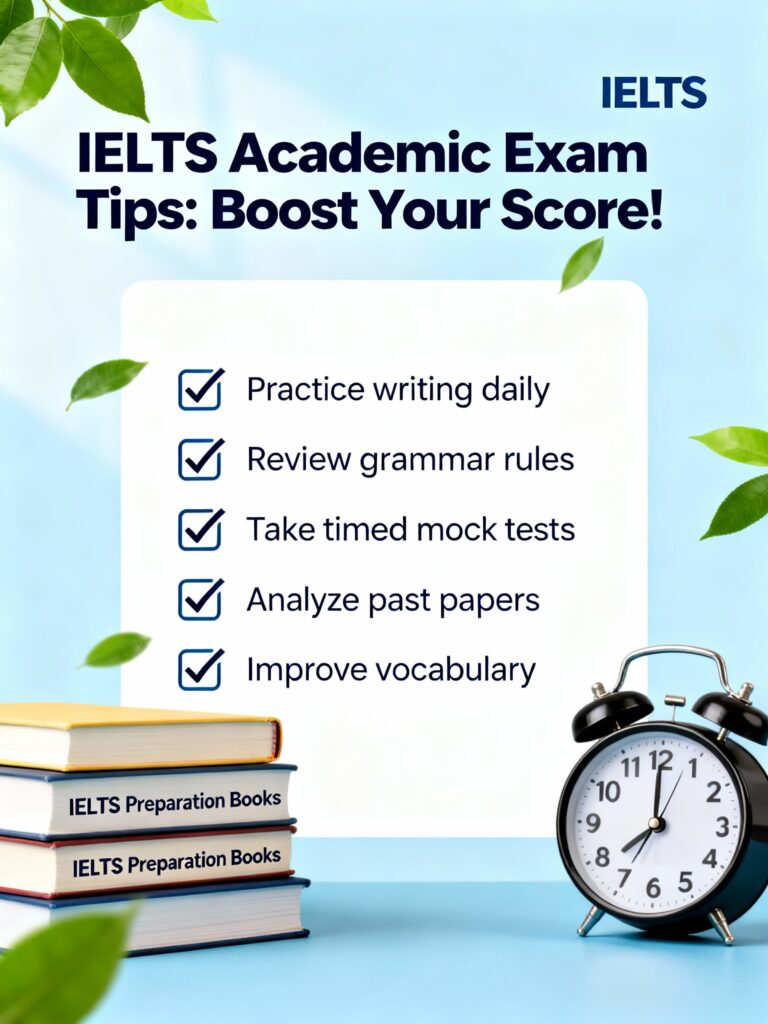
To score better in the IELTS Academic exam, focus on targeted preparation for each section: Listening, Reading, Writing, and Speaking, using proven strategies and consistent practice.
Understanding IELTS Academic Sections
Each section of the IELTS Academic test evaluates specific language skills:
-
Listening: Assesses understanding of spoken English in a variety of accents and situations.
-
Reading: Tests ability to interpret academic texts, diagrams, and extract key details.
-
Writing: Measures ability to describe visual information (Task 1) and construct well-structured arguments or discussions (Task 2).
-
Speaking: Examines fluency, pronunciation, grammar, and coherence in conversational English.
Get our Latest Post/Blogs here.
Effective Preparation Strategies
-
Take multiple full-length IELTS practice tests to familiarize yourself with the test format and timing.
-
Review sample answers and examiner comments to understand what scores higher in writing and speaking.
-
Build vocabulary specifically for academic topics and practice paraphrasing to maximize reading and writing scores along with audio visual methods.
-
Join IELTS preparation courses, either in-person or online, for expert feedback and peer interaction.
Section-Wise Tips
Listening
-
Practice understanding diverse English accents (British, American, Australian).
-
Listen for keywords, instructions, and transitions in audio passages.
-
Take notes rapidly; focus on numbers, names, and dates as these are frequently tested.
Reading
-
Skim passages for main ideas before reading questions.
-
Highlight keywords in questions to locate information quickly.
-
Develop scanning skills to find specific details or answers efficiently.
Writing
-
Plan your essay structure with clear introductions, body paragraphs, and conclusions before you start writing.
-
Address all parts of the question and support arguments with examples and explanations.
-
Practice summarizing graphs, tables, and charts for Task 1 and forming balanced opinions for Task 2.
Speaking
-
Practice speaking English regularly, preferably with native speakers or teachers.
-
Develop answers beyond simple responses; add details and explanations.
-
Record yourself and evaluate fluency, pronunciation, and grammar for improvement.
Additional Resources
-
Use official IELTS study materials and reputable online resources for targeted practice.
-
Set a study schedule and track progress in mock tests.
-
Maintain confidence and keep anxiety in check during test day by following relaxation techniques and thorough revision of all modules.
Score higher in the IELTS Academic exam by mastering the test format, building exam skills for each module, and following a focused practice plan with regular feedback.
Understand the test and your target
-
Learn band descriptors for each skill (especially Writing and Speaking) so you know what “Band 7/8” actually requires.
-
Take a timed full-length mock test to identify weak sections and set a realistic band target for each module.
Listening improvement tips
-
Practice with official IELTS recordings and mixed accents (British, Australian, North American) several times a week.
-
Train prediction skills: read questions first, underline keywords, and check spelling and word limits carefully in answers.
Reading improvement tips
-
Develop skimming (main idea) and scanning (specific details) using academic articles and past IELTS passages under 60-minute timing.
-
Focus on paraphrasing: build a vocabulary notebook of synonyms and practise True/False/Not Given and Matching Headings regularly.
Writing improvement tips
-
For Task 1 (Academic), learn standard structures for line graphs, bar charts, tables, and processes, describing key trends and making clear comparisons.
-
For Task 2, plan 3–5 minutes, write clear topic sentences, support each idea with examples, and then check grammar, linking words, and task response at the end.
Speaking improvement tips
-
Practise daily with common IELTS topics, recording yourself to check fluency, pronunciation, and range of grammar and vocabulary.
-
Extend answers with reasons and examples, avoid memorised speeches, and simulate full Speaking tests with a partner or tutor when possible.
These methods will improve overall performance and help achieve a better band score in the IELTS Academic exam.
HOW TO WRITE AN OPINION ESSAY: AN ULTIMATE GUIDE