Get our Latest Post/Blogs here.
IELTS Academic and General Training
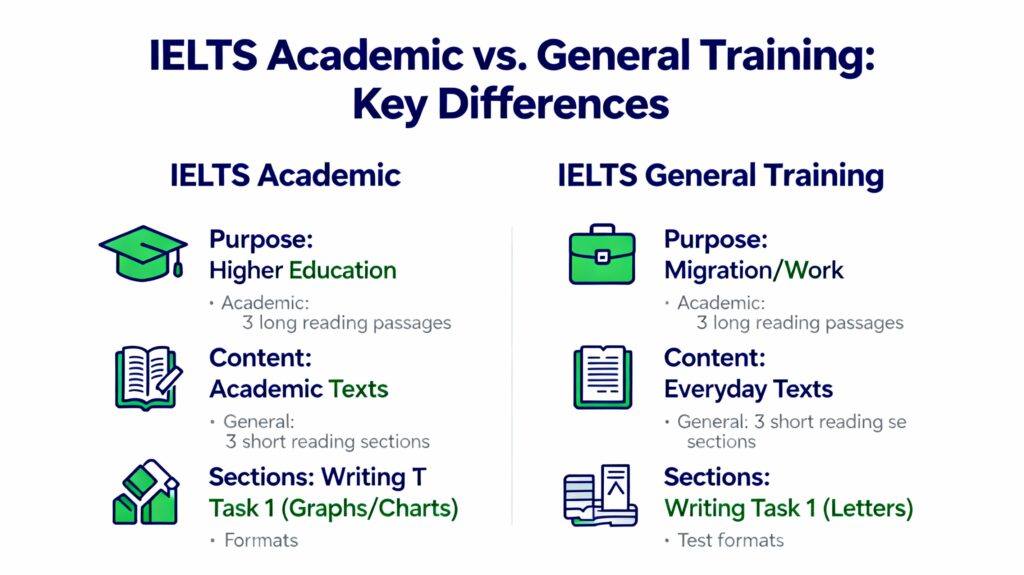
The key difference between IELTS Academic and General Training lies in their purpose and content:
-
The key difference between IELTS Academic and General Training lies in their purpose and content, tailored to distinct goals for English language proficiency.
IELTS Academic suits candidates pursuing higher education or professional registration in English-speaking countries. It rigorously tests academic English skills essential for university lectures, research papers, and scholarly discussions. The Reading section features three lengthy passages drawn from books, journals, newspapers, and magazines—often dense with complex vocabulary, arguments, and inferences that mirror real academic reading demands. Writing Task 1 challenges test-takers to analyze and summarize visual data like line graphs, bar charts, pie charts, tables, or diagrams, requiring precise description of trends, comparisons, and key features in at least 150 words. Task 2 demands a 250-word essay responding to a viewpoint, argument, or problem on topics such as education, technology, environment, or society, emphasizing critical thinking and formal academic language. This version is typically more demanding due to its focus on analytical and abstract content, preparing users for rigorous study environments.
In contrast, IELTS General Training targets those planning migration, employment, or training in English-speaking nations, emphasizing practical, everyday language skills. The Reading section comprises 2-3 short sections with 4-6 texts from real-world sources like advertisements, company handbooks, guides, notices, and newspapers, testing comprehension of straightforward information. Writing Task 1 requires composing a 150-word letter—formal, semi-formal, or informal—handling scenarios like job applications, complaints, requests for information, or accommodation issues. Task 2 mirrors Academic’s essay format but on general interest topics like family, work-life balance, travel, or consumer issues, allowing more relatable responses. Overall, General Training feels more accessible, prioritizing functional communication over scholarly depth.
Both formats share identical Listening and Speaking modules. Listening involves 40 questions across four recordings—conversations and monologues with diverse accents—testing note-taking and detail capture over 30 minutes plus 10 for transfer. Speaking is a 11-14 minute face-to-face interview in three parts: personal questions, a 1-2 minute cue card monologue, and abstract discussion, assessing fluency, pronunciation, grammar, and vocabulary uniformly. Test duration (2 hours 45 minutes), band scores (0-9 per section, overall average), and validity (2 years) remain consistent.
Feature IELTS Academic IELTS General Training Purpose Study, professional registration Migration, work, training Reading 3 long academic texts 4-6 shorter everyday texts Writing Task 1 Data description (graphs/charts) Letter writing (real-life scenarios) Writing Task 2 Essay on academic topics Essay on general topics Difficulty More challenging, academic focus Easier, practical focus Listening & Speaking Same format Same format Beyond content, preparation strategies differ. Academic test-takers should practice academic vocabulary (e.g., “hypothesis,” “mitigate”) and data interpretation via resources like Cambridge IELTS books or official practice tests. General Training users benefit from role-playing letters and skimming daily notices. Regardless of version, consistent practice—aiming for 2-3 hours daily—mock tests, error analysis, and feedback from tutors elevate scores. Time management is crucial: allocate wisely in Reading (20 minutes per passage) and Writing (20 for Task 1, 40 for Task 2).
Choose Academic for undergraduate/graduate programs or bodies like nursing councils; opt for General Training for skilled migration (e.g., Australia’s points system) or non-degree work visas. Verify requirements via university websites or immigration portals, as some accept both. With targeted prep, band 7+ is achievable in either—start early for optimal results.
- Pro Tip: Bookmark this this post for future updates and news related to IELTS Academic and IELTS General.
HOW TO WRITE AN OPINION ESSAY: AN ULTIMATE GUIDE