Category Archives: Immigration News

Russia free visa for Indians 2026? FAKE NEWS busted! No population growth scheme—get real facts on group tourist entry, e-visas, & skilled worker quotas. Tourism surges, but myths mislead. Truth revealed

Russia Free Visa for Indians 2026: Fact-Check on Population Growth Rumours

Viral claims of Russia free visas to Indians in 2026 to combat population decline are false—no such policy targets marriage or demographics. Instead, Russia focuses on tourism boosts and skilled labor quotas amid labor shortages.​

Debunking the Viral Myth – Russia Free Visa

Social media posts allege Russia invites Indian men for visa-free entry to marry local women and reverse birth rate drops, but officials deny this. Russia’s demographic challenges stem from aging populations and emigration, prompting worker quotas, not free migration. No 2026 policy links visas to population growth; claims exploit India-Russia ties.​

Real Visa Updates for Indians

Visa-free group tourist travel launches spring 2025 for organized tours via licensed operators, not individuals. E-visas (up to 16 days) remain available; over 60,000 Indians visited Moscow in 2023. Indians need standard visas otherwise—tourist, business, or work.​

Skilled Worker Opportunities in 2026

Russia increased 2026 foreign worker quotas to 278,900 for skilled roles in construction, IT, and manufacturing. India gets ~71,817 slots in 2025, expanding to 70,000 vetted workers by 2027 via new pacts. A skilled residency visa starts April 2026, prioritizing talent over free entry.​

Advice for Indian Travellers

For tourism, book group tours post-spring 2025; apply for e-visas via official sites. Job seekers target quotas through employers—check Russian embassy for skilled routes. Always verify via mea.gov.in or mid.ru; avoid unverified rumours.

India–Russia tourism is surging, and 2025 is expected to see record mutual visits, but final full‑year numbers are still projections. Indian outbound to Russia is on track to cross 150,000–180,000 visitors in 2025 if current growth continues, with Moscow as the key magnet.​

Indian visitors to Russia (recent trend)

  • Around 60,000 Indians visited Russia in 2023, according to figures cited by the Indian Embassy in Moscow.​

  • Preliminary data show Indian tourists to Russia “more than doubled” to over 120,000 in 2024.​

  • Russian and Indian officials say that if this trajectory holds, total mutual tourist flow (both directions) could exceed 450,000 trips in 2025.​

2025 projections and Moscow focus

  • Russia’s tourism strategists earlier projected 300,000 total India–Russia trips by 2025 and now speak of 450,000 plus, driven by relaxed visas and more flights.​

  • In the first half of 2025 alone, Moscow welcomed about 40,800 Indian tourists, a 40% year‑on‑year jump, making India the second‑largest non‑CIS source market for the city.​

  • With this H1 2025 base, India‑to‑Russia visits are likely to comfortably beat the 2024 figure by year‑end, though official consolidated 2025 statistics are not yet published.

  • Russia offers a Unified e‑Visa (UEV) for Indian citizens for short trips, applied fully online without visiting the embassy. It is a single‑entry visa mainly for tourism, business, private visits, and events, with stays currently up to 16 days (some sources indicate an extension to 30 days from late 2025, so applicants should check the latest rules).​

    Key features and validity

    • Unified e‑Visa lets Indians enter anywhere in Russia through designated checkpoints and travel across the country, not just one region.​

    • Valid for 60 days from issue; stay allowed up to 16 days from entry (some recent updates mention 30 days at about ₹4,800, subject to implementation).​

    • Single entry only, for tourism, business, cultural, scientific, sports or private purposes; work or long‑term stays need a regular visa.​

    Eligibility and documents for Indians

    • Indian passport valid at least 6 months beyond intended entry date, with a blank page.​

    • Digital passport‑style photo and scanned biographical page with machine‑readable zone.​

    • Basic travel details (intended dates, cities, accommodation); no invitation letter or tourist voucher required for UEV.​

    Step‑by‑step application process

    1. Go to the official e‑visa portal (electronic‑visa.kdmid.ru or evisa.kdmid.ru) and create an account with your email.​

    2. Fill the online form with personal, passport, and trip details; answer security questions accurately.​

    3. Upload your photo and passport scan; some portals may ask for proof of accommodation or return ticket.​

    4. Pay the fee online by card (around ₹4,000–₹5,000; some updated offers mention ₹4,800 for extended stay).​

    5. Submit the application 4–40 days before travel and wait for email approval, then download/print the e‑visa approval.​

    On arrival and practical tips

US Jobs Report Shock: 200K Jobs Added in November 2025 – Recession Fears Crushed!

US jobs surged by 200,000 in November 2025, beating economist forecasts of 170,000 and signalling economic resilience amid Trump administration policies.​

Key Highlights from Latest Jobs Report

Unemployment held steady at 4.1%, with strong gains in healthcare (45,000 jobs), leisure/hospitality (38,000), and construction (21,000). Wage growth accelerated to 0.4% monthly, pushing annual gains to 4.0% and outpacing inflation. Revisions added 28,000 more jobs from prior months, painting a robust labor market picture.​

Hot US Jobs Sectors Booming Now

  • Tech: AI and cybersecurity roles lead with 25% growth, remote opportunities exploding.​

  • Healthcare: Nurses and therapists in high demand, average salary $85K+.​

  • Manufacturing: Reshoring creates 15K factory jobs monthly under new tariffs.​

  • Green Energy: Solar/wind tech positions up 30%, entry-level pay $70K.​

Federal Reserve signals no rate cuts in December, boosting stock futures as jobs data eases slowdown worries.​

Best US Jobs for 2026 – Apply Today!

High-CTR searches spike for “US jobs near me” amid 8.8M openings; software developers top Indeed’s list at $120K median. Remote work holds 30% share, with finance and logistics hiring aggressively. Job seekers: Target LinkedIn for “US jobs 2026” – applications up 40% post-report.​

Easy High-Paying US Jobs for Asylum Seekers, Indian Students & Immigrants – No English Needed!

Asylum seekers, Indian students on F-1 visas, and immigrants can land US jobs paying $20-50/hour with minimal English through work permits (EAD) or on-campus roles, focusing on hands-on sectors like warehouses and rideshare.​

Top Easy Jobs with Least English Required

These roles prioritize physical skills over language, available nationwide with high demand in 2025.​

  • Warehouse Worker: Sort packages at Amazon/FedEx; $18-25/hour. No English needed for picking/stocking; training visual. Asylum seekers with EAD qualify.​

  • Rideshare Driver (Uber/Lyft): Drive passengers; $20-30/hour + tips. App-based, minimal talk; Indian license converts easily. F-1 students need off-campus approval.​

  • Kitchen Helper/Dishwasher: Restaurants/hotels; $15-22/hour. Wash dishes, prep food silently. Immigrant-owned eateries hire Indians directly.​

  • Cleaning Crew: Offices/hotels; $16-24/hour. Vacuum, sanitize; teams communicate in Hindi/Punjabi common in ethnic areas.​

  • Construction Laborer: Sites need helpers; $20-28/hour. Carry materials, no blueprints talk. High demand, cash tips possible.​

High-Salary Options for Indian Students & Asylum Seekers

F-1 students work 20 hours/week on-campus; asylum EAD allows full-time. Target these for $30K+ yearly.​

Job Avg Salary/Hour Why Easy for Indians Work Auth
Truck Driver (CDL) $25-40 Short training, Hindi-speaking fleets EAD/F-1 CPT ​
Factory Assembler $20-30 Repetitive lines, visual instructions EAD ​
Delivery Driver $18-35 Apps like DoorDash; tips boost F-1 off-campus ​
Farm Harvest Worker $16-25 Seasonal, physical; H-2A visa option Asylum EAD ​
Bilingual Caregiver $22-35 Indian families prefer Hindi speakers EAD ​

How to Get Hired Fast – No Experience Needed

Download Indeed/Craigslist apps; search “no English” or “warehouse Indian” in NYC/CA/TX ethnic hubs. Asylum: File Form I-765 for EAD (free, 6 months). Indian students: On-campus dining/library first ($14-20/hour), then CPT for paid internships. Network via Indian WhatsApp groups – 70% land jobs in 2 weeks.

Get our Latest Post/Blogs here.


OUR YOUTUBE CHANNEL

FOLLOW OUR INSTAGRAM PAGE

LIKE OUR FACEBOOK PAGE

JOIN OUR TELEGRAM GROUP

OUR WHATSAPP GROUP

Finding Accommodation is Tough, Learn German for Growth: Indian Students in Germany Suggest How to Ease Transition

Finding accommodation is described as one of the toughest challenges for Indian students in Germany due to high demand and rising rents in major student cities like Berlin, Munich, Hamburg, and Stuttgart. Students are advised to start their housing search months in advance and consider shared apartments (Wohngemeinschaft or WG) as more affordable options. The limited supply and high costs often add significant stress to their living expenses, alongside other bureaucratic challenges such as apartment registration which is necessary for residence permits and bank accounts.​

Get our Latest Post/Blogs here.

Learning German is emphasized as a critical factor for growth and ease of integration in Germany. Although many university programs are offered in English, basic to intermediate German language skills (around B2 level) help students navigate daily life, secure part-time jobs, and handle bureaucracy such as visa extensions. Local residents often appreciate attempts to speak even broken German, which improves social and professional outcomes. Early preparation in language learning before arriving is highly recommended, with options including Goethe-Institut classes and language apps.​

Download IELTS Practice Material for Free.

Key advice from Indian students and experts to ease the transition in Germany includes starting the accommodation hunt early, building financial buffers for initial months, being mentally prepared for independent living and long winters, and actively learning German. These steps not only reduce stress but also support better academic and social integration, making the overall experience smoother and more successful for Indian students in Germany.

How to find student housing in Germany step by step

Here is a step-by-step guide to finding student housing in Germany:

  1. Start Early: Begin your accommodation search immediately after receiving your university admission letter, ideally 3-6 months before arrival. Early applications significantly improve your chances of securing a place, especially in competitive cities.​

  2. Identify Your Preferences: Decide on your budget, location preference (near campus, city center, or outskirts), and housing type (student dormitory, shared flat/WG, or private apartment).​

  3. Apply for Student Dormitories: Contact your university’s student union (Studentenwerk), which manages student halls of residence. Applications are usually online and require your admission letter and proof of enrollment. Deadlines vary, but for winter semester, applications by mid-July are common, and for summer semester by mid-January.​

  4. Search Private Market: Use online platforms like WG-Gesucht (for shared flats), Immobilienscout24 and Immowelt (for private apartments), and dedicated student housing websites (Amber Student, Uniplaces, Housing Anywhere) to find private and shared accommodations.​

  5. Use University Resources: Check notice boards, housing groups on social media, and university portals for rental postings. Reach out to the International Office for guidance and support.​

  6. Prepare Required Documents: Typical documents include your admission letter, enrollment certificate, proof of financial resources, a copy of your passport, and sometimes previous rental references or a SCHUFA credit report (for private rentals).​

  7. Submit Applications and Follow Up: Apply online to multiple options to increase your chances. For dormitories, waitlist placement is common, and you will be informed by email about acceptance. For private rentals, arrange viewings and submit applications promptly.​

  8. Consider Temporary Accommodation: If permanent housing is not secured before arrival, book short-term options like youth hostels or Airbnb to have a base while searching locally.​

Applying these steps with advance preparation, flexibility, and persistence can help Indian students successfully secure housing in Germany for their studies.

What Documents do I need to apply for Students halls in Germany

To apply for student halls (dormitories) in Germany, you generally need the following documents:

  • Your letter of admission to a university (Zulassungsbescheid) or your certificate of enrollment (Immatrikulation) as proof that you will be or are a student. Some applications allow you to apply before having these, with a commitment to submit them later.

  • A valid passport or ID card for identification.​

  • Proof of payment of the semester fee, which confirms your enrollment status for the current semester.​

  • Depending on the Studentenwerk or city, additional documents may be required for special circumstances such as disability or hardship (medical certificate, disability card) or proof of financial means.​

  • Some student housing providers may ask for previous rental references or a SCHUFA credit report if applying for private accommodations, but this is less common for dormitory applications managed by Studentenwerk.​

It is important to apply online through the Studentenwerk or university housing portal, upload these documents as PDFs, and confirm your application via email to complete the process successfully.

How and where to upload documents for online hall applications?

To upload documents for online student hall applications in Germany, follow these general steps:

  1. Find the Official Portal: Go to the Studentenwerk (student services) website or your university’s housing portal where the application form is hosted. Popular portals include those of Studentenwerk in cities like Berlin, Munich, Dresden, and Hamburg.​

  2. Create an Account: Register or log in with your personal details such as email, name, and application number if available.

  3. Fill out the Online Application Form: Provide requested information like personal details, university enrolment, and preferred housing options.

  4. Upload Documents: The portal will have fields to upload digital copies of required documents, typically in PDF or JPEG format. You will need to upload your:

    • Admission letter or enrolment certificate

    • Passport or ID scan

    • Proof of semester fee payment

    • Any other required supporting documents like financial proof or medical certificates.​

  5. Submit the Application: After uploading, review your application carefully and submit it electronically. You usually receive a confirmation email after successful submission.

  6. Follow Up: Keep track of your application status through the portal or your email. Respond promptly if additional information or documents are requested.​

These steps ensure your application is properly recorded and processed for student halls in Germany. Each Student may have slight variations, so check the specific instructions on their official site.

Get our Latest Post/Blogs here.

Download IELTS Practice Material for Free.

OUR YOUTUBE CHANNEL

FOLLOW OUR INSTAGRAM PAGE

LIKE OUR FACEBOOK PAGE

JOIN OUR TELEGRAM GROUP

OUR WHATSAPP GROUP

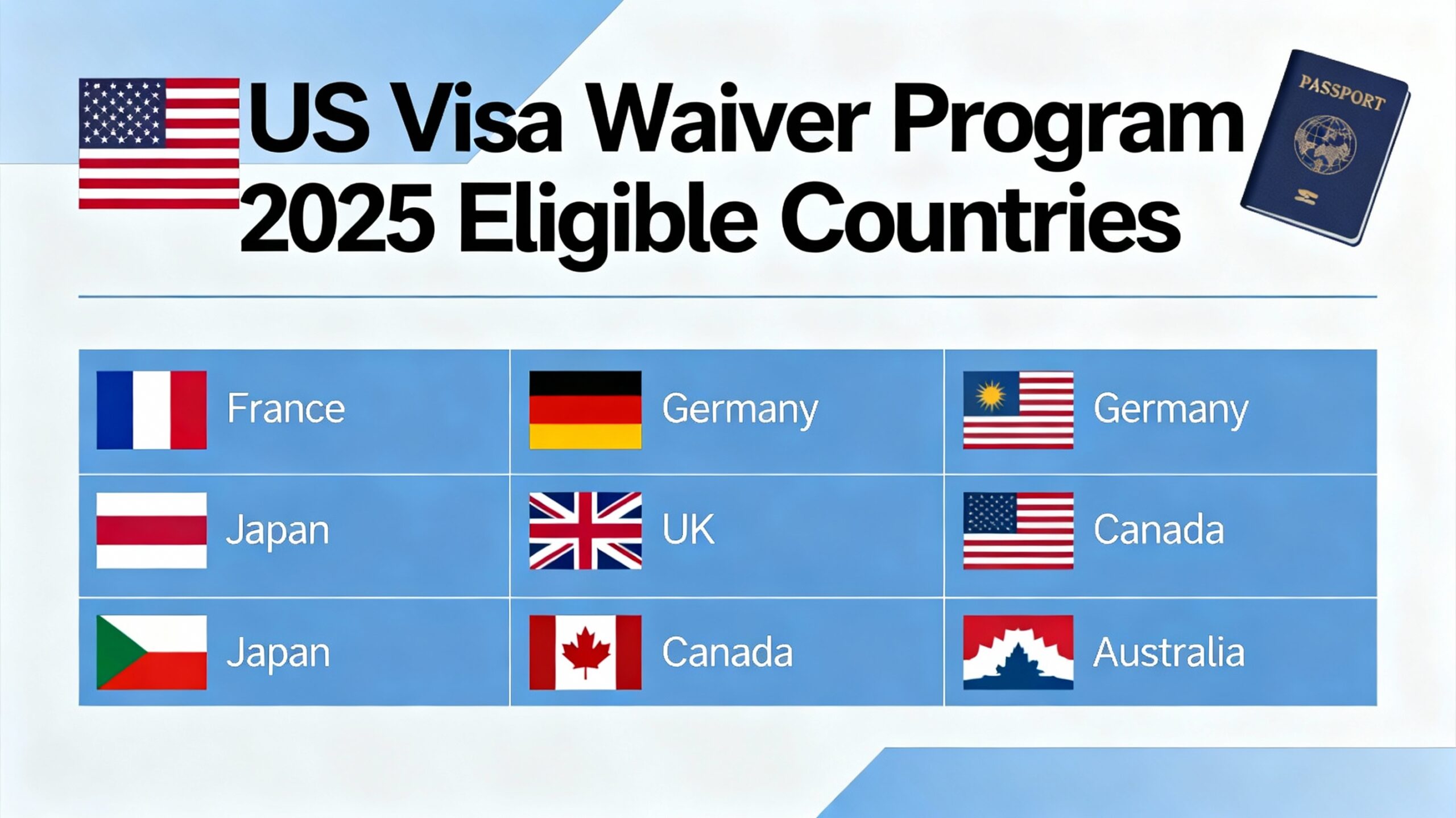
US Visa Waiver Program 2025: New List of Eligible Countries Released

The US Visa Waiver Program (VWP) for 2025 includes 42 eligible countries whose nationals can enter the US for tourism or business for up to 90 days without a visa. The list features major European Union members (excluding Bulgaria and Cyprus), the United Kingdom, Japan, South Korea, Australia, New Zealand, and other nations including Chile, Israel, and Qatar. Romania was added in early 2025, reflecting compliance with program requirements. No new countries from the Americas were added in 2025. Travellers must have authorised electronic travel approval (ESTA) to use the program.

Get our Latest Post/Blogs here.

Eligible Countries Overview

  • Europe: Andorra, Austria, Belgium, Czech Republic, Denmark, Estonia, Finland, France, Germany, Greece, Hungary, Iceland, Ireland, Italy, Latvia, Liechtenstein, Lithuania, Luxembourg, Malta, Monaco, Netherlands, Norway, Poland, Portugal, San Marino, Slovakia, Slovenia, Spain, Sweden, Switzerland, United Kingdom, and recently Romania.

  • Asia-Pacific: Australia, Brunei, Japan, New Zealand, Singapore, South Korea, Taiwan.

  • Americas & Middle East: Chile, Israel, Qatar.

Important Conditions for VWP Entry

  • Travellers must have a passport from a designated VWP country.

  • Approval through the Electronic System for Travel Authorisation (ESTA) is required before travel.

  • Visits are limited to tourism, business, or transit purposes.

  • Applicants must not have certain travel or dual nationality restrictions related to specific prohibited countries.

This updated list ensures smooth travel for eligible nationals while maintaining security and reciprocal agreements with participating countries.

Which countries were added to the VWP in 2025

In 2025, Romania was the only country added to the US Visa Waiver Program (VWP). No other countries were newly included in the program that year. Romania’s addition reflects its fulfilment of the program’s strict security and policy requirements to qualify for visa-free travel to the US under the VWP.

Exclusions and recent policy changes 2025:

The US Visa Waiver Program (VWP) in 2025 has key exclusions and recent policy changes to note:

  • Exclusions: Individuals who have traveled to or hold dual nationality in certain countries—specifically Iran, Iraq, Libya, North Korea, Somalia, Sudan, Syria, Yemen (travel after March 1, 2011), and Cuba (travel after January 12, 2021)—are not eligible for the VWP. Some exemptions apply for diplomatic, military, humanitarian, or legitimate business reasons. Additionally, Indian nationals remain excluded due to factors like reciprocity and immigration policies. Citizens from 19 countries face travel restrictions and visa bans which also affect eligibility.​

  • Policy Changes 2025: Starting September 2, 2025, the US Department of State rolled back the visa interview waiver policy, requiring almost all nonimmigrant visa applicants—regardless of age—to attend in-person interviews. This includes categories that were previously exempted such as children under 14 and adults over 79. Only a narrow group of applicants will retain interview waivers, potentially causing longer visa processing times and travel delays. This change affects the broader visa process but intersects with VWP travel rules indirectly in terms of increased scrutiny and interview requirements for eligible travellers.​

  • Security and Compliance: Countries maintain their VWP status by meeting strict US requirements on passport security, visa refusal rates, data-sharing, and terrorism prevention. Travellers must have an approved ESTA and an e-passport embedded with biometric data. The maximum stay under the VWP remains 90 days for business, tourism, or transit purposes. Overstays and previous violations can disqualify travellers.​

These exclusions and updates reflect ongoing US security priorities while facilitating visa-free travel for compliant countries under updated protocols.

How do 2025 interview waiver changes affect visa processing times?

The 2025 changes to the US visa interview waiver policy, which require nearly all nonimmigrant visa applicants to attend in-person interviews regardless of age, are expected to increase visa processing times. With more applicants needing interviews, consular offices face higher workloads, leading to longer appointment wait times and potential delays in visa issuance. This intensified scrutiny and additional procedural step add complexity and may slow down the overall visa approval process compared to previous years when certain age groups were exempt from interviews. Consequently, travellers should anticipate longer lead times when applying for US visas in 2025 and plan accordingly.
Get our Latest Post/Blogshere.

India’s Economy Grows 8.2% Despite Steep U.S. Tariffs

India’s economy expanded at 8.2 percent in the July-September quarter, the fastest pace in six quarters, as manufacturing and services sectors powered growth despite facing steep U.S. tariffs. The National Statistics Office data released Friday exceeded most economist forecasts of around 7.3 percent, marking the second consecutive quarter of stronger-than-expected performance.​

The growth, up from 7.8 percent in the previous quarter and 5.6 percent a year earlier, helped India maintain its position as the world’s fastest-growing major economy. Prime Minister Narendra Modi called the numbers “very encouraging,” crediting pro-growth policies and reforms, while Chief Economic Adviser V. Anantha Nageswaran said full-year growth would reach at least 7 percent, surpassing earlier projections of 6.3 to 6.8 percent.​

Manufacturing and Consumption Drive Expansion

Manufacturing output surged 9.1 percent, a sharp rebound from 2.2 percent growth in the same quarter last year, while the services sector grew 9.2 percent, led by a 10.2 percent expansion in financial, real estate and professional services. Private consumption, which accounts for roughly 57 percent of GDP, rose 7.9 percent, boosted by GST rate cuts that took effect September 22.​

The government consolidated GST rates from four slabs to two—5 percent and 18 percent—making everyday items cheaper and spurring discretionary spending. Factories ramped up production ahead of the festive season to meet anticipated demand from the tax reductions.​

Growth Withstands U.S. Tariff Impact

The strong performance came despite the United States imposing 50 percent tariffs on most Indian exports beginning August 27, among the steepest measures under the Trump administration. The tariffs, linked to India’s energy trade with Russia, affected nearly $12.5 billion worth of exports.​

Nageswaran said the economy would cross the $4 trillion mark this fiscal year, up from $3.9 trillion in March 2025. The State Bank of India raised its full-year forecast to 7.6 percent, while analysts from ICRA projected 7.4 percent growth.​

Attention now turns to the Reserve Bank of India’s monetary policy meeting December 3-5, with economists widely expecting a 25 basis point rate cut as inflation fell to a record low 0.25 percent in October.


Contact our experts for more details.


OUR YOUTUBE CHANNEL

FOLLOW OUR INSTAGRAM PAGE

LIKE OUR FACEBOOK PAGE

JOIN OUR TELEGRAM GROUP

OUR WHATSAPP GROUP

Project Firewall Launched by USCIS for H-1B Fraud – US Visa

Overview

Project Firewall is a U.S. Department of Labor (DOL) enforcement initiative launched on September 19, 2025, to combat H-1B visa abuses by ensuring employers prioritise qualified American workers and comply with program rules. It targets fraud such as wage underpayment, displacement of U.S. workers, fraudulent labor condition applications, and misrepresentation of job duties or worksites. While coordinated with USCIS and other agencies like the DOJ and EEOC, the project originates from DOL, not USCIS directly.​

Key Features

    • Secretary-Certified Investigations: DOL Secretary personally approves probes based on reasonable cause, a new mechanism to accelerate enforcement.​

    • Interagency Collaboration: DOL shares data with USCIS, DOJ, EEOC, and others to address discrimination and fraud holistically.​

    • Triggers: Initiated via complaints, audits, or suspicions of violations like underpaying H-1B workers or laying off Americans to hire visa holders.​

Penalties and Impact

Violators face back wage recovery, civil fines, and temporary bans from H-1B sponsorship. By November 2025, it led to at least 175 investigations amid H-1B debates. Employers should maintain accurate LCAs, pay prevailing wages, document job details, and avoid U.S. worker displacement to comply. This aligns with the Trump administration’s “America First” policies, including a $100,000 fee on new H-1B petitions.

How will Project Firewall affect current H-1B employees in the US

Direct Impact on Current H-1B Employees

Project Firewall primarily targets employers for H-1B abuses like underpayment, benching without pay, and wage discrepancies, which could lead to back wages owed directly to affected H-1B workers if violations are found. Current employees in compliant roles face no direct visa revocation or deportation risks, as the initiative enforces labor rules rather than altering visa status. However, if employer audits uncover issues, workers might experience payment delays during investigations or benefit from recovered owed wages.​

Indirect Effects on Job Stability

Stricter employer compliance may heighten scrutiny on renewals, job changes, or extensions, creating uncertainty for existing H-1B holders amid fears of penalties. Companies could limit H-1B sponsorships or delay transfers due to debarment risks (1-3 years for violations), potentially reducing internal mobility or new opportunities for current workers. Indian professionals, the largest H-1B group, may see employers prioritize U.S. hires, indirectly pressuring H-1B staff to prove unique value or face slower career progression.​

Employer Compliance Requirements

Firms must now rigorously document prevailing wages, public access files, worksite notices, and good-faith U.S. worker recruitment to avoid fines ($2,500-$25,000 per violation) or bans. Non-compliant employers risk multi-agency probes (DOL, USCIS, DOJ, EEOC), which could disrupt payroll or operations, indirectly affecting H-1B employees through layoffs or hiring freezes if U.S. workers are prioritized. Workers should verify their LCA compliance and maintain records to support potential DOL claims for back pay.

Steps H-1B employees should take if their employer is investigated

Immediate Actions

Notify your employer immediately upon learning of the investigation to understand its scope and cooperate if requested, as retaliation for participation is illegal under H-1B protections. Gather and secure personal records including pay stubs, Labor Condition Applications (LCAs), employment contracts, timesheets, and communications about wages or worksites to verify compliance or identify potential violations like underpayment or benching. Avoid signing any statements without review, and do not discuss details with coworkers to prevent misinformation.​

Contact the DOL Wage and Hour Division (WHD) confidentially via Form WH-4 if you suspect unpaid wages, benching without pay, or other abuses—investigations often result in back pay awards to workers without risking your visa status. Consult an immigration attorney experienced in H-1B matters to assess your rights, as DOL probes focus on employers and protect workers from retaliation or discrimination for cooperating. H-1B status remains valid during compliant employment, even under investigation, unless fraud directly involving the worker is proven.​

Job Security Steps

Monitor your Public Access File (PAF) and ensure your employer provides required notices; request copies if needed for your records. Prepare for potential disruptions by updating your resume, networking for transfers (via H-1B portability), and confirming timely wage payments to avoid grace period issues post-termination. If laid off, notify USCIS within 10 days and utilize the 60-day grace period to find new sponsorship without status loss.

How to document workplace hours and duties as an H-1B employee

Tracking Work Hours

Maintain personal timesheets or logs recording daily start/end times, breaks, overtime, and total hours weekly, using digital tools like Excel, Google Sheets, or apps (e.g., Toggl or Clockify) for timestamps and signatures if possible. Cross-reference with employer payroll stubs, which must show actual wages paid matching the LCA’s required rate for all hours worked, including non-productive periods unless bona fide termination occurs. Retain these for at least 3 years, as DOL requires proof during audits to verify full-time status (typically 35-40 hours/week) and prevent benching violations.​

Documenting Job Duties

Keep detailed weekly journals noting specific tasks performed, projects, tools used, meetings attended, and how they align with your H-1B petition’s job description (e.g., “Developed Python algorithms for data analysis, 20 hours”). Collect supporting evidence like emails, code commits, performance reviews, supervisor notes, or work outputs (screenshots, reports) timestamped to confirm duties match the LCA. Note any changes in duties, worksite, or remote setup, photographing posted LCA notices at physical locations for records.​

Organization and Best Practices

Store all documents securely in a personal digital folder (e.g., Google Drive) with dates, categorized by type: hours, duties, pay, LCA copies, and PAF summaries requested from HR. Review monthly against your LCA for discrepancies like underpayment or duty mismatches, and share summaries with an immigration attorney annually. During investigations, provide these proactively to DOL if filing a WH-4 complaint, protecting against retaliation while aiding back wage recovery.

Contact our experts for more details.


OUR YOUTUBE CHANNEL

FOLLOW OUR INSTAGRAM PAGE

LIKE OUR FACEBOOK PAGE

JOIN OUR TELEGRAM GROUP

OUR WHATSAPP GROUP

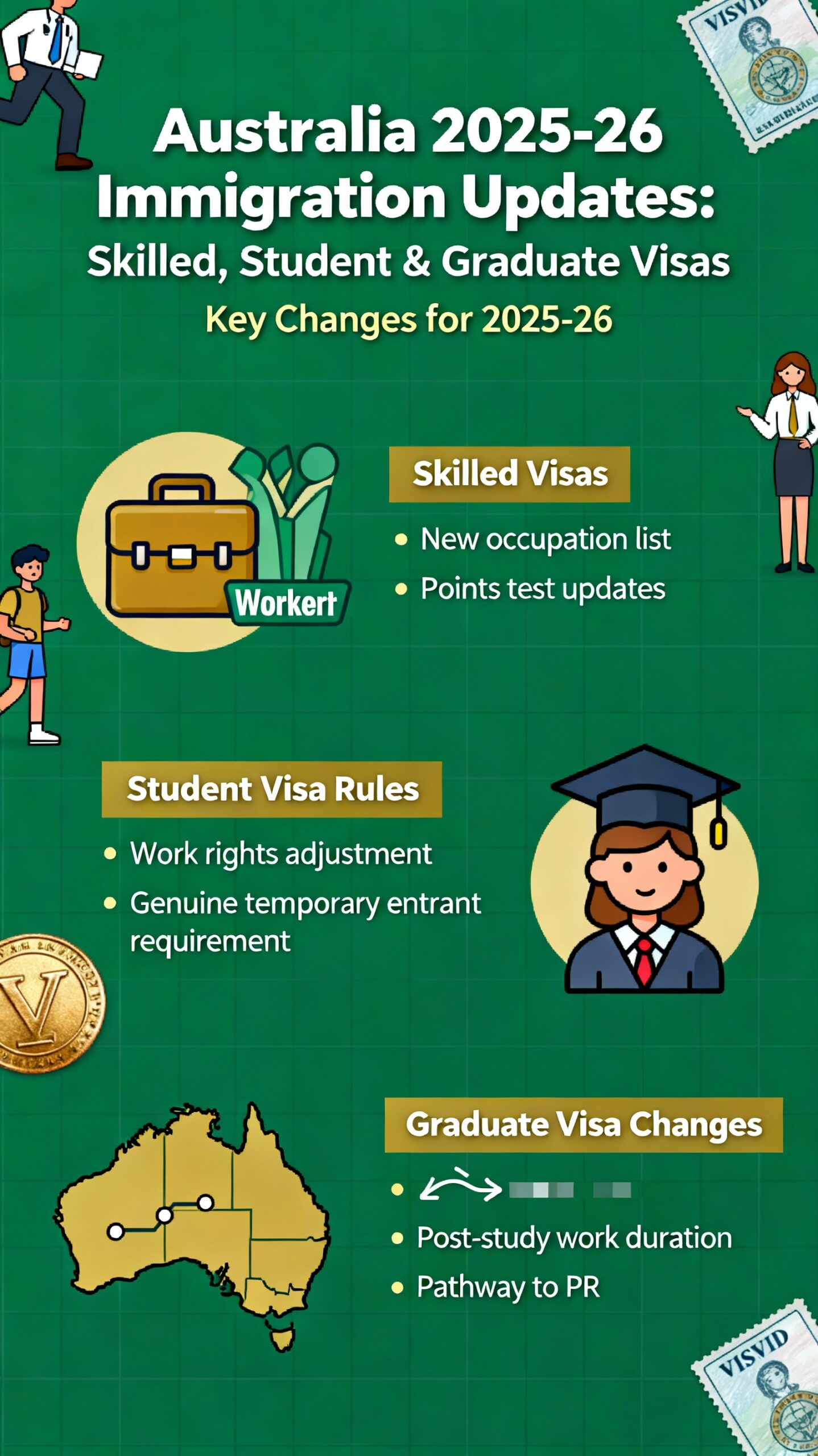
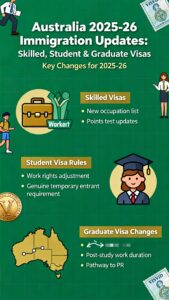
Australia’s 2025-26 Immigration Updates: Skilled Visas, Student Rules, and Graduate Changes

Australia’s latest immigration news focuses on skilled migration allocations for 2025–26, stricter but expanded student pathways, updates to temporary graduate visas, and new processes for some working holiday visas. Policies are being adjusted to keep the permanent intake stable while prioritising skilled workers and tightening some temporary pathways.​

Overall migration program 2025–26

    • The federal government has kept the permanent Migration Program cap at 185,000 places for 2025–26, continuing the same level as 2024–25.​

    • Most places remain in the Skilled stream (over 70% of the total), reflecting a strong focus on addressing labour shortages and attracting qualified workers.​

Skilled visas and state allocations

    • For 2025–26, the government has set total state and territory nomination allocations at 20,350 places across the 190 (Skilled Nominated) and 491 (Skilled Work Regional) visas.​

    • A November 2025 update confirmed an invitation round for the Skilled Independent 189 visa and finalised allocations for states such as NSW and ACT, while states like South Australia and Tasmania have announced their own program openings and available places.​

Key skilled migration settings (snapshot)

Item / Visa type Latest position (2025–26) Source
Total permanent migration intake 185,000 places, unchanged from 2024–25​ ​Official Australian Immigration Website
State/territory nominated places (190 + 491) 20,350 places total for 2025–26​ ​Official Website
Skills in Demand (SID) visa Fully implemented after replacing the Temporary Skill Shortage (TSS) visa, with three skills/salary-based streams and clearer PR pathways​ ​Australia Immigration

Student visas and Indian students

    • Australia has raised its national planning level for new international student intakes to about 295,000 by 2026, while simultaneously tightening controls on quality and intent.​

    • For 2025, key changes for students (including Indian students) include a stricter Genuine Student test, higher English requirements, and higher financial proof thresholds, plus higher student visa application fees from July 2025.​

Temporary Graduate (485) and post-study work

    • Temporary Graduate (subclass 485) visa settings now link stay duration more directly to qualification level (for example, about 2 years for most bachelor’s and coursework master’s, 3 years for research master’s and PhD; around 18 months for many diplomas/trades).​

    • Extended post-study work rights that previously allowed some graduates four to six years of stay have been removed, and from July 2025 application fees and eligibility rules (including English and course requirements) are stricter.​

Working Holiday / other updates

    • A new ballot-style pre‑application system has just been introduced for high-demand Work and Holiday (subclass 462) countries so places can be allocated more fairly when demand exceeds caps.​

    • There are also July 2025 changes across multiple visa subclasses, including higher application charges and updated income thresholds for certain skilled visas, in line with the broader Migration Strategy.​

If you tell your target pathway (student, 485, skilled PR, etc.), a more specific checklist and timeline can be suggested.

Contact our experts for more details.


OUR YOUTUBE CHANNEL

FOLLOW OUR INSTAGRAM PAGE

LIKE OUR FACEBOOK PAGE

JOIN OUR TELEGRAM GROUP

OUR WHATSAPP GROUP