Category Archives: PTE

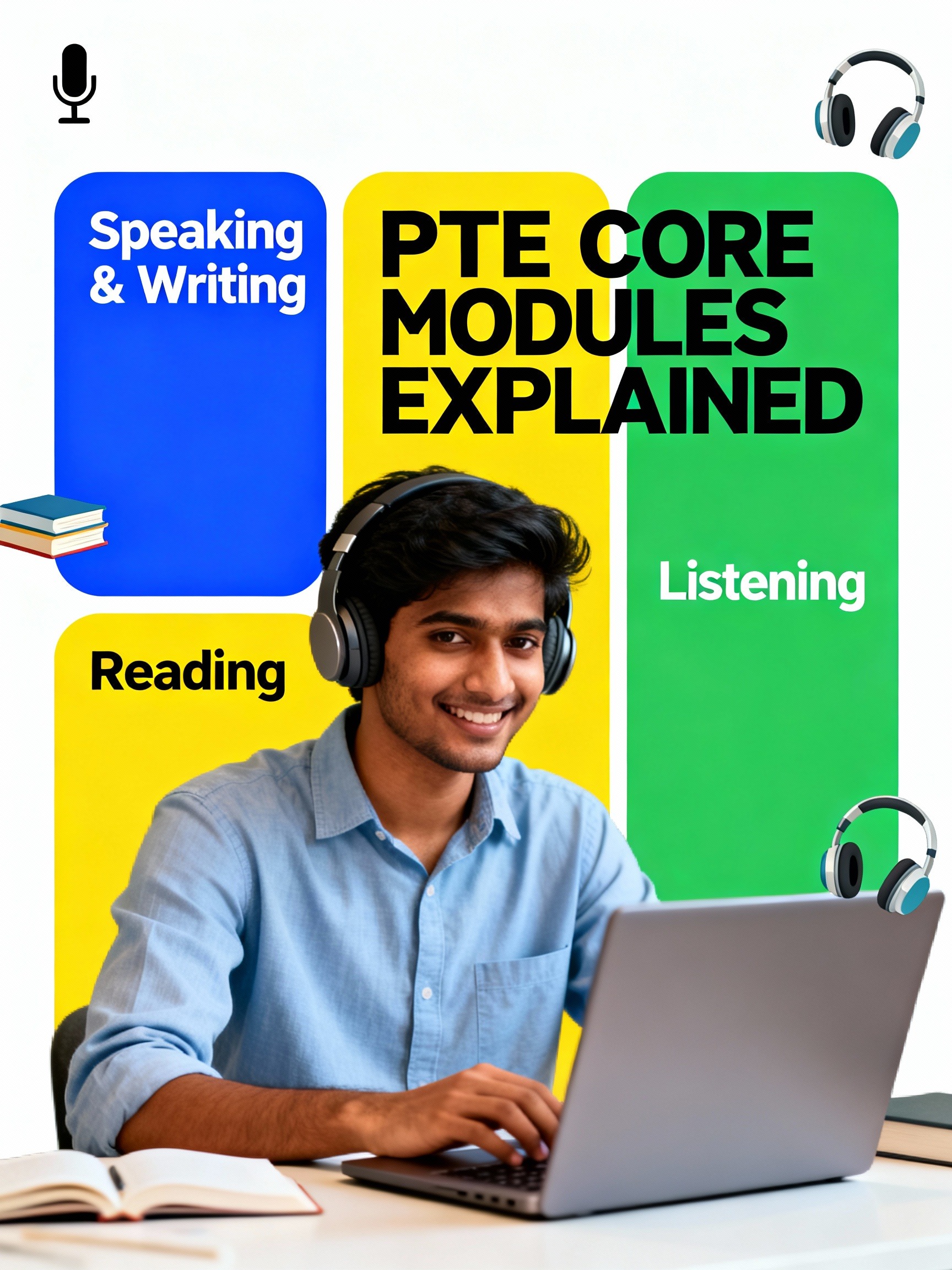
Master PTE Core modules in detail: Speaking & Writing (54-67 mins), Reading (29-32 mins), Listening (30-34 mins). Tasks, tips & scoring for 90 score—UK MBA prep guide!

Pearson PTE Core Modules in Detail – Tips & Tricks

Speaking & Writing Module

Pearson PTE Core combined section evaluates fluency, pronunciation, and written coherence through tasks like Personal Introduction (unscored), Read Aloud (6-7 items, read passages naturally), Repeat Sentence (10-12, exact repetition), Describe Image (3-4, analyze visuals in 40 seconds), Respond to a Situation (real-life scenarios like emails), Answer Short Question (5-6 quick facts), Summarize Written Text (1-2, 50-70 words in 10 minutes), and Write Essay (1-2, 20 minutes on topics). Focus on clear enunciation and logical structure for high scores.​

Reading Module

Tasks test comprehension and vocabulary: Reading & Writing Fill in the Blanks (5-6, select words), Multiple Choice Single/Multiple Answer (2-3, passage-based), Re-order Paragraphs (2-3, logical sequencing), and Fill in the Blanks (4-5, drag words). Skim for main ideas and use context clues, as it impacts both reading and writing scores.​

Listening Module

Assess audio understanding with Summarize Spoken Text (1-2, 50-70 words), Multiple Choice (2-3), Fill in the Blanks/Highlight Incorrect Words (2-3 each), Highlight Correct Summary (1-2), and Write from Dictation (3-4). Note keywords during 60-90 second clips; practice varied accents to boost from your prior 56 score.
PTE Core Preparation Plan

To boost your PTE Core score from 64 overall (target 70+ for UK MBA), follow this 8-week plan emphasizing Listening (56) while leveraging Writing strength (73).

Weeks 1-2: Build Foundations

  • Daily 90 mins: 20 mins Speaking (Read Aloud/Repeat Sentence via PTE app—record for fluency), 30 mins Listening (dictations, note keywords), 20 mins Reading (fill blanks), 20 mins Writing (summaries).

  • Resources: Official PTE Core practice tests (2x/week); E2Language free mocks.​

  • Track: Log errors; aim 70% accuracy.

Weeks 3-5: Targeted Drills

  • Listening Focus (45 mins/day): Summarize Spoken Text (transcribe 10 clips daily), MCQs—practice accents on YouTube PTE channels to fix your weak 56.

  • Integrated Practice: 1 full timed mock (2 hrs) 3x/week; review weak tasks like Describe Image (structure: intro-data-trend).​

  • Vocabulary: 50 words/day via Anki (academic/practical themes).

Weeks 6-8: Simulate & Refine

  • Full Mocks: 4x/week under exam conditions (no breaks); analyze score reports for partial credit gains.​

  • Weak Area Blitz: Extra 30 mins Listening/Reading; Speaking—mirror practice for Respond to Situation.

  • Review Day: Sundays—error log trends, redo mistakes.

Consistent 2-hour daily practice with mocks yields 5-10 point gains; retake in 4-6 weeks for May 2026 intake.

PTE Core Scoring System

PTE Core uses an AI-driven scoring system on a 10-90 scale for each skill (Listening, Reading, Speaking, Writing) and overall, combining four communicative skills with enabling skills like grammar, vocabulary, pronunciation, fluency, and spelling.​

Scoring Methods

Tasks receive scores via correct/incorrect (1 point for right answers, 0 for wrong, no negatives—e.g., Answer Short Question, MCQ Single) or partial credit (graded on traits like content relevance, form, organization—e.g., Read Aloud, Write Email, Describe Image). Partial credit tasks (most Speaking/Writing) evaluate multiple criteria; low content/form scores yield 0 points.​

Score Calculation

Overall score aggregates 49-54 tasks across 19 types using weighted algorithms—not a simple average—mapping to CLB levels for Canada PR (e.g., 60-70 PTE ≈ CLB 7). Scores available in 48 hours; practice high-impact tasks like Repeat Sentence and Summarize Spoken Text for max gains from your prior 64.​

PTE Core Score CLB Level Target for UK MBA
69-78 7 Minimum often 65+ ​
79-87 8 Competitive

PTE Core Speaking Tasks Overview

PTE Core Speaking (part of 54-67 min section) includes Read Aloud, Repeat Sentence, Describe Image, Respond to Situation, and Answer Short Question—scored on fluency, pronunciation, content via partial credit.​

Task-Specific Tips

  • Read Aloud (6-7 items): Pause naturally at punctuation; stress key words for rhythm—practice 60-word texts at 150 wpm to hit fluency/pronunciation max.​

  • Repeat Sentence (10-12): Listen once, repeat verbatim (even partials score points); chunk into 3-4 phrases mentally—record daily for 90% recall.​

  • Describe Image (3-4, 40 secs): Structure: “This [type] shows [trend/overview], peaking at [high], due to [reason]”—highlight extremes/trends, end strong; ignore minor details.​

  • Respond to Situation (new in Core, email-like): Polite structure: Greeting + purpose + details + closing (e.g., “Dear [ ], I suggest… Best, [ ]”)—50-70 words, formal tone.​

  • Answer Short Question (5-6, 10 secs): One-word/key-phrase answers (e.g., “What’s opposite of same? Different.”); speak clearly—no full sentences needed.​

Practice 30 mins daily with official mocks; focus on your prior Speaking 64 by self-recording for AI-like feedback—aim fluency over perfection.


Get our Latest Post/Blogs here.


OUR YOUTUBE CHANNEL

FOLLOW OUR INSTAGRAM PAGE

LIKE OUR FACEBOOK PAGE

JOIN OUR TELEGRAM GROUP

OUR WHATSAPP GROUP

Book your Pearson PTE Exam at Lowest Price Today !!! Hurry

Book your Pearson PTE exam at the lowest price and save significantly with authorised vouchers and booking services. This post guides you on how to book your PTE Academic exam affordably, highlights current discounts, and provides step-by-step instructions for a smooth booking experience.

Get our Latest Post/Blogs here.

Why Choose Pearson PTE Academic?

The Pearson PTE Academic is a trusted English proficiency test accepted worldwide for study, work, and immigration purposes. With over 500 test centers globally and flexible test dates, it’s easy to find a slot that suits your schedule. The official testing fee in India is INR 18,000, including 18% GST, but there are legit ways to secure discounts and pay less without compromising on reliability.

How to Book Your PTE Exam at the Lowest Price

  • Purchase an authorized PTE exam voucher from trusted partners like Vision Overseas (Contact). Voucher prices can be as low as INR 12,999, saving up to INR 5000 or more off the standard fee.

  • Utilize promo codes or coupon discounts on voucher purchases.

  • Opt for assisted booking services offered by authorized resellers where a trained representative books your slot using a partner portal, leading to instant discounts up to ₹3000.

  • Book your exam 48 hours or more in advance online, or check last-minute availability for additional savings.

  • Ensure to buy vouchers or booking services only from authorized sources to avoid scams.

Step-by-Step Guide to Booking

  1. Visit an authorized voucher seller website (e.g., Pearson PTE).

  2. Select the number of exam vouchers and proceed with payment.

  3. Receive your unique voucher code via email or SMS.

  4. Go to the official Pearson PTE website, create or log in to your account.

  5. Choose your test center, date, and time.

  6. Apply the voucher code at the payment page to get the discount and confirm your booking.

  7. Prepare for the test with official practice material and mock tests, sometimes included with voucher purchases.

Additional Tips

  • Book early to get your preferred test date and location and to take advantage of early-bird discounts.

  • Follow official Pearson channels for updates on offers, last-minute deals, or changes in exam patterns.

  • Combine voucher purchases with preparation material discounts when available.

By following these strategies, booking your Pearson PTE exam at the lowest price while ensuring a smooth, reliable experience is achievable.


OUR YOUTUBE CHANNEL

FOLLOW OUR INSTAGRAM PAGE

LIKE OUR FACEBOOK PAGE

JOIN OUR TELEGRAM GROUP

OUR WHATSAPP GROUP

Templates for Pearson PTE – Pearson Test of English

Here are some pre-prepared Templates for all the major modules from Speaking, Writing, Listening and Reading.

Get our Latest Post/Blogs here.

These templates are the easiest ways to answer Describe Image (Pie Chart, Line graph, Bar graph and random image), Retell Lecture, Summarise Group Discussion, Respond to a Situation and Summarise Spoken Text.

In case you are not able to answer the above mentioned question type in your Pearson PTE exam, you can follow these pre-prepared templated and get your desired score easily.

Just memorise these templates and you can easily tackle the above mention question type in the exam.

Templates

Here are the Templates for the Describe Image (Pie Chart, Line graph, Bar graph and random image), Retell Lecture, Summarise Group Discussion, Respond to a Situation and Summarise Spoken Text:


Pie chart

The given image is a pie chart and gives us information about ———. There are several categories mentioned in this pie chart such as———-,——-,——,. The data has been calibrated into percentage. The maximum value is in —— i.e ——- and the minimum value is in ——i.e ——-. Overall , this pie chart is very informative.


Line graph

The given image is a line graph and gives us information about——-. We can clearly see that this given image has maximum and minimum ranges. The line graph on x – axis shows the ——- and y- axis shows ——-. The maximum value is in —- and the minimum value is in ——-. Overall this line graph is very informative.


Bar graph

The given image is a bar graph and given us information about——-. The bar graph is a representation of highest and lowest values. The highest value in the bar graph is —— and the second highest value is —— . The value of —— is higher than the value of——-. Overall this bar graph is very informative.


Random image

The given image is very interesting and tells us about the——-. There are several categories mentioned in this image. There are several colors mentioned in this image such as———-. Overall this image is very informative.


Retell lecture

The lecture was about——

Firstly, the speaker talks about—————

Moreover, he clearly discussed that———

Furthermore, he mentioned———-

In addition, he sheds light on ————

And then, he informed us about——-

The audio also asserted that———-

Overall the lecture was very informative.


Summarise Group Discussion

(Number of speakers)were involved in the group discussion and the group discussion was about——-

So, the first speaker talked about ——- ——-

Then he/ she said that ——- ——-

Speaker 2 stated that ——- ——-

Then he/ she further stated that ——— ———

Speaker 3 mentioned about ——— ———

Then, he/ she also talked about ——- ———


Respond to a Situation

Hi, ——-

This is to state my only concern is that ———-

You -My / I You’re – I am Your- My In this situation, i want to ask if ———-

I would be thankful if——

Thank you so much for your assistance ——-

Looking forward for your help in the above matter.


Summarise Spoken Text

The speaker was discussing——

Firstly, the lecture provides information about——-, which indicates——-.

Secondly, he/ she mentioned information about——-.

Moreover, he asserted————.

Finally, he deduced——-.

Overall, the lecture was very informative.


Our Social Media links:

OUR YOUTUBE CHANNEL

FOLLOW OUR INSTAGRAM PAGE

LIKE OUR FACEBOOK PAGE

JOIN OUR TELEGRAM GROUP

OUR WHATSAPP GROUP

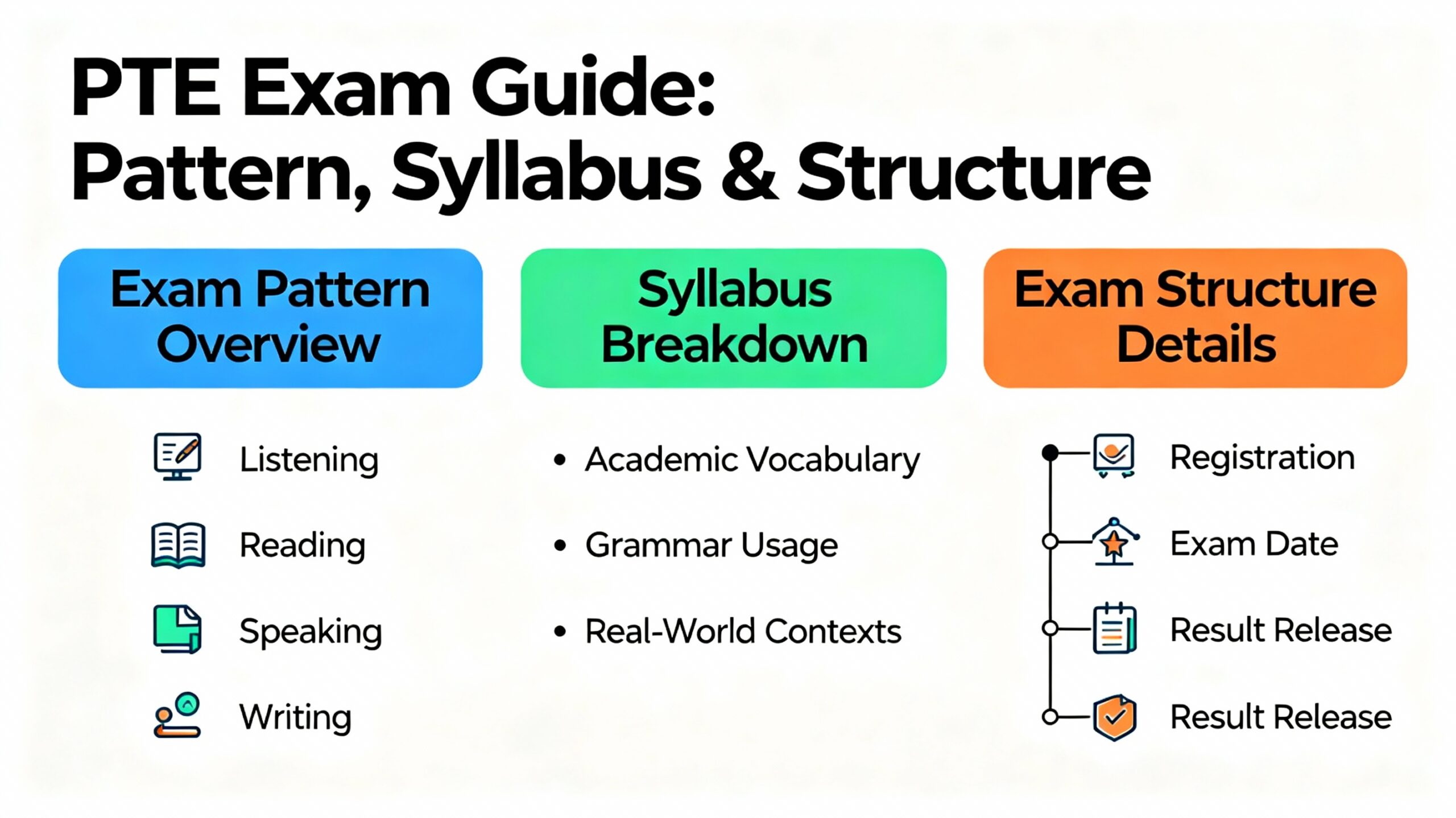
PTE exam pattern / PTE exam syllabus / PTE exam structure

The PTE exam pattern for 2025 consists of three main sections completed in approximately 2 hours: Speaking & Writing (54–67 minutes), Reading (29–30 minutes), and Listening (30–43 minutes).

Get our Latest Post/Blogs here.

Speaking & Writing Section

  • Duration: 54–67 minutes with 28–36 questions.

  • Tasks include personal introduction, read aloud, repeat sentence, describe image, retell lecture, answer short questions, summarize written text, and writing an essay (200–300 words).

Reading Section

  • Duration: 29–30 minutes with 13–18 questions.

  • Tasks include fill in the blanks (dropdown and drag-and-drop), multiple-choice questions (single and multiple answers), reordering paragraphs, and answering fill-in-the-blank questions.

Listening Section

  • Duration: 30–43 minutes with 12–20 questions.

  • Tasks include summarizing spoken text, multiple-choice questions, fill in the blanks, highlighting correct summaries or words, and writing from dictation.

The exam is fully computer-based and scored by AI without breaks between sections. The number of questions and some task types have been adjusted in the latest update to focus assessment on key English skills.

PTE Speaking Modules Explanation

The PTE Speaking module consists of five main types of questions designed to evaluate different aspects of your spoken English skills, including pronunciation, fluency, content clarity, and oral communication. These question types are Read Aloud, Repeat Sentence, Describe Image, Retell Lecture, and Answer Short Question.

Explanation of Each PTE Speaking Module

  • Read Aloud: You read a short written passage aloud, usually up to 60 words. This task assesses your reading fluency and pronunciation with around 6-7 items. Clear and natural speech is important, and you get brief preparation time before recording your answer.​

  • Repeat Sentence: You listen to a sentence played through audio and then repeat it exactly. This task tests your listening and speaking skills, requiring accurate memory and pronunciation. There are about 10-12 sentences to repeat.​

  • Describe Image: You are shown an image, chart, or graph and need to describe it orally in one or two sentences. This exercise evaluates your ability to convey visual information clearly and coherently.​

  • Retell Lecture: After listening to a short lecture or academic talk, you must orally summarize the key points within 40 seconds. This integrated task assesses both listening comprehension and spoken summary skills, requiring you to structure information logically.​

  • Answer Short Question: You hear a question and respond with a brief answer, usually one or two words or a short sentence. This evaluates quick comprehension and concise spoken replies.

    Scoring Criteria

    The speaking section is scored on pronunciation, fluency, content, oral communication, grammar, and vocabulary. Clear pronunciation and natural fluency without unnatural pauses boost your score, as does organizing your ideas well and directly answering the prompt. Each module contributes partial credit based on these factors.​

    Additional Key Points

    • The entire Speaking & Writing section lasts about 54-67 minutes, with the Speaking module taking roughly 24-37 minutes.

    • The speaking tasks are computer-based, not face-to-face, with responses recorded via microphone.​

    • Preparing for the question types with timed practice is essential for effective performance.

    This detailed breakdown covers the key aspects and question types in the PTE Academic Speaking module, helping candidates understand what to expect and how each part is evaluated.

    PTE Writing Module Explanation

    The PTE Writing Module consists primarily of two key tasks: Summarize Written Text and Write Essay. The module tests your ability to comprehend written content, summarize key points succinctly, and produce coherent, well-structured essays within a given time limit.

    PTE Writing Task Types

    • Summarize Written Text: Candidates receive a text of up to 300 words and must summarize it in one sentence of no more than 75 words within 10 minutes. The task tests reading comprehension and the ability to concisely convey main ideas.

    • Write Essay: Candidates write an essay of 200-300 words on a given topic, usually argumentative in nature. The essay is expected to have a clear thesis, supporting arguments, and a logical structure. The time allocated is about 20 minutes.

    Scoring Criteria

    • Content: How well the response addresses the prompt (up to 3 points).

    • Formal Requirements: Adherence to word count and task instructions (up to 2 points).

    • Grammar and Spelling: Accurate use of language and correct spelling (each up to 2 points).

    • Vocabulary: Use of appropriate, varied vocabulary (up to 2 points).

    • Coherence and Structure: Logical organization and flow of ideas (up to 2 points).

    • General Linguistic Range: Variety and complexity of sentence structures (up to 2 points).

    Additional Aspects

    • The Writing module is integrated with the Speaking section and appears in Part 1 of the exam.

    • Other related question types impacting writing skills include Reading and Writing: Fill in the Blanks.

    • Practice involves focusing on grammar, formatting sentences, staying on topic, and effective time management.

    This detailed explanation highlights the main components you need to prepare for in the PTE Writing module to maximize your score.

    PTE Reading Module Explanation

The PTE Reading module tests a range of reading comprehension skills through five main question types within about 29 to 41 minutes. The tasks assess abilities such as vocabulary knowledge, grammar, text coherence, and analytical skills. The five question types are:

    • Multiple-choice, single answer: Identify the correct answer after reading a passage.

    • Multiple-choice, multiple answers: Select more than one correct option based on the passage content.

    • Reorder paragraphs: Arrange jumbled text boxes into a logical sequence.

    • Fill in the blanks (Reading): Drag and drop words from a box to fill gaps in a passage.

    • Fill in the blanks (Reading & Writing): Choose words from dropdown menus to complete a passage.

These tasks range in text length from about 80 to 300 words and require strategic reading such as scanning for keywords, understanding context, and managing time across questions. The reading section score affects both reading and overall PTE scores due to the integrated scoring system. It is important to carefully read, analyze context clues, and apply elimination strategies in multiple-choice questions to boost accuracy and efficiency in this module.

PTE Listening Module Explanation in Detail

The PTE Listening module is the final part of the PTE Academic exam that assesses your ability to understand spoken English in various contexts like lectures and everyday conversations. It features 8 types of tasks completed in about 45 to 57 minutes, testing both listening and writing skills through audio or video clips played once. You respond by selecting, typing, or dragging answers based on the recordings, which range from 15 seconds to 2 minutes long.

The 8 task types in detail are:

    • Summarize Spoken Text: Listen to a 60-90 second recording and write a brief summary.

    • Multiple-choice, Multiple Answers: After listening (40-90 seconds), select more than one correct answer; negative marking applies for wrong selections.

    • Fill in the Blanks: Listen to a recording while filling in missing words in a transcript.

    • Highlight Correct Summary: Choose the option that best summarizes a 30-90 second recording.

    • Multiple-choice, Single Answer: Pick the single best answer after a 30-60 second recording.

    • Select Missing Word: Identify the missing last word(s) replaced by a beep in a short clip.

    • Highlight Incorrect Words: Find words in a transcript that differ from the recording.

    • Write from Dictation: Type the sentence you hear in a short (up to 5 sec) recording exactly.

The listening module requires focused attention since you hear each audio only once and must answer within the allotted time. Scoring depends on accuracy and sometimes involves negative marking for wrong selections. Preparation involves improving comprehension of different accents, note-taking skills, and practice with each question type to build confidence and speed.


OUR YOUTUBE CHANNEL

FOLLOW OUR INSTAGRAM PAGE

LIKE OUR FACEBOOK PAGE

JOIN OUR TELEGRAM GROUP

OUR WHATSAPP GROUP