

Here’s how to write IELTS Task 1 Process chart
In this post you will learn how to write IELTS Task 1 Process chart with detailed explanation with examples and sample answers :
How to write IELTS Task 1 Process chart
Although this type of diagram is less common to see in the test, it is still very important to have an understanding of how to write task 1 process chart.
This should follow the same format as any task 1:
- Introduce the diagram
- Give an overview of the main point/s
- Give the detail
5 Step Plan
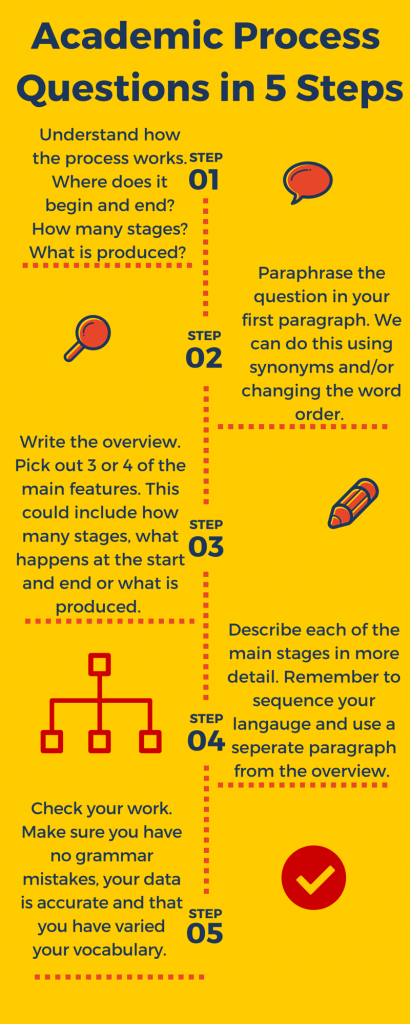
To understand the task and quickly make a plan to answer process questions you should follow the 7 steps below:
- Understand the process. Find the start and the end of the process. Count how many stages there are and understand what each stage does and the relationship it has with the stage before and after it.
- Paraphrase the question.
- Describe what is happening generally in 2 sentences. This is your overview paragraph and I will show you how to write this in more detail below.
- Divide the process in two and write two separate paragraphs detailing each stage of the process.
- Check your work.
Follow this link about how to write a task 1.
Go through this video to learn the structure of the IElTS writing task 1 process chart :-
A process will have a number of stages that are in time order. So you should start at the beginning, and describe each stage through to the last one.
Processes are not always this clear, and you may have to look more carefully to spot the beginning, and there may also be two things happening at the same time.
So it is important that you look at other sample processes to get a good understanding of how they can vary.
Introduce the Diagram
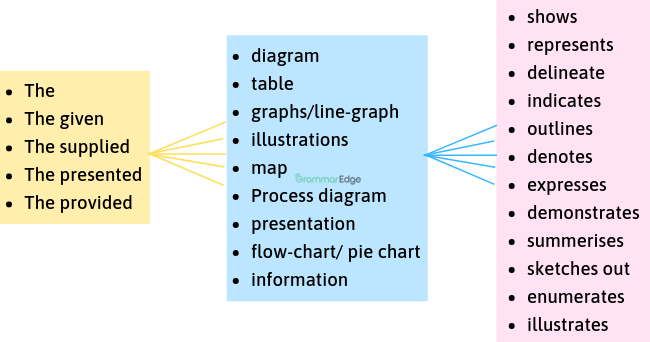
As with any task 1, you can begin by paraphrasing the given statement. You need to write the given statement with the question in your own words. For example :
Question 1: The diagram below shows the process of photosynthesis.
Paraphrased: The illustration demonstrates how plants produce energy from sunlight.
Question 2: The diagram below shows how electricity is produced in a nuclear power station.
Paraphrased: The illustration below shows the process of how nuclear power plants make electricity.

Highlight the Main Points
An IELTS process diagram is different to a line, bar, pie chart or table in that there are not usually key changes or trends to identify. However, you should still give an overview of what is taking place.
The ‘public band descriptors’ state that to achieve a band 6 or more for ‘task response’ the student must provide an overview in a task 1.
As there are no trends to comment on, you can make a comment on, for example, the number of stages in the process and how it begins and ends.
Detail Each Stage of the Process
Now that we have paraphrased the question and provided an overview we need to tell the examiner about each stage in more detail.
You can:
- say what each stage does
- what it produces
- if any materials are added
- and/or discuss the relationship with the previous or subsequent stages.

Give the Detail
Now you need to explain the IELTS process diagram, and there are two key aspects of language associated with this:
1) Time Connectors
A process is a series of events, one taking place after the other. Therefore, to connect your stages, you should use ‘time connectors’.
These connectors are the same you would use to write a graph over time when you explain a series of changes.
These are some common IELTS process diagram connectors:
- To begin
- Following this
- Next
- Then
- After
- After That
- Before**
- Subsequently
- Finally
** If you use before, this means that you will be mentioning a later stage before an earlier stage, so you need to use it carefully. If you can use it properly though, it will get noticed.
2) The Passive
When we describe an IELTS process that involves humans (a man-made process as opposed to a natural one), the focus is on the activities, NOT the person doing them.
When this is the case, we use the passive voice, not the active. For a natural process, such as the life-cycle of a frog, we use active as there is not a person doing the activity in the diagram.
This is a brief explanation of how to use the passive voice, but if you are new or unsure about using it, you should do some further study and practice.
Varying your Language
Sometimes it may be appropriate just to use the same language that you are given in the IELTS process diagram to describe it, but you should try to vary it.
You may be able to use nouns from the diagram as your verbs.
One of the most challenging things about these questions is having to write about something you have never seen or heard of before.
Don’t worry, try to remember two things.
First, the examiner knows that you have probably never seen this process before and you have only 20 minutes to write about it. They do not expect a perfect answer. Just pick out the main features and report them accurately.
Second, you can quickly understand any process by asking yourself these questions:
- Where does the process start and where does it end?
- How many stages are there?
- Is it a man-made process or natural process?
- Is it a cyclical (in a circle) or linear (one start point and one end point) process?
- Are there any materials that need to be added to the process?
- What is produced?
- What does each stage of the process do?
- What are the relationships between each stage?
The processes you will be asked to write about in the IELTS test will not be very complicated and you should be able to easily answer all of the questions above. When you do this you will completely understand what is happening and you will be able to start writing your answer.
Check Your Essay
You should try to leave 3-4 minutes at the end to check and improve your work. Many students do not do this because they feel they do not have enough time, however, it is better to try and get everything done in 15 minutes and then check and refine your work, than do everything in 20 minutes.
Things that you should check are:
- Are there any spelling or punctuation mistakes?
- Are the verbs the correct tense?
- Does the process I describe make sense? Does it match the diagram?
- Is there any vocabulary repetition we could remove with synonyms?
- Do I have 4 clear paragraphs?
- Did I write over 150 words?
- Have I included things only obvious from the diagram?
- Have I included the main features in the overview?