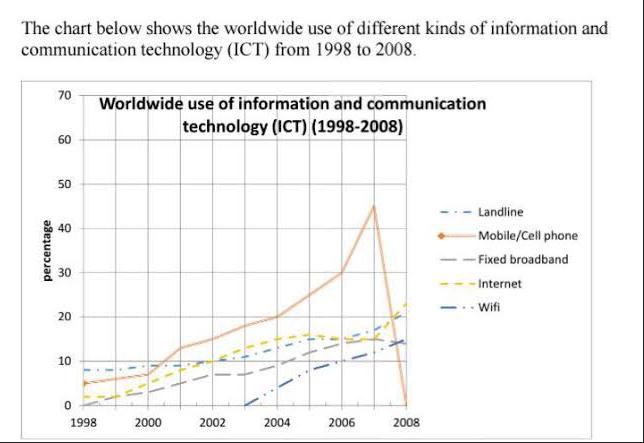
THE LINE GRAPH COMPARES THE USAGE OF FIVE DIFFERENT WAYS OF INFORMATION AND COMMUNICAL TECHNOLOGY AROUND THE WORLD DURING 1998 TO 2008 IN PERCENTUM FORM.
The line graph compares the usage of five different ways of information and communical technology around the world during 1998 to 2008 in percentum form.
SAMPLE ANSWER 1
The line graph compares the usage of five different ways of information and communication technology around the world during 1998 to 2008 in percentum form. Overall, while the data for mobile/cell phones rose with some fluctuations, the recorded percentage was minimum for wifi. To commence with, the percentage for mobile/cell phone was approximately 5 in 1998 however it experienced many years of up and down and reached at the peak with about 45% in 2006 whereas the figure plunged to 0 in next two years. The fixed broadband with a rather lower start at 0% tended to increase considerably to 15% in 2006 but stopped at roughly 13% in 2008 with a small decline. The data experienced a rapid incline for the use of the internet. In 1998, the usage was roughly 2% although this figure increased briskly to about 22% in 2008. By contrast, there was not any data for the use of wifi till 2003 where it inclined sharply from 0% to nearly 15% albeit the figure for the usage of landline accounted for roughly 8% however it reached to exactly 20% in last year after having significant growth in all years.
THE LINE GRAPH COMPARES THE USAGE OF FIVE DIFFERENT WAYS OF INFORMATION AND COMMUNICATION TECHNOLOGY AROUND THE WORLD DURING 1998 TO 2008 IN PERCENTUM FORM.
SAMPLE ANSWER 2
The line diagram looks at the utilization of five distinct methods of data and correspondence innovation all over the planet during 1998 to 2008 in percentum structure. Generally speaking, while the information for versatile/mobile phones rose for certain vacillations, the recorded rate was least for wifi. To initiate with, the rate for portable/cell was roughly 5 of every 1998 anyway it encountered numerous long periods of all over and reached at the top with around 45% in 2006 though the figure plunged to 0 in next two years. The fixed broadband with a somewhat lower start at 0% would in general build extensively to 15% in 2006 yet halted at generally 13% in 2008 with a little decrease. The information encountered a fast slope for the utilization of the web. In 1998, the utilization was generally 2% albeit this figure expanded energetically to around 22% in 2008. On the other hand, there was no information for the utilization of wifi till 2003 where it slanted forcefully from 0% to almost 15% yet the figure for the use of landline represented generally 8% anyway it came to precisely 20% in last year subsequent to having huge development in throughout the years.
SAMPLE ANSWER 3
The line graph checks out the use of five particular techniques for information and correspondence advancement all around the planet during 1998 to 2008 in percentum structure. By and large, talking, while the data for adaptable/cell phones rose for specific instabilities, the recorded rate was least for wifi. To start with, the rate for versatile/cell was about 5 of each 1998, in any case, it experienced various significant stretches of everywhere and reached at the top with around 45% in 2006 however the figure plunged to 0 in next two years. The fixed broadband with a fairly lower start at 0% would overall form widely to 15% in 2006 yet ended at commonly 13% in 2008 with a little reduction. The data experienced a quick slant for the use of the web. In 1998, the usage was for the most part 2% but this figure extended vivaciously to around 22% in 2008. Then again, there was no data for the use of wifi till 2003 where it skewed powerfully from 0% to practically 15% yet the figure for the utilization of landline addressed commonly 8%, in any case, it came to exactly 20% in last year resulting to having immense advancement in overtime.
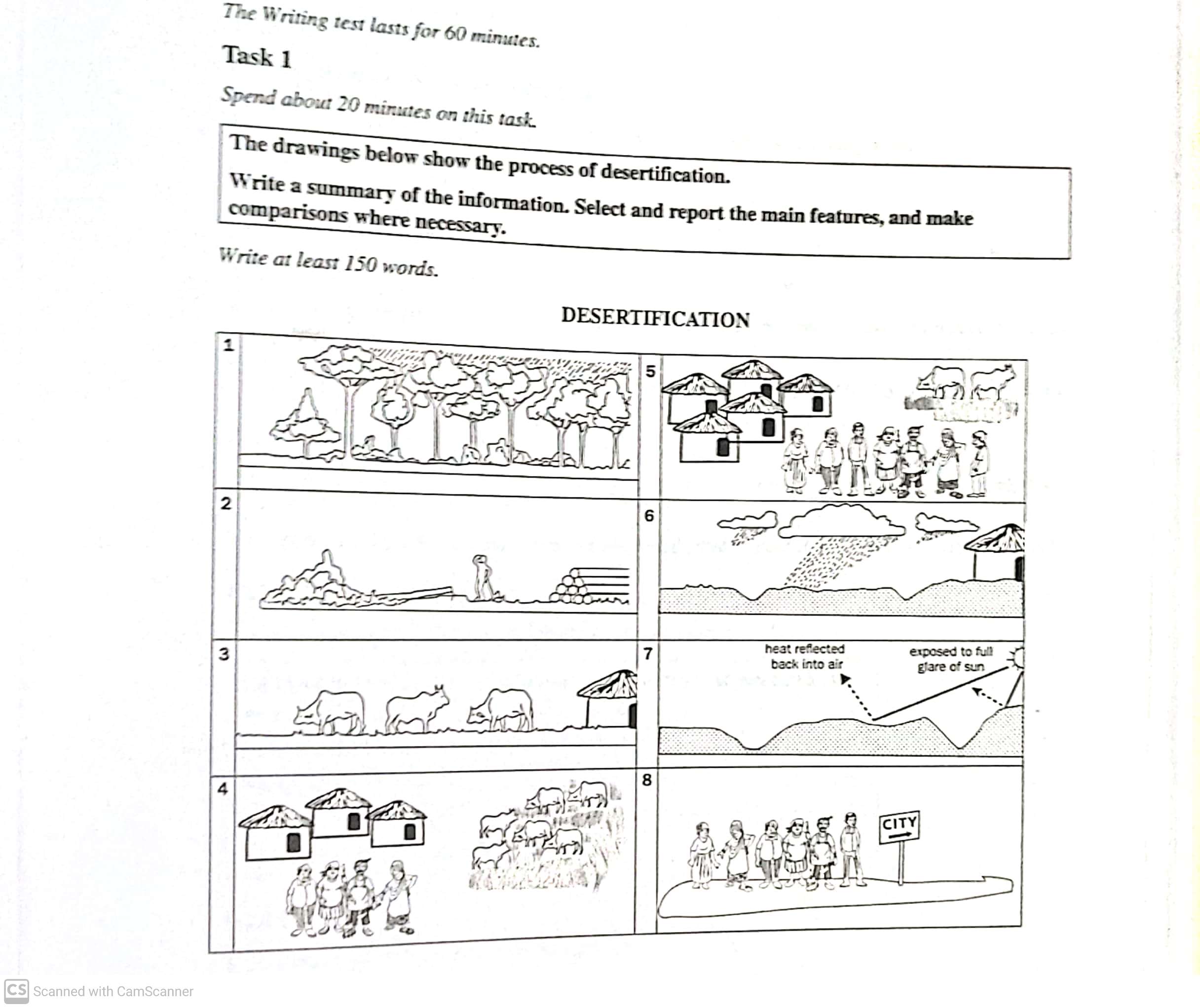
THE DRAWINGS BELOW SHOWS THE PROCESS OF DESERTIFICATION
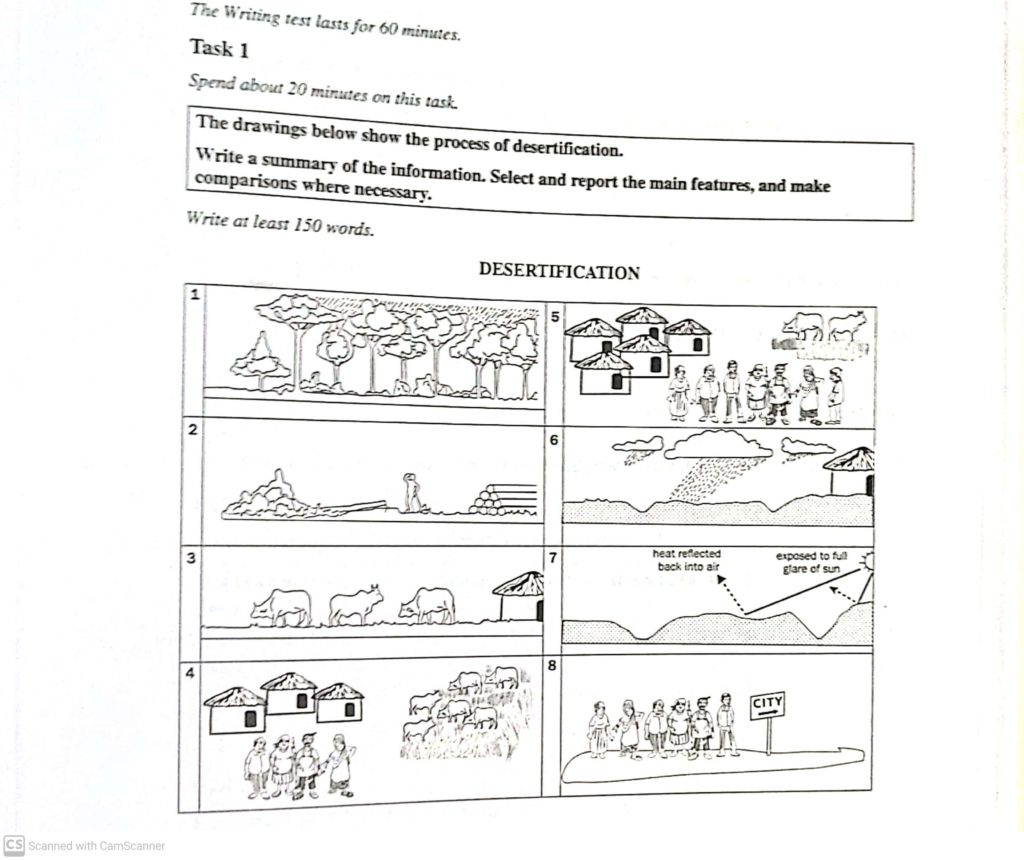
THE DRAWINGS BELOW SHOWS THE PROCESS OF DESERTIFICATION
TASK 1
Spend about 20 minutes on this task.
The drawings below show the process of desertification.
Write a summary of the information. Select and report the main features, and make comparisons where necessary.
Write at least 150 words.
SAMPLE ANSWER
The process diagram illustrates the steps involved in the desertification that takes place during the whole outgrowth. The entire process mainly consists of eight steps starting with trees in the forest and terminating at the migration of the people.
First of all, it is evident from the given diagram that trees in the forest are visible in the maiden picture of the drawing. Then in the second step of the drawing trees are cut down by humans with the help of axe and other tools. After that, the vacant field from the forest is used by the humans for farming, grazing field for domestic animals, and housing of the people. Next to it, half of the total field has been acquired by people for farming and the other half for housing and gatherings.
On the other hand, it can be seen that more fields have been covered for housing and gathering as compared to farming and grazing field for animals. In the further step, a few houses can be seen, also it is raining on the vacant bumpy fields. At the second last step of the process, that whole area is left by people and it is totally exposed to the full glare of the sun because of it heat reflects back to air which results in rising of temperature, and the land is converted in the desert. At last, people migrate to the city as the lush green place is totally converted in the desert.
SAMPLE ANSWER
The interaction outline shows the means associated with the desertification that happens during the entire outgrowth. The whole cycle mostly comprises of eight stages beginning with trees in the woodland and ending at the relocation of individuals.
As a matter of first importance, it is obvious from the given graph that trees in the timberland are noticeable in the lady image of the drawing. At that point in the second step of the drawing trees are chopped somewhere near people with the assistance of hatchet and different instruments. From that point onward, the empty field from the timberland is utilized by the people for cultivating, eating field for homegrown creatures, and lodging of individuals. Close to it, half of the absolute field has been obtained by individuals for cultivating and the other half for lodging and social occasions.
Then again, it very well may be seen that more fields have been covered for lodging and assembling when contrasted with cultivating and munching fields for creatures. In the further advance, a couple of houses can be seen, likewise, it is coming down on the empty uneven fields. At the subsequent last advance of the cycle, that entire territory is left by individuals and it is completely presented to the full glare of the sun in light of it heat reflects back to air which brings about ascending of temperature, and the land is changed over in the desert. Finally, individuals relocate to the city as the lavish green spot is completely changed over in the desert.
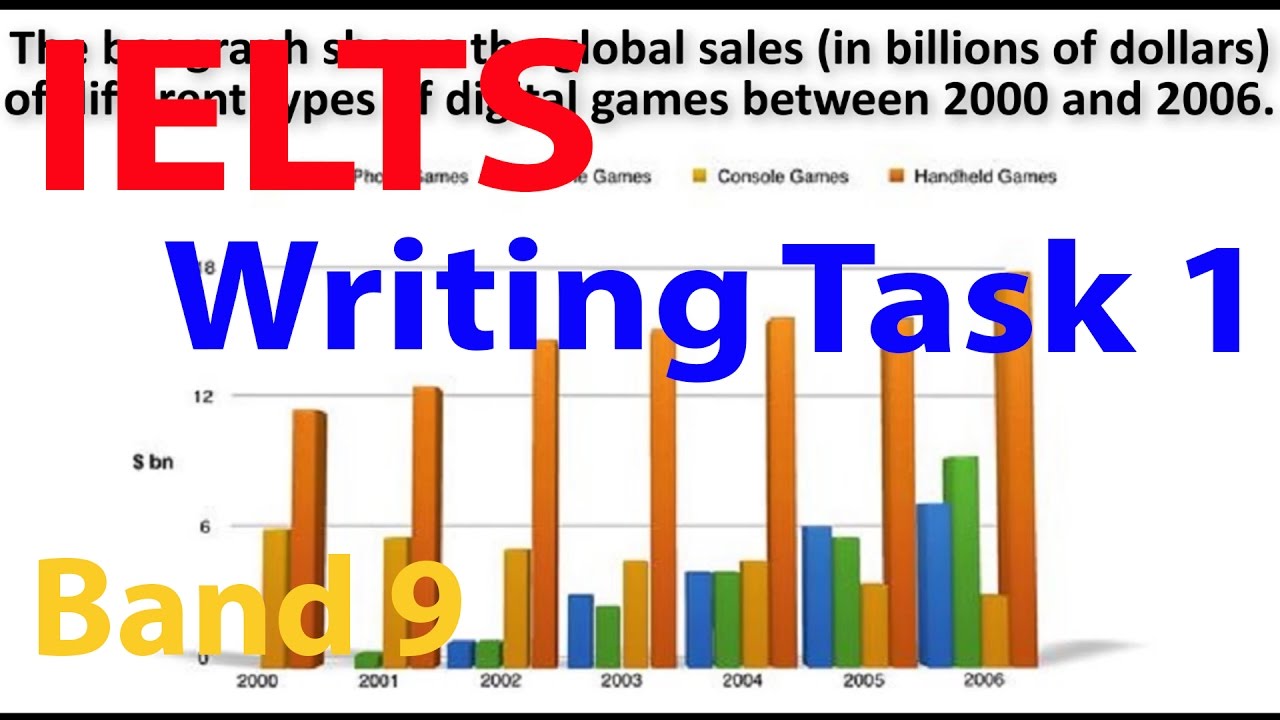
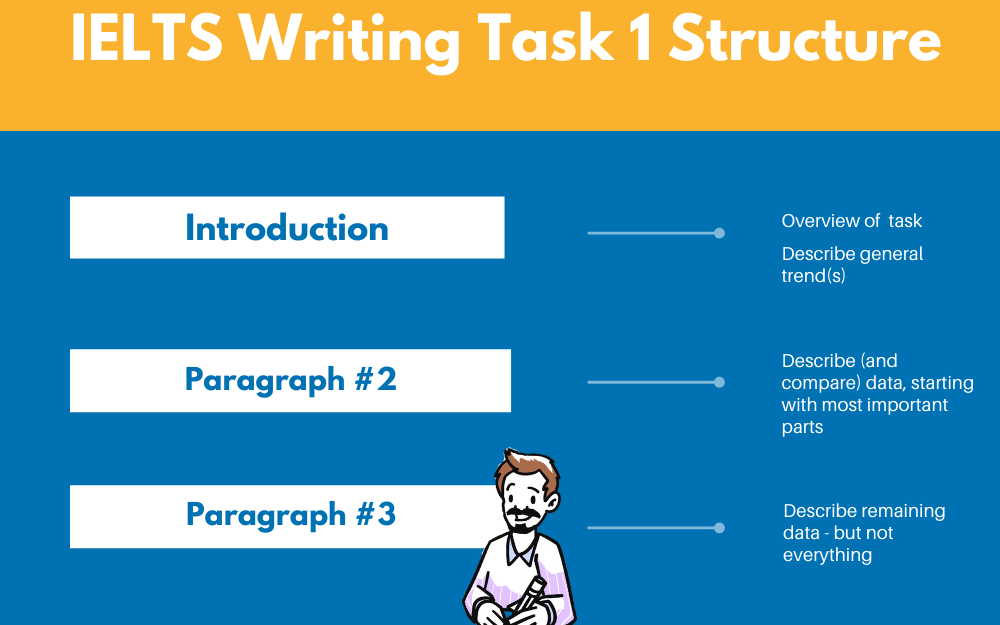
In this lesson, we’re going to learn how to tackle bar charts in IELTS Writing task 1 questionsto get the highest score. To get a band 9 in IELTS Writing task 1, you should follow this answer structure:
Introduction
General overview
Specific features
IELTS Bar chart answering strategy:
1. Introduction
You should start your answer by writing an introduction. The introduction is 1 or 2 sentences, where you paraphrase the information from your question. You should mention two things in your introduction:
what your graph shows
for what period of time
2. General Overview
The second paragraph of your answer is a general overview, where you briefly describe major trends on your graph. Ideally, you should describe 2-4 key features.
3. Specific details
After we’ve written the introduction and general overview, it’s time to give the specific details. You should describe the specific features in 2 or 3 (sometimes more) paragraphs.
When you have two countries (or two cities or any other two things depicted on the graph). The simplest way of grouping data is to describe each country’s trend in a separate paragraph.
When giving specific features, you have to write exact numbers/percentages and include as much details as you can.
How to choose information from the Bar chart?
Assuming one sentence contains around 10 to 15 words. We can estimate that your description of the Bar Chart will be made out of 10 to 12 sentences, we can now assign each sentence for a specific task:
One sentence for the introduction.
Two sentences with the superlative(usually marked by the suffix -est).
A sentence with a comparison. Make comparisons where relevant.
A sentence grouping two data points because they are similar..
A sentence noting an exception.
A sentence describing some data in an advanced manner.
A sentence describing the data in a normal fashion.
Two sentences for the summary.
Note that these sentences don’t necessarily need to go in this particular order. You must write them in a way that makes your Bar Chart description flow naturally. You may also have to repeat a few sentences with different data if you find your graphic contains more information. The structure above is a rough guide to get you started, once you are comfortable with it you can start experimenting. Just remember to get feedback while you are testing your ideas, otherwise, it’s quite difficult to improve.
Final tips on describing a Bar chart
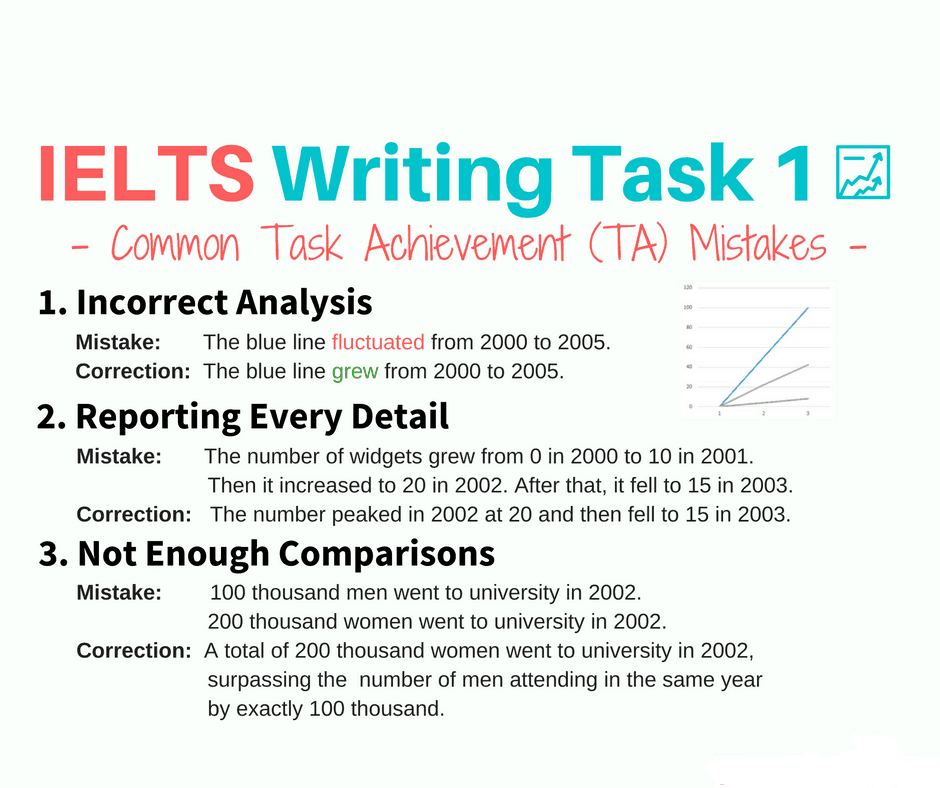
Avoid listing every single data point by grouping the data together.
Avoid mixing formats, for example, don’t mix decimals with estimations in the same sentence.
After you have successfully written out your description with all of the information you wanted to include, go over it and replace some simpler words with more academic ones – this will get you more marks. For example, change “big” to “most significant”.
Check that the whole text is free of errors and mistakes.
Practice with different Bar Charts to improve.
Review the superlatives -these are essential if you want to effectively describe the chart.
The fastest way to improve is to get feedback on your work.
When analyzing a bar-chart, we cannot always give exact details (due to inaccuracies of the chart), so use words around, about, and approximately when giving inexact data.
Give data for each year shown on the chart
Look for the key data and make sure that you are comparing and contrasting the data, NOT just listing the data from one section to the next. If you just write about what happened to X, what happened to Y, and what happened to Z, without showing any relationship between them, you will not get a high score.
You will need to look for similarities and differences when you first analyze the chart and you will need to decide what can logically be put together or not. This means that you don’t have to describe everything that you see in the bar chart, just the key points!
Group the data together so that you have a well-organized and coherent answer. It is a good idea to divide your answer into two or three paragraphs so it is well organized. To do this, you should group similar ideas together into paragraphs or sections.
Use a wide variety of sentence structures. Include complex sentences and simple sentences.
Bonus tip: Try copying out sample bar charts with pen and paper. You will start to understand what information to select. Also, your confidence will improve when it comes to writing your next essay.
IELTS bar chart Question:
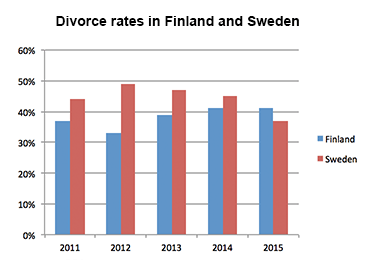
The bar chart shows the divorce rates in two European countries from 2011 to 2015.
Summarise the information by selecting and reporting the main features, and make comparisons where relevant.
Sample Answer
The bar graph provides information about the percentages of divorces in Finland and Sweden between 2011 and 2015.
Overall, Sweden experienced a downward trend, while Finland showed an upward trend throughout the period. Both countries’ divorce rates had some fluctuations. Although Finland initially had a lower rate, it outraced Sweden at the end of the period.
Sweden’s divorce rate was about 45% in 2011, being higher than Finland’s rate by approximately 8%. Then, it rose to almost fifty percent in 2012. However, the figure showed a gradual decrease to about 47% in 2013 and continued to decline steadily to the end of the period, reaching around 45% in 2014 and hitting a low point of about 37% in 2015.
The percentage of divorces in Finland was less than 40% in 2011, and it decreased in 2012, when about one third of marriages in Finland ended with a divorce (as opposed to almost a half in Sweden). However, the figure experienced a steady growth during the next two years. It rose to approximately 39% in 2013, then increased by around 3% in 2014, and remained steady for the next year, outracing the rate of Sweden.
IELTS PIE CHART: OVERVIEW, WRITING STRATEGIES, TIPS AND SAMPLES
IELTS PIE CHART: OVERVIEW, WRITING STRATEGIES, TIPS AND SAMPLES
Here is a post for the IELTS PIE CHART: OVERVIEW, WRITING STRATEGIES, TIPS AND SAMPLES
IELTS PIE CHART: OVERVIEW, WRITING STRATEGIES, TIPS AND SAMPLES
IELTS PIE CHART: OVERVIEW, WRITING STRATEGIES, TIPS AND SAMPLES
In writing module, task 1, of the academic section there will be a visual representation or a diagram on which you have to write a paragraph. One of these visual representations may be pie charts.
Pie Charts are the circular charts that are divided into sections or pie slices usually representing the percentages. Each section of the pie chart shows the percentage of data that it represents. When you put all the sections together it forms a circle.
The Pie charts are most commonly used in multimedia and business world and less commonly used in scientific and technical publications.
Pie chart in IELTS is one of the major question types in IELTS academic writing task 1 that are asked frequently. You are expected to write a response describing the given Pie chart.
Moreover, you are expected to write a report in a minimum of 150 words in 20 minutes . To score band 8 and more, it is essential to examine the question well and find out key features that can be written.
IELTS task 1 Pie charts are the best way to organize data in order to see the size of components relative to the whole, and especially at showing percentage or proportional data.
Now, let’s see what we are going to cover in this article.
What is the IELTS Pie Chart?
Steps to write a Pie Chart
Strategies to Score High in IELTS task 1 Pie chart
Tips for describing Pie chart in IELTS Writing Task 1
Sample IELTS Pie chart with answer
IELTS Pie chart Vocabulary
FAQs about Pie chart in IELTS
What is the IELTS Pie Chart?
Pie Chart in IELTS is a type of graph in which a circle is divided into sectors representing a proportion of the whole.
Moreover, in the Pie chart of IELTS academic writing task1, you are expected to write a short descriptive report based on the given visual data or information.
As mentioned earlier, the Pie charts are divided into ‘pie slices’ to illustrate the percentages.
The size of each pie slice displays the relative data quantity it represents. These slices together create a full circle.
Besides, these are used commonly in the mass media and business world, but less common in technical and scientific publications.
Steps to write a Pie Chart
There are certain steps that you need to follow while describing the Pie Chart. You can follow the below steps:
Introduction
You have to begin the chart with an introduction. The introduction can go up to 2 sentences and while introducing you can paraphrase the sentence that is already there in the question. You need to include two points. Firstly, what is your graph showing and secondly, the time period?
General Overview
In the second paragraph, you need to write a general overview of the graph. You need to pick some main features from the chart and explain it. Firstly, you can take the biggest or the smallest sections from the pie chart and explain it. Secondly, identify the ones that didn’t change over time. You can choose to write on any one of the options, but do not write both.
Specific Details
In the last paragraph, you have to write about the specific details. You can split the group of specific details into two or three paragraphs. You can group the specific details in the following manner:
Firstly based on the sectors that have increased and secondly based on the factors that have decreased or didn’t change.
Strategies to Score High in IELTS Task 1 Pie Chart
Read the Question Properly to Select Information
In order to properly display the information in the Pie Chart, read the given information before you proceed.
Follow the right structure
A proper Pie chart structure should include:
Introduction, body paragraphs, and conclusion
Connective words to make the writing cohesive within sentences and paragraphs.
Meet the requirements of the task
Make sure that the Pie chart has enough grammar
Describing the whole graph adequately
Meeting the word limit requirements
Focusing on the important trends presented in the Pie chart
Focus on the Vocabulary
Vocabulary for IELTS pie chart plays a crucial role in achieving a good score. Moreover, to score high within the limited instructions is a bit challenging.
To prove that your report has a great vocabulary for IELTS, maintain the following:
Use a wide vocabulary range
Avoid repeated phrases and words
Use words precisely
Use Synonyms
Enriching vocabulary can help you hit a high band score as it holds 25% of the score.
You have seen about the describing a Pie chart in IELTS writing task 1 and the major strategies to follow. Now, let’s look into some tips that help in effective report generation.
Tips for Describing Pie Chart in IELTS Writing Task 1
Follow the below tips to crack the Pie chart in IELTS academic writing task 1
Read the given question and identify the key information.
Pay attention to your Pie chart time-frame and use appropriate tense.
Paraphrasing the given question using proper grammar and vocabulary
Use Transition Words to maintain continuity and keep a count on the word count.
Focus on acquiring the appropriate data from the Pie charts into your writing.
Compare the information on your Pie chart, do not panic. In such cases, give a summary of each picture.
Do not give personal opinions at any cost.
Let’s implement our Pie chart describing strategies of IELTS in the below sample and generate a report:
Sample IELTS Pie Chart with Answer
You should spend about 20 minutes on this task. Moreover, write at least 150 words.
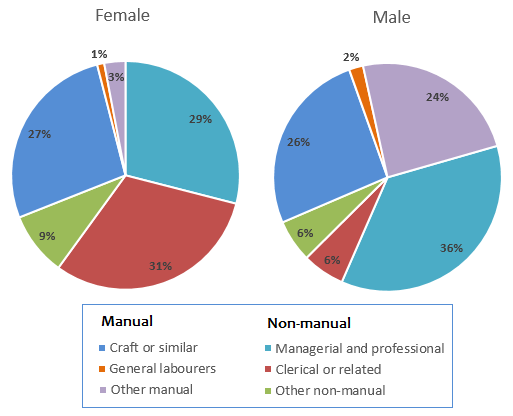
The two pie charts below show some employment patterns in Great Britain in 1992.
Summarize the information by selecting and reporting the main features, and make comparisons where relevant.
IELTS PIE CHART: OVERVIEW, WRITING STRATEGIES, TIPS AND SAMPLES
The pie charts outline employment scenario of British males and females in six job sectors in 1992. It is obvious that manual jobs were predominantly done by males whereas a higher percentage of females did clerical jobs. Moreover, managerial and craft related jobs were engaged by a higher proportion of both genders.
As the illustration indicates, more percentages of British males worked in manual sectors, except in craft-related industries, compared to their female counterparts. For instance, 2% general labourers in Great Britain were men while the female labourers’ ratio was half of that. Moreover, 24% males worked in numerous other manual jobs while this was only 3% for females. Nevertheless, 27% females in craft-related industries marginally exceeded the ratio of males in the same sector.
Looking further into the data, non-manual professions included managerial & professional, clerical and other non-manual jobs. Interestingly, employment rates of females in clerical was five times higher than that of males. This is the job category that many females (31%) we engaged in. Besides, over one-third males were in managerial and professional jobs while almost 30% females were in these positions as well.
IELTS PIE CHART: OVERVIEW, WRITING STRATEGIES, TIPS AND SAMPLES
IELTS Pie chart Vocabulary :
In writing task 1 of Academic module, there is a dedicated vocabulary for pie chart. IELTS pie chart description must be done accordingly. Here are some sample vocabulary:
You can also use other words and fractions.
A large number of people
over a quarter of people
a small minority
A significant number of people
less than a fifth
This table presents some examples of how you can change percentages to fractions or ratios:
Percentage
Fraction
80%
four-fifth
75%
third quarter
60%
three-fifth
55%
more than half
40%
two-fifth
35%
more than a third
20%
a fifth
15%
less than a fifth
10%
one in ten
5%
one in twenty
IELTS PIE CHART: OVERVIEW, WRITING STRATEGIES, TIPS AND SAMPLES
If the percentages are not exact as above, then you can use qualifiers to make sure your description remains accurate. Here are some examples:
Percentage
Qualifier
77%
just over three quarters
77%
approximately three quarter
49%
just under a half
49%
near a half
32%
almost a third
This table presents some examples of how you can change percentages to other phrases:
Percentage
proportion / number / amount / majority / minority
75% – 85%
a very large majority
65% – 75%
a significant proportion
10% – 15%
a minority
5%
a very small number
When describing increases/decreases, use words given below:
Noun phrase + verb + adverb Eg : The price of tomatoes fell sharply.
There + be + noun + in + noun phrase Eg: There has been a sharp decrease in the price of leather goods.
IELTS PIE CHART: OVERVIEW, WRITING STRATEGIES, TIPS AND SAMPLES
Frequently Asked Questions on IELTS Pie Chart
1) How many words should we use to describe Pie Chart graphs in IELTS?
You have to write a minimum of 150 words or a bit more. The ideal word length is 160-180 words.
2) What are the basic elements of the Pie chart?
The basic elements of the Pie chart in task 1 include an introduction, overview, and body paragraphs.
3) Where to note the key features of Pie chart?
You will be provided with a paper and you can use a pen or pencil to note the key features in the IELTS Writing test.
4) What tense should we use while describing the Pie chart?
You have to use the right tense according to the context. Crucially the usage of tense depends on the time frame of the graph.
5) Should we conclude or give an opinion on Pie chart data?
No, you are not supposed to give any opinion on the Pie chart. It is statistics and needs to be interpreted not evaluated. In addition, the graders consider your task achievement (not task response).
6) By concluding the data can we get high marks?
Of course not! Besides, it is a waste of time. The conclusion is another form of overview relatively short. An overview is important for a good score.
IELTS PIE CHART: OVERVIEW, WRITING STRATEGIES, TIPS AND SAMPLES
This post is about how to describe a table in IELTS writing task 1?
Important factors for scoring good band scores in IELTS Writing Task 1 Table:
Task achievement: The essay should identify a major point of interest in the data and supports with relevant figures from the table.
Coherence and cohesion: The essay should organise into paragraphs which are connected logically. There is an overall description at the beginning or at end of the answer.
Lexical resource: The essay should use vocabulary appropriate to comparing data such as ‘accounted for’ and ‘witnessed a significant rise’. Native-like collocation is used throughout the model answer.
Grammatical range and accuracy: The essay should include many examples of complex sentences that combine a main point with supporting evidence in two clauses.
In IELTS writing task 1 of academic module, you find different types of diagrammatic questions. Table is one of such questions that can be asked in IELTS writing task 1. Table questions appear in different ways in the exam. There can be a single table or two tables. It can also be the case that you have a table with a combination of other diagram such as bar chart, line graph or pie chart. Whatever the question is, you can follow the below easy steps in order to describe a table effectively.
The first step to follow in any type of question in IELTS writing task 1 is to read the question carefully and understand it well. In the question statement, you will find the basic information of what the table is about and then you can check the table heading which would also give you more clarity of the question. Afterwards, you can check the main headings of columns and rows with a slight glare at the figures. Do not analyse the figures deeply at this stage.
Your introduction should be quite impressive as it makes the first impression on the examiner. It could potentially make or break your overall score!
If there are multiple graphs and each one presents a different type of data, you can write which graph represents what type of data and use ‘while’ to show a connection.
For example: The given bar graph shows the amount spent on fast food items in 2009 in the UK, while the pie chart presents a comparison of people’s ages who spent more on fast food.
For multiple graphs and/ or table(s), you can write what they present in combination instead of saying which each graph depicts.
Your introduction alone should be about 20 to 30 words.
General overview
You can write your introduction (paraphrasing the question) and General overview in the same paragraph, or you can also write both in separate paragraphs. It doesn’t really matter which you chose, but you will have to write both!
Never provide any data (give numbers, percentages or quantity) in your general overview. You only start discussing the data in detail in the in-depth part. So, you should give the most striking features of the graph that could be easily understood at a glance.
In your general overview do not write:
At first glance the graphs reveals that 70% of the male were employed in 2001, while 40 thousand women in this year had jobs.
Instead write:
At first glance the graphs reveals that more men were employed than their female counterparts in 2001 and that almost two-third of the females were jobless in the same year.
Your Introduction (paraphrasing the question + general overview) should have a word count of about 75 – 80 words.
In-depth analysis
Your in-depth analysis is the next part of your writing and the biggest chunk of the task. So, it should have about 75-80 words. Combined with the 75-80 words of your introduction and General overview you have your 150 to 160 words. This means you have covered the 150 word count.
Depending on the question, you can either use 1 or 2 paragraphs for the body of the in-depth analysis. Just remember to group things together logically.
General tips
Take time to analyse and plan your writing, these are essential parts of any writing. It makes sure you know what you are writing about and it saves time when you are writing.
Write in pencil, that way you can easily correct your mistakes in the final 2 minutes, as well as replace words by synonyms if you are using the same words too often.
Make your point clearly
How you structure your answer can help set the overall flow of your answer. Usually, two main paragraphs will be used so that you can describe each group of data. That means that one group of data would be described in one paragraph whilst the second group of data would be a new a paragraph.
This keeps things organised and helps you keep track of your overall point.
Compare & Contrast with Exceptions
For example, the first paragraph could be comparing the data whilst the second paragraph is talking this in more detail, whilst a final summary sentence ties it all nicely.
This helps you stay on track and easily cover all the IELTS bases too.
Be a master and prepare fully with these tips
Use practice tests – the more experience, the better!
Review sample essays.
Time yourself as you practice more and more.
Try answering the question without using a dictionary.
An inspection of the data in the first table clearly shows It is apparent from this table that considerable … In the third column there is a distinct trend of … What stands out in the table is … Closer inspection of the table shows … As the table shows, there is a significant decrease … There is a significant difference between column A and column B, most notably… An inspection of the data in the table reveals that…
What stands out in this table …
…is the general pattern of …is the difference between …is the wide disparity between …is the rapid increase of …is the growth of …is the high rate of
Fancy Sentences
The figure for 1999 is almost three times that of 2010. The figure for 2011 is exactly four times that of 2010. It is clear that the figures between 2001 and 2010 are broadly in the same range.
Grouping
The figures between 1999 and 2000 are very similar to those of the prior year. The figures in column A and B are almost identical.
HOW TO DESCRIBE A TABLE IN IELTS WRITING TASK 1: Tenses
Use past simple (e.g. “increased) to write about the past.
Basic Example: “The number of people increased…” or “Several houses were built in the northern area…”
Whenever you are writing about the past, use past simple (e.g. “was”, “increased”). It’s no problem if you use present perfect (e.g. “have increased) or past perfect (e.g. “had increased”) if it’s correct, but most of the time it’s unnecessary.
The choice of which tense to use will be determined by whether or not the graphic contains dates and, if it does, whether the dates are in the past or the future.
If we don’t have dates, and so present tense must be used.
For example,
Cooking utilises 5%, standby 5% and lighting 11% with total utilisation of 21% of the power while refrigerators need 12% electricity. All other appliances consume the rest 24% of the energy share.
– Past tense – past simple
If the dates are in the past, you would have to use Past Tense.
For example,
Among the full-time employed people, men had about 45 hours of leisure time on an average per week compared to the almost 38 hours of leisure time for women.
– Future tense – future simple or the future perfect
If the dates are in the future, you would have to use future tense.
For example,
The life expectancy is predicted to rise in every country, which will be 23% and 25 per cent in 1940 in Sweden and USA respectively.
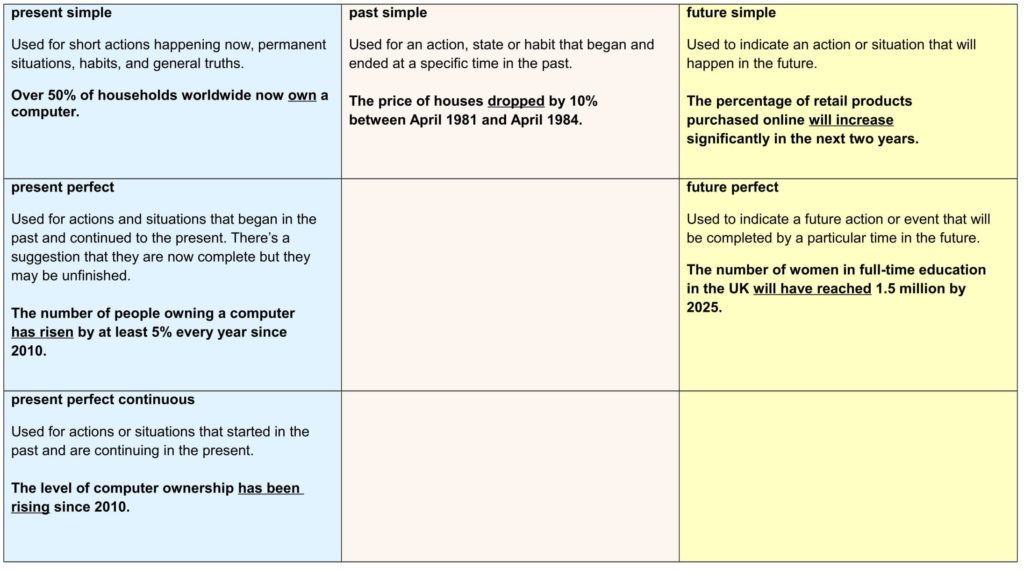
The table below gives explanations of these verb tenses and examples from Task 1 essays.
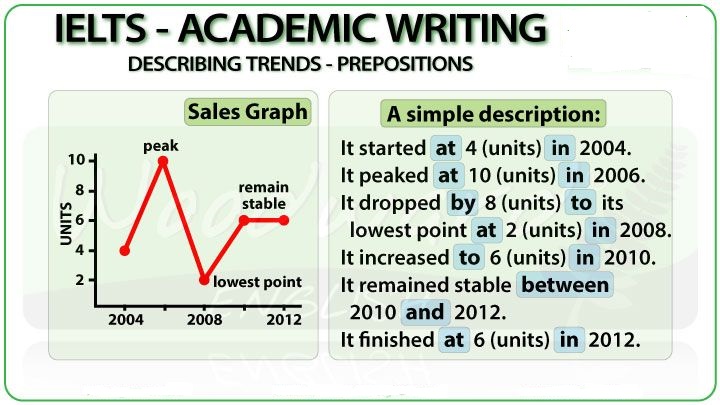
How to Describe Trends
The two most useful grammatical structures for describing trends are:
1) Noun phrase + verb + adverb
For example,
The number of unemployed women fell significantly.
2) There + be + adjective + in + noun phrase
For example:
There was a dramatic improvement in the percentage of people in employment.
How to Describe Increases and Decreases
The two most useful grammatical structures for describing increases and decreases are:
1) Noun phrase + verb + adverb
For example,
The popularity of social media climbed steadily.
2) There + be + noun + in + noun phrase
For example,
There was a fluctuation in university applications.
There is now a swimming pool in the location of the old factory.
How to Make Comparisons
1) More/fewer/less + noun + than
For example,
More teenagers play computer games than a sport.
2) Most/least + adjective
For example,
The most common childhood illness in 1979 was chickenpox.
3) More/less + adjective + than
For example,
Cruises were more popular than beach holidays in 2012.
4) High/low/few -er + than
For example,
A lower number of teenagers play a sport than play computer games.
5) High/low/large/small -est
For example,
The largest proportion of immigrants came from Mexico.
These sentence structures are valuable tools for getting high marks for your Writing IELTS Task 1 essay, so practice using them.
2 Common Grammatical Errors
For many students, two aspects of grammar that are a particular problem are:
Prepositions
Articles
Prepositions
There are two specific prepositions that you will probably use numerous times in your Task 1 essay when reporting change – ‘in’ and ‘of’. They are easy to get wrong.
Follow this general rule:
When stating the specific value of the change (number, amount, percentage etc.) – use ‘of’.
When stating what has changed – use ‘in’.
For example:
An increase of 20%.
An increase in the number of over 60’s taking exercise classes.
A drop of almost a half.
A drop in house prices.
An improvement of 45 units per week.
An improvement in retail sales from April to June.
‘Of’ is also used after a value. You will probably want to use proportional values in your Task 1 essay so here are some examples.
a small percentage of
just under a quarter of
exactly a half of
roughly three quarters of
a significant majority of
a high number of
Articles
Many languages do not have articles, and native speakers of those languages can find it a huge challenge to remember to use them.
In English, there are three articles – the, a, and an. Each is used in specific instances.
1) With singular and plural nouns:
Use the before singular and plural nouns when the noun is a specific thing. For example,
The bar graph illustrates how many male and female students were studying full-time and part-time in Britain during the years 1970/1971, 1980/1 and 1990/1.
Use a or an before a singular noun or noun phrase when the noun is non-specific and could be any one of a group or type.
Use a before a noun or noun phrase beginning with a consonant. Use an before a noun or noun phrase beginning with a vowel.
For example,
Less than 30% of the population took a foreign holiday between 1975 and 1985.
There was an upward trend in families taking an annual holiday abroad after 1990.
2) Noun combinations:
Also, use a/an before adjective singular noun combinations such as these from our preposition list:
a small percentage of
an insignificant minority of
a high number of
The key to improving your grammar is to know your weaknesses and focus on these as you practice and when you check your work in the exam.
We now have everything we need to begin planning and writing our IELTS table chart essay.
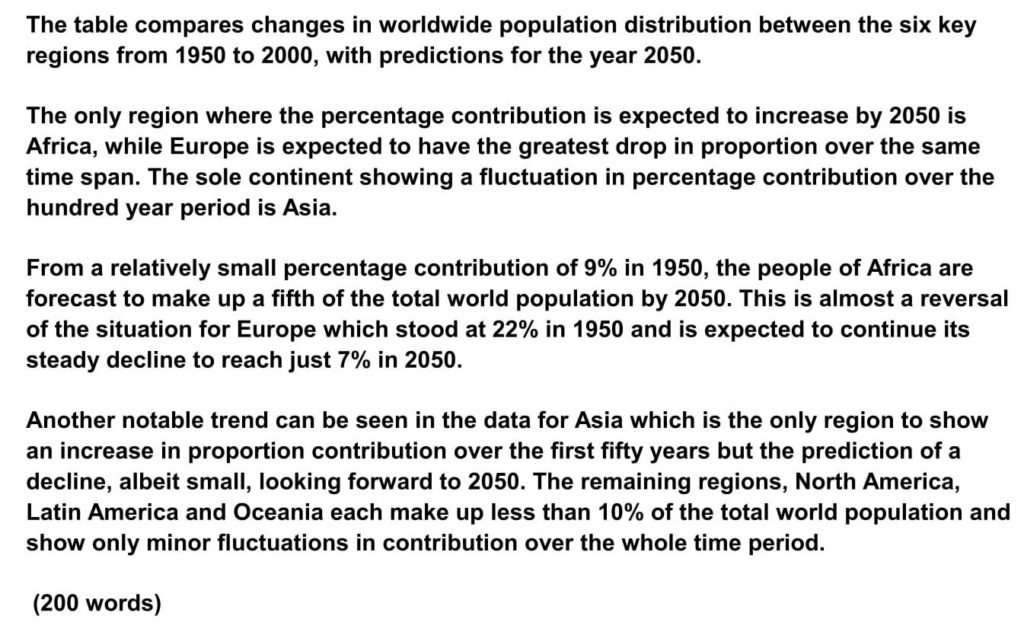
How to Describe a Table in IELTS Writing Task 1: Sample Question
Here’s our practice question:
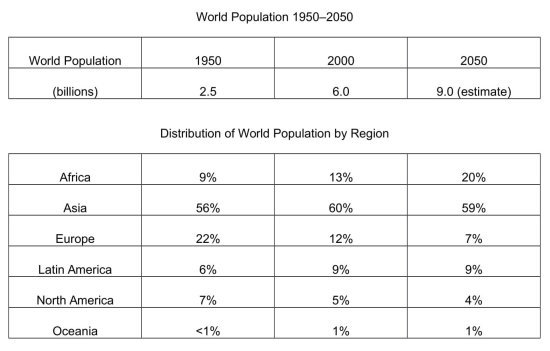
The tables below give the distribution of world population in 1950 and 2000, with an estimate of the situation in 2050.
Summarise the information by selecting and reporting the main features, and make comparisons where relevant.
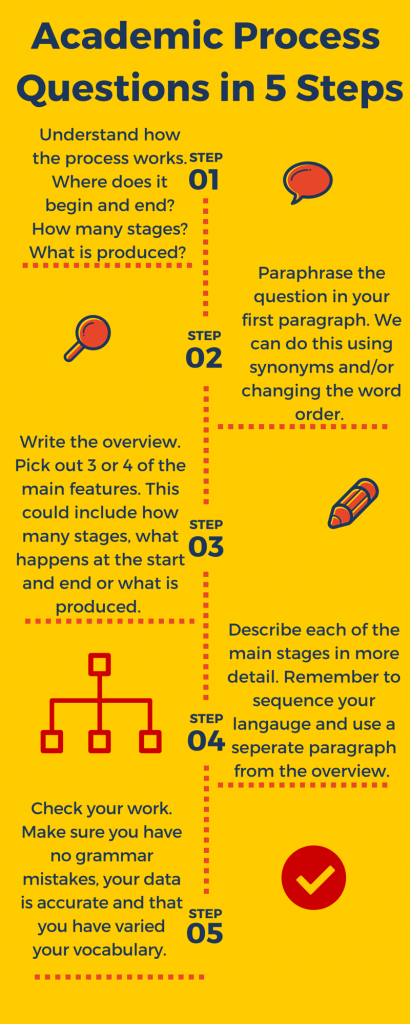
In this post you will learn how to write IELTS Task 1 Process chart with detailed explanation with examples and sample answers :
How to write IELTS Task 1 Process chart
Although this type of diagram is less common to see in the test, it is still very important to have an understanding of how to write task 1 process chart.
This should follow the same format as any task 1:
Introduce the diagram
Give an overview of the main point/s
Give the detail
5 Step Plan
To understand the task and quickly make a plan to answer process questions you should follow the 7 steps below:
Understand the process. Find the start and the end of the process. Count how many stages there are and understand what each stage does and the relationship it has with the stage before and after it.
Paraphrase the question.
Describe what is happening generally in 2 sentences. This is your overview paragraph and I will show you how to write this in more detail below.
Divide the process in two and write two separate paragraphs detailing each stage of the process.
A process will have a number of stages that are in time order. So you should start at the beginning, and describe each stage through to the last one.
Processes are not always this clear, and you may have to look more carefully to spot the beginning, and there may also be two things happening at the same time.
So it is important that you look at other sample processes to get a good understanding of how they can vary.
Introduce the Diagram
As with any task 1, you can begin by paraphrasing the given statement. You need to write the given statement with the question in your own words. For example :
Question 1: The diagram below shows the process of photosynthesis.
Paraphrased: The illustration demonstrates how plants produce energy from sunlight.
Question 2: The diagram below shows how electricity is produced in a nuclear power station.
Paraphrased: The illustration below shows the process of how nuclear power plants make electricity.
Highlight the Main Points
An IELTS process diagram is different to a line, bar, pie chart or table in that there are not usually key changes or trends to identify. However, you should still give an overview of what is taking place.
The ‘public band descriptors’ state that to achieve a band 6 or more for ‘task response’ the student must provide an overview in a task 1.
As there are no trends to comment on, you can make a comment on, for example, the number of stages in the process and how it begins and ends.
Detail Each Stage of the Process
Now that we have paraphrased the question and provided an overview we need to tell the examiner about each stage in more detail.
You can:
say what each stage does
what it produces
if any materials are added
and/or discuss the relationship with the previous or subsequent stages.
Give the Detail
Now you need to explain the IELTS process diagram, and there are two key aspects of language associated with this:
1) Time Connectors
A process is a series of events, one taking place after the other. Therefore, to connect your stages, you should use ‘time connectors’.
These connectors are the same you would use to write a graph over time when you explain a series of changes.
These are some common IELTS process diagram connectors:
To begin
Following this
Next
Then
After
After That
Before**
Subsequently
Finally
** If you use before, this means that you will be mentioning a later stage before an earlier stage, so you need to use it carefully. If you can use it properly though, it will get noticed.
2) The Passive
When we describe an IELTS process that involves humans (a man-made process as opposed to a natural one), the focus is on the activities, NOT the person doing them.
When this is the case, we use the passive voice, not the active. For a natural process, such as the life-cycle of a frog, we use active as there is not a person doing the activity in the diagram.
This is a brief explanation of how to use the passive voice, but if you are new or unsure about using it, you should do some further study and practice.
Varying your Language
Sometimes it may be appropriate just to use the same language that you are given in the IELTS process diagram to describe it, but you should try to vary it.
You may be able to use nouns from the diagram as your verbs.
One of the most challenging things about these questions is having to write about something you have never seen or heard of before.
Don’t worry, try to remember two things.
First, the examiner knows that you have probably never seen this process before and you have only 20 minutes to write about it. They do not expect a perfect answer. Just pick out the main features and report them accurately.
Second, you can quickly understand any process by asking yourself these questions:
Where does the process start and where does it end?
How many stages are there?
Is it a man-made process or natural process?
Is it a cyclical (in a circle) or linear (one start point and one end point) process?
Are there any materials that need to be added to the process?
What is produced?
What does each stage of the process do?
What are the relationships between each stage?
The processes you will be asked to write about in the IELTS test will not be very complicated and you should be able to easily answer all of the questions above. When you do this you will completely understand what is happening and you will be able to start writing your answer.
Check Your Essay
You should try to leave 3-4 minutes at the end to check and improve your work. Many students do not do this because they feel they do not have enough time, however, it is better to try and get everything done in 15 minutes and then check and refine your work, than do everything in 20 minutes.
Things that you should check are:
Are there any spelling or punctuation mistakes?
Are the verbs the correct tense?
Does the process I describe make sense? Does it match the diagram?
Is there any vocabulary repetition we could remove with synonyms?
Do I have 4 clear paragraphs?
Did I write over 150 words?
Have I included things only obvious from the diagram?
Have I included the main features in the overview?
Today’s post is about how to write IELTS task 1 Map
You will also be able to learn some new vocabulary that will help you deal with how to write IELTS Task 1 map question.
In the IELTS writing test you might be asked to describe a map in Task 1. This type of question is becoming increasingly popular and in my opinion, the easiest one to score high marks in, if you’re prepared.
Many students, Books and teachers overlook this type of question and it is therefore a bit of a surprise when one comes up. Therefore, if you’re prepared you’ll probably do better than most of the other students.
HOW TO WRITE IELTS TASK 1 MAP
Follow these steps to write IELTS Task 1 Map:
Different Kinds of Map Question
There are three main types of map:
Describe one map in the present day.
Describe two maps- one in the present and one in the future.
Describe two maps- one in the past and one in the present.
The first kind is very rare, as it only requires you to use the present simple and it is impossible for any comparisons to be made.
The second kind does come up occasionally and would require you to use present and future tenses. This kind of question is normally about the future development of a town or city. It requires the same vocabulary as the other two.
The third is the most common.
Structure
To describe two maps I advise to follow a four paragraph structure.
Introduction- Paraphrase Sentence
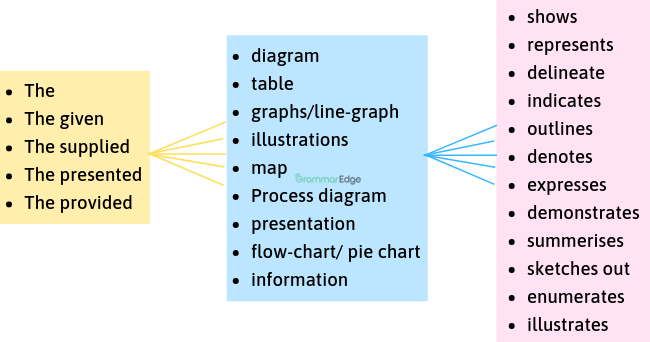
Paraphrasequestion using synonyms. Below is the list of helpful vocabulary – how to write the introduction of the writing task 1 map:
Overall- Overview
Make two general statements about the map. You should describe the maps generally and write about the most noticeable differences between the two maps. You could ask yourself the following questions to identify general changes. Is the map more or less residential? Is there more or less countryside? Are there more or less trees? Were the changes dramatic or negligible? Were there any major improvements in infrastructure? How have the buildings and leisure facilities changed?
Paragraph 1- Main Body 1
Three to four sentences about specific changes that have occurred.
Paragraph 2- Main Body 2
Further three to four sentences about specific changes that have occurred.
You can group information together in paragraph 1 and 2 by time or location, depending on the question asked.
Look at the sample answer to see how I have used this structure.
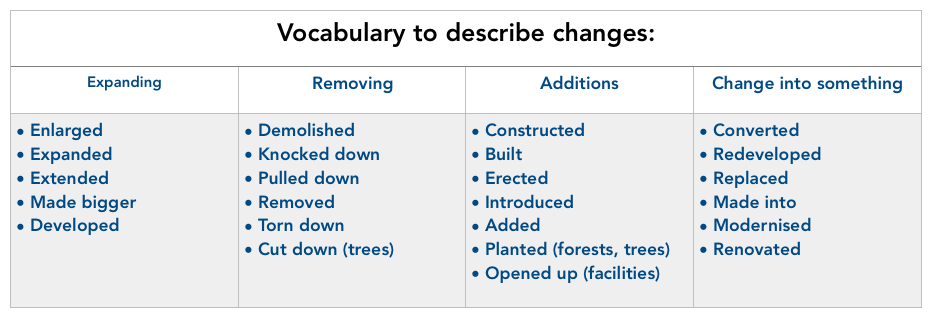
How to Describe Specific Changes
The ability to describe change is crucial to answer these questions. The various buildings and features will normally be labelled. What you need to work on is how to write about how they have changed from the past until the present day.
Vocabulary for IELTS Writing Task 1 Map
Below are the vocabulary for the IELTS Task 1 map:
The government demolished the university and developed a exam hall.
They removed the park and replaced it with a shopping mall.
A park was constructed at the edge of the ocean.
The parking in the city centre was demolished and relocated to the north of the city.
The old buildings were replaced with new restaurants.
The houses was converted into flats.
Trees and Forests – cleared, cut-down, chopped-down, removed, planted.
Examples:
The trees were cut-down and replaced with apartments.
The trees were cleared to make way for roads.
Roads, bridges and railways lines – constructed, built, extended, expanded and removed.
The road was extended and a new park built over the land.
Leisure facilities – opened, set up, developed.
Examples:
A park was set up next to the shopping mall.
A city was developed beside the forest.
How to Describe Overall
As this is an IELTS writing task 1 question we must write an overall and this is where we talk generally about the main changes that have occurred between the two maps.
Below are some examples of general statements we could use to describe change in towns and cities.
Over the period, the area witnessed dramatic changes.
From 1995 to 2005, the city centre saw spectacular developments.
The village changed considerably over the time period.
During the 10 year period, the industrial area was totally transformed.
Over the past 20 years, the residential area was totally reconstructed.
Over the time period, the old docks were totally redeveloped.
Between 1995 and 2005, the old houses were rebuilt.
The central business district was completely modernised during the time period.
Pick two or three of the most noticeable differences in the map and write a general statement for each. This will be your overview paragraph.
The more specific changes should be included in your main body paragraphs.
How to Describe Locations in Map
You will also be expected to describe where things are maps and describe where changes have occurred.
You can use ‘to the left’ and ‘to the right’, but a better way is to use ‘north’, ‘south’, ‘east’ and ‘west’. I normally advise my students to draw the symbols on the question paper if they are not already there.
Examples:
The forest to the south of the river was cut down.
A golf course was constructed to the north of the airport.
The houses in the south-west of the town were demolished.
The green fields to the north-west of the city were redeveloped as a park.
The airport in the centre of the city was relocated to the north-east of the river.
The school to the south-east was knocked down and a new one built to the east of the forest.
Finally, you will also be expected to use prepositions of place, e.g. at/in/on/by/beside/to/off/from, to describe where things are.
Examples:
Dramatic changes took place in the city centre.
To the south of the town, there is a golf course surrounded by trees.
A new school was built next to the swimming pool.
The old road running from north to south was replaced by a new motorway.
RECENT IELTS WRITING TEST TASK 1 (ACADEMIC) WITH SAMPLE ANSWER AND COMPLETE EXPLANATION OF TASK 1
How to write :
RECENT IELTS WRITING TEST TASK 1 (ACADEMIC) WITH SAMPLE ANSWER AND COMPLETE EXPLANATION OF TASK 1
The writing task 1 consists of brief detailing of whatever information is given in the given picture which covers the whole schema of the given graph like when, where, what (3W) approach. No data/details should b missing. Also, you can add a summary/overall/overview of the picture in the introduction paragraph.
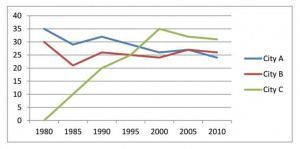
Introduction : Paraphrase: shows>compares; in terms of; hosted; between 1980 and 2010.
Overall/Overview/summary paragraph: (1) the number of conferences declined in Cities A and B (2) contrast rapid increase in the figures for City C.
Body Paragraph 1: City A and City B: compare 1980 numbers; give numbers for 2005, when both cities hosted the same number of international conferences; compare final numbers in 2010.
Body Paragraph 2: contrast City C trend and numbers, giving figures for 1980, 1990, 2000 and 2010.
IELTS Writing Task 1 : Lessons, Tips and strategies
In the IELTS writing Task 1 for academic you have to describe some kind of graph, diagram, map or process which would be in the form of picture.
Here you will get all the tips and tricks you will need for writing about the Task 1, or to find out how to improve your score if it has been too low.
There are three basic things you need to structure an IELTS writing task 1.
Introduce the graph
Give an overview
Compare and contrast in body paragraphs
We’ll look at each of these in turn.
1) Introduce the Graph
You need to begin with one or two sentences that state what the IELTS writing task 1 shows. To do this, paraphrase the title of the graph, making sure you put in a time frame if there is one. No detail about the picture should be missing in the intro
2) Give an Overview
You also need to state what the main trend or trends in the graph are. Don’t give detail such as data here, you are just looking for something that describes what is happening overall. Just write a brief summary or you can say an overview.
One thing that stands out in this graph is that one type of fast food fell over the period, whilst the other two increased, so this would be a good overview. It can be in increasing or decreasing pattern of the data or the maximum or minimum pattern of the data.
You may sometimes see this overview as a conclusion. It does not matter if you put it in the conclusion or the introduction when you do an IELTS writing task 1, but you should provide an overview in one of these places, no matter where you are providing.
3) Compare and contrast in body paragraphs
You can now give more specific detail in the body paragraphs.
When you give the detail in your body paragraphs in your IELTS writing task 1, you must make reference to the data.
The key to organizing your body paragraphs for an IELTS writing task 1 is to group data together where there are pattern.
To do this you need to identify any similarities and differences about the given data.
Look at the graph – what things are similar and what things are different? This is very important to differentiate because the whole task depends on it.
How good you can categorize and how good you can differentiate, can vary your band score for the task. After that its just a matter of words. because you just have to write it in words.
So it is clear that pizza and hamburgers were following a similar pattern, but fish and chips were different. On this basis, you can use these as your ‘groups’, and focus one paragraph on fish and chip and the other one on pizza and hamburgers.
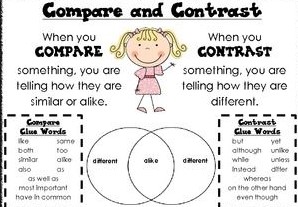
What is compare and contrast?
Basically compare and contrast is an idiom which we use to tell what is similar and what is different about something. that is it.
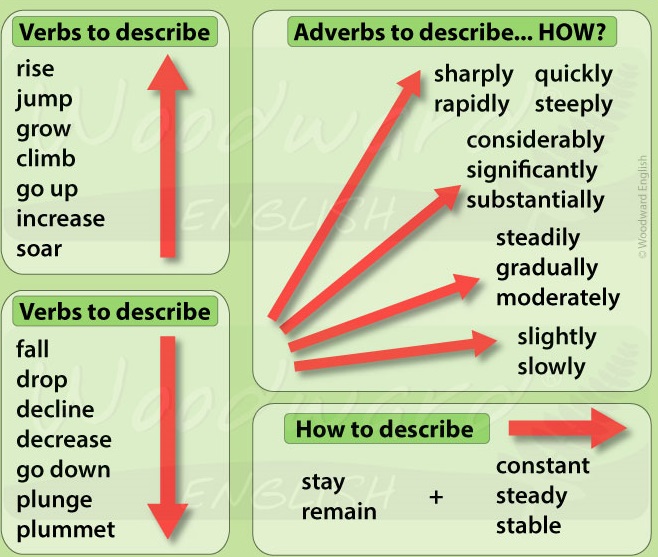
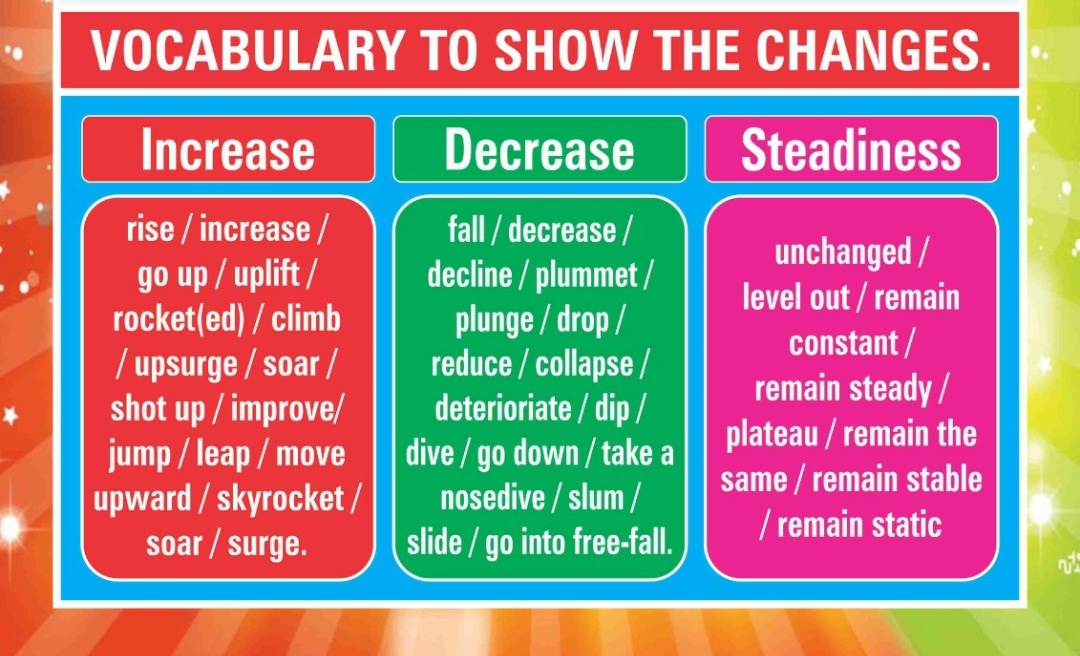
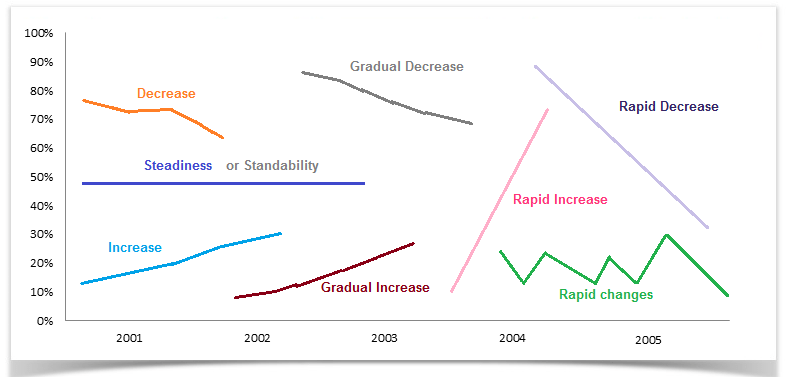
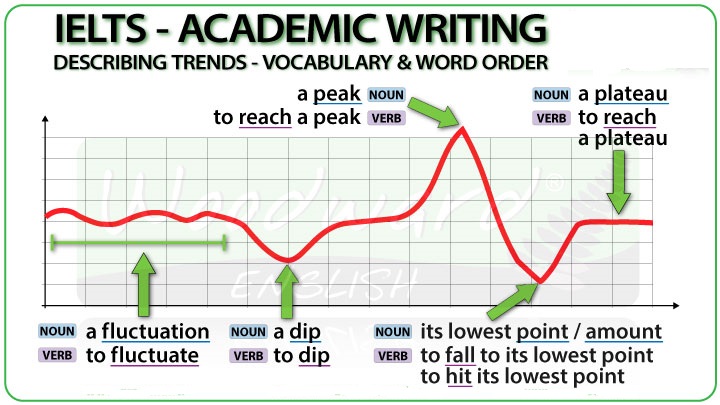
People usually face difficulty to justify the changes occurring in the IELTS writing task 1 graph, vocabulary for the changes is very important and the trend of change in the graph are explained in the following image :
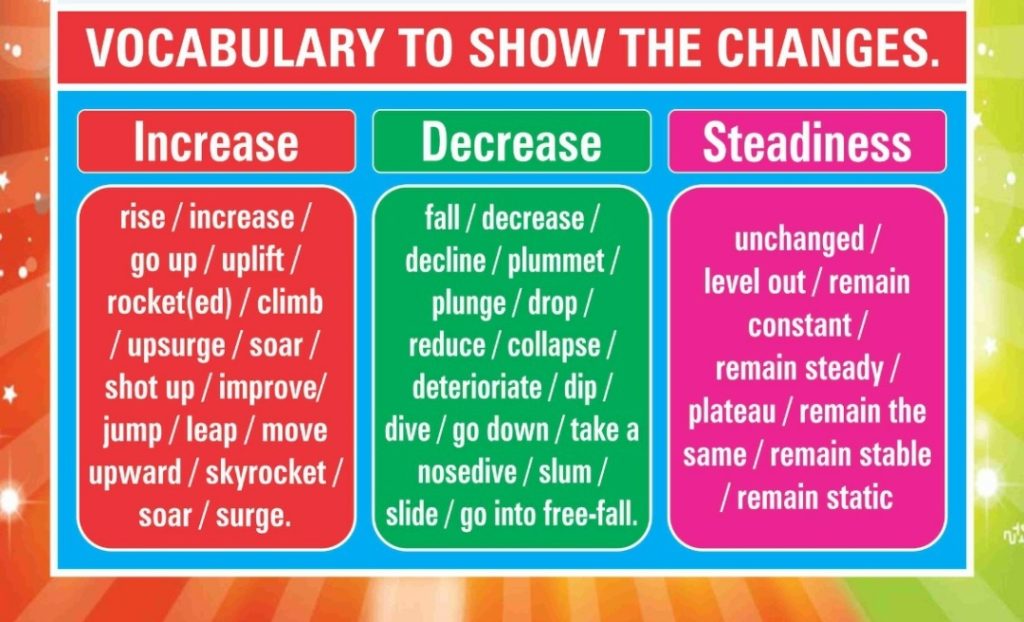
Basic vocabulary for the IELTS writing task 1 graph is as follows:
Here’s is an example of describing IELTS Writing Task 1
What are adverb and adjective in IELTS writing task 1?
In IELTS writing task 1 you may have to describe trends. This may come up in a line graph, bar chart or when comparing more than one chart.
There are two main grammatical structures we can use to describe trends.
There + be + adj. + noun + in + noun phrase
Example:
There was a gradual rise in the price of oil.
There has been a sharp drop in the price of oil.
Possible adjectives
gradual
moderate
modest
sharp
dramatic
slight
steep
steady
significant
considerable
rapid
Possible nouns:
variation
decline
decrease
dip
drop
fall
peak
fluctuation
growth
increase
rise
slump
Noun phrase + verb + adverb
Example:
The price of oil rose gradually.
The price of oil has risen dramatically.
Possible verbs:
rise
jump
grow
climb
increase
rocket
fall
drop
decline
decrease
go down
plummet
plunge
Possible adverbs:
gradually
moderately
modestly
sharply
dramatically
slightly
steeply
steadily
significantly
considerably
rapidly
slowly
Tenses used in IELTS Writing Task 1 :
Using the appropriate tenses in IELTS writing task 1 is essential if you want to get a high band score.
The key is to look at the title of the chart and the information contained on both axes to establish what time frame is used. This will help you establish what tense you should use.
Example:
If the time is one point in the past, for example January 1990, then we should use the past tense.
If it has projections for the future, for example 2045, we use future tenses.
Below are a range of tenses that could be used in task 1. Remember, the tense you use will depend on the information displayed in the graph. This is not a complete list of tenses and an awareness of all the English tenses will help you achieve the IELTS score you need.
Present Perfect:
We use this tense generally to talk about an action that happened at an unspecified time before now. The exact time period is not important.
In writing task 1, we use this tense to talk about changes in data that have happened over a period of time.
Example
The price of oil has fallen by $5 a barrel every week since July.
Present Perfect Continuous
We use this tense to show that something started in the past and has continued up until now.
Example
Oil prices have been decreasing since July.
Future Perfect
We use this tense to state that something will be finished by a particular time in the future.
We often use it with ‘by’ or ‘in’.
Example
The price of oil will have reached $300 a barrel by 2020.
Past Simple
Use this tense to talk about an action that started and finished at a specific time in the past.
Example
The price of oil fell from $150 in Jan 2014 to $50 in Jan 2015.
Commonly used Approximations, Percentages and Fractions
In many of the IELTS writing task 1 questions, you will have to deal with percentages. This is a good opportunity to express these percentages in a different way and boost your score. A way of varying this language is to express them as fractions or proportions.
Remember that you should vary your language as much as possible in order to score high in the ‘lexical resource’ part of the test.
For instance, use approximations. E.g. 49% can be expressed as “nearly a half”.
Below are a range of expressions that can be used to express percentages.
The graph shows the information about the international conferences in three capital cities in 1980 – 2010
IELTS Writing Task 1 Sample Answer :
The given line graph compares three capital cities in terms of the number of international conferences hosted between 1980 and 2010.
Overall, it is clear that the number of international conferences in City A and City B declined over this period. In contrast, in City C the number of such conferences saw a rapid increase until the year 2000.
In 1980, there were 35 international conferences in City A, compared with 30 in City B. Despite similar fluctuations, these figures then decreased overall, until in 2005 both cities hosted 27 conferences. By 2010, conferences in City B had overtaken the number in City A, with 26 and 24 international conferences respectively.
City C held no international conferences in 1980. However, it was the venue for 20 conferences in 1990, and by the year 2000 this figure had risen dramatically to 35. According to given graph, the number then remained higher than in the other two cities, although it fell slightly to 31 conferences by the end of the period.
Two maps describe the way to get to a city hospital of two different years (2001 and 2010).
According to both maps, the key features which is city hospital is surrounded by Ring Road. In these two maps, there have been two features that still remained same. These two features are City Hospital and staff car park. Apart from these two features there are some features that shows on 2010 map but have not shown on 2001 map. The additional features that appear on the map of 2010 are public car park which is situated on the east-side of the city hospital. The further additional features are two round about on the hospital Rd. which can lead to the bus station.
Overall, there are two major features that did not change on both 2001 and 2010 map. These features are city hospital and staff car park. However, there are some additional features that seems on the map of 2010 but not on 2001. These features are public car park, bus station and two around turns.
(160 Roads)
This is an answer which achieved a Band 6.0 score. Here is the examiner’s comment:
The candidate has identified all the key features (hospital, ring road, new public car park, staff car park and bus station in 2010) but the descriptions are not always accurate e.g. [two features that still remained. This two features are City Hospital and staff car park] whereas the staff car park was formerly a car park for both staff and public, while the mention of the bus station is not developed. Organisation is clear, however, with some good use of cohesive devices [According to | Apart from The further additional features], although there is an error in the use of reference pronouns [This/These two features]. The range of vocabulary is sufficient for the task [two different years | features | remained | additional], though [features] is over-used. A spelling error is noted in the second line but this does not cause any difficulty for the reader; similarly, the use of [around-turn]can be easily understood as ’roundabout’. There is a mix of simple and complex sentences, mainly used accurately.
Sample Answer 2
Two maps outline the best approach to get to a city medical clinic of two unique years (2001 and 2010).
As per the two maps, the primary highlights which is city emergency clinic is encircled by Ring Road. In these two maps, there have been two highlights that despite everything remained. This two highlights are City Hospital and staff vehicle leave. Aside from these two highlights there are a few highlights that appears on 2010 guide yet haven’t appeared on 2001 guide. The extra highlights that show up on the guide of 2010 are open vehicle leave which situated on the east-side of the city medical clinic. The further extra highlights are two around-turn on the clinic Rd. which can prompt the bus stop.
Generally, there are two significant highlights that never show signs of change on both 2001 and 2010 guide. These highlights are city emergency clinic and staff vehicle leave. In any case, there are some extra highlights that show up on the guide of 2010 yet not on 2001. These highlights are open vehicle leave, bus stop and two around-turns.
(155 words).
This is an answer which achieved a Band 6.0 score. Here is the examiner’s comment:
The applicant has distinguished all the key highlights (clinic, ring street, new open vehicle leave, staff vehicle park and bus stop in 2010) however the portrayals are not generally precise for example [two highlights that despite everything remained. This two highlights are City Hospital and staff vehicle park] though the staff vehicle leave was in the past a vehicle leave for both staff and open, while the notice of the bus stop isn’t created. Association is clear, be that as it may, with some great utilization of firm gadgets [According to | Apart from The further extra features], in spite of the fact that there is a mistake in the utilization of reference pronouns [This/These two features]. The scope of jargon is adequate for the errand [two various years | highlights | remained | additional], however [features] is over-utilized. A spelling mistake is noted in the subsequent line however this doesn’t cause any trouble for the peruser; comparatively, the utilization of [around-turn]can be effectively comprehended as ‘indirect’. There is a blend of straightforward and complex sentences, for the most part utilized precisely.
Sample Answer 3
Two maps diagram the best way to deal with get to a city clinical center of two novel years (2001 and 2010).
According to the two maps, the essential features which is city crisis facility is enclosed by Ring Road. In these two maps, there have been two features that in spite of everything remained. This two features are City Hospital and staff vehicle leave. Beside these two features there are a couple of features that shows up on 2010 guide yet haven’t showed up on 2001 guide. The additional features that appear on the guide of 2010 are open vehicle leave which arranged on the east-side of the city clinical facility. The further additional features are two around-turn on the center Rd. which can incite the bus station.
By and large, there are two critical features that never give indications of progress on both 2001 and 2010 guide. These features are city crisis facility and staff vehicle leave. Regardless, there are some additional features that appear on the guide of 2010 yet not on 2001. These features are open vehicle leave, transport stop and two around-turns.
(160 words).
This is an answer which achieved a Band 6.5 score. Here is the examiner’s comment:
The candidate has recognized all the key features (center, ring road, new open vehicle leave, staff vehicle park and transport stop in 2010) anyway the depictions are not commonly exact for instance [two features that in spite of everything remained. This two features are City Hospital and staff vehicle park] however the staff vehicle leave was in the previous a vehicle leave for both staff and open, while the notification of the bus station isn’t made. Affiliation is clear, in any case, with some incredible use of firm devices [According to | Apart from The further extra features], disregarding the way that there is a misstep in the usage of reference pronouns [This/These two features]. The extent of language is satisfactory for the task [two different years | features | remained | additional], anyway [features] is over-used. A spelling botch is noted in the resulting line anyway this doesn’t raise any ruckus for the peruser; relatively, the use of [around-turn]can be viably appreciated as ‘circuitous’. There is a mix of clear and complex sentences, generally used absolutely.
WRITING TASK 1 – BAR CHART – HOUSEHOLDS OWNING AND RENTING ACCOMMODATION IN ENGLAND AND WALES 1918 TO 2011
You should spend about 20 minutes on this task.
The chart below shows the percentage of households in owned and rented accommodation in England and wales between 1918 to 2011.
Summarise the information by selecting and reporting the main features, and make comparisons where relevant.
Write at least 150 words.
Sample Answer 1
WRITING TASK 1 – BAR CHART – HOUSEHOLDS OWNING AND RENTING ACCOMMODATION IN ENGLAND AND WALES 1918 TO 2011
The given bar chart depicts the comparison of buying or renting homes in England and Wales from 1918 to 2011.
1918 the rented households was raised near about 78 percentage. After that it leveled of between 1934 to 1953. From 1961 to 1981 it dramatically fallen to 35 percentage. This accommodation seems the same until 2001. In 2011 there was a slight increase in rented households and it rose up to 38%.
The same year the bought ones has raise from 21% to 32% in 1918 to 1952. In 1939 to 1953 was graduate state in the percentage. Then it starts to leveled up to 4% In 1991. At 2001 to 2011 there was a declination in the owned accommodation and it was 62%.
Generally, both of the rented and owned households has boosted and dropped through the years from 1918 to 2011. The was a year that the were the same percentage and it was 1971 which 50%.
(151 words)
This is an answer which achieved a Band 6.0 score. Here is the examiner’s comment:
The candidate has identified all the main features and trends, including the fact that in 1971 the number of households in owned and rented households was the same. Comments are supported by dates and percentages of households and there is a short overview at the end of the script. Organisation is clear as the writer deals with each category in turn. The range of vocabulary is adequate but there are frequent spelling errors [ stated/stayed | yeas/year | leveled/levelled ]. These do not noticeably impede communication, however. There is a mix of grammatical structures and some complex sentence forms, though these are not always accurate: the meaning is still clear, however.
Sample Answer 2
The given bar graph delineates the correlation of purchasing or leasing houses in England and Wales from 1918 to 2011.
1918 the leased family units was raised around 78 rate. At that point it leveled of between 1934 to 1953. From 1961 to 1981 it significantly dropped to 35 rate. This settlement expressed the equivalent until 2001. In 2011 there was a slight increment in leased family units and it was up to 38%.
That year the possessed ones has raise from 21% to 32% in 1918 to 1952. In 1939 to 1953 was graduate state in the rate. At that point it starts to leveled up to 4% In 1991. At 2001 to 2011 there was a decrease in the claimed settlement and it was 62%.
For the most part, both of the leased and claimed families has raised and dropped during that time from 1918 to 2011. The was a year that the were a similar rate and it was 1971 which half.
(150 words).
This is an answer which achieved a Band 6.5 score. Here is the examiner’s comment:
The applicant has recognized all the principle highlights and patterns, incorporating the way that in 1971 the quantity of family units in possessed and leased families was the equivalent. Remarks are upheld by dates and rates of family units and there is a short review toward the finish of the content. Association is clear as the essayist manages every class thus. The scope of jargon is satisfactory yet there are visit spelling blunders [ expressed/stayed | yeas/year | leveled/leveled ]. These don’t recognizably block correspondence, be that as it may. There is a blend of linguistic structures and some perplexing sentence structures, however these are not generally precise: the significance is still clear, be that as it may.
Sample Answer 3
The given reference diagram outlines the connection of buying or renting houses in England and Wales from 1918 to 2011.
That year the had ones has raise from 21% to 32% in 1918 to 1952. In 1939 to 1953 was graduate state in the rate. By then it starts to leveled up to 4% In 1991. At 2001 to 2011 there was an abatement in the guaranteed settlement and it was 62%.
1918 the rented nuclear families was raised around 78 rate. By then it leveled of between 1934 to 1953. From 1961 to 1981 it fundamentally dropped to 35 rate. This settlement communicated the proportional until 2001. In 2011 there was a slight addition in rented nuclear families and it was up to 38%.
Generally, both of the rented and guaranteed families has raised and dropped during that time from 1918 to 2011. The was a year that the were a comparative rate and it was 1971 which half.
(155 words)
This is an answer which achieved a Band 6.0 score. Here is the examiner’s comment:
The candidate has perceived all the guideline features and examples, fusing the path that in 1971 the amount of nuclear families in had and rented families was the identical. Comments are maintained by dates and paces of nuclear families and there is a short survey around the completion of the substance. Affiliation is clear as the writer deals with each class in this manner. The extent of language is agreeable yet there are visit spelling botches [ communicated/stayed | yeas/year | leveled/leveled ]. These don’t unmistakably square correspondence, nevertheless. There is a mix of phonetic structures and some baffling sentence structures, anyway these are not commonly exact: the hugeness is still clear, nevertheless.
Sample Answer 4
The given reference graph plots the association of purchasing or leasing houses in England and Wales from 1918 to 2011.
For the most part, both of the leased and ensured families has raised and dropped during that time from 1918 to 2011. The was a year that the were a similar rate and it was 1971 which half.
1918 the leased family units was raised around 78 rate. By then it leveled of between 1934 to 1953. From 1961 to 1981 it on a very basic level dropped to 35 rate. This settlement conveyed the relative until 2001. In 2011 there was a slight expansion in leased family units and it was up to 38%.
That year the had ones has raise from 21% to 32% in 1918 to 1952. In 1939 to 1953 was graduate state in the rate. By then it starts to leveled up to 4% In 1991. At 2001 to 2011 there was a decrease in the ensured settlement and it was 62%.
(152 words)
This is an answer which achieved a Band 7.0 score. Here is the examiner’s comment:
The up-and-comer has seen all the rule highlights and models, melding the way that in 1971 the measure of family units in had and leased families was the indistinguishable. Remarks are kept up by dates and paces of family units and there is a short study around the culmination of the substance. Alliance is clear as the essayist manages each class as such. The degree of language is pleasing yet there are visit spelling messes up [ imparted/stayed | yeas/year | leveled/leveled ]. These don’t undeniably square correspondence, by the by. There is a blend of phonetic structures and some confusing sentence structures, in any case these are not ordinarily accurate: the tremendousness is still clear, by and by.