



How to describe a Bar chart


In this lesson, we’re going to learn how to tackle bar charts in IELTS Writing task 1 questions to get the highest score. To get a band 9 in IELTS Writing task 1, you should follow this answer structure:
- Introduction
- General overview
- Specific features


IELTS Bar chart answering strategy:
1. Introduction
You should start your answer by writing an introduction. The introduction is 1 or 2 sentences, where you paraphrase the information from your question. You should mention two things in your introduction:
- what your graph shows
- for what period of time
2. General Overview
The second paragraph of your answer is a general overview, where you briefly describe major trends on your graph. Ideally, you should describe 2-4 key features.
3. Specific details
After we’ve written the introduction and general overview, it’s time to give the specific details. You should describe the specific features in 2 or 3 (sometimes more) paragraphs.
When you have two countries (or two cities or any other two things depicted on the graph). The simplest way of grouping data is to describe each country’s trend in a separate paragraph.
When giving specific features, you have to write exact numbers/percentages and include as much details as you can.

How to choose information from the Bar chart?
Assuming one sentence contains around 10 to 15 words. We can estimate that your description of the Bar Chart will be made out of 10 to 12 sentences, we can now assign each sentence for a specific task:
- One sentence for the introduction.
- Two sentences with the superlative(usually marked by the suffix -est).
- A sentence with a comparison. Make comparisons where relevant.
- A sentence grouping two data points because they are similar..
- A sentence noting an exception.
- A sentence describing some data in an advanced manner.
- A sentence describing the data in a normal fashion.
- Two sentences for the summary.
Note that these sentences don’t necessarily need to go in this particular order. You must write them in a way that makes your Bar Chart description flow naturally. You may also have to repeat a few sentences with different data if you find your graphic contains more information.
The structure above is a rough guide to get you started, once you are comfortable with it you can start experimenting. Just remember to get feedback while you are testing your ideas, otherwise, it’s quite difficult to improve.


Final tips on describing a Bar chart
- Avoid listing every single data point by grouping the data together.
- Avoid mixing formats, for example, don’t mix decimals with estimations in the same sentence.
- After you have successfully written out your description with all of the information you wanted to include, go over it and replace some simpler words with more academic ones – this will get you more marks. For example, change “big” to “most significant”.
- Check that the whole text is free of errors and mistakes.
- Practice with different Bar Charts to improve.
- Review the superlatives -these are essential if you want to effectively describe the chart.
- The fastest way to improve is to get feedback on your work.
- When analyzing a bar-chart, we cannot always give exact details (due to inaccuracies of the chart), so use words around, about, and approximately when giving inexact data.
- Give data for each year shown on the chart
- Look for the key data and make sure that you are comparing and contrasting the data, NOT just listing the data from one section to the next. If you just write about what happened to X, what happened to Y, and what happened to Z, without showing any relationship between them, you will not get a high score.
- You will need to look for similarities and differences when you first analyze the chart and you will need to decide what can logically be put together or not. This means that you don’t have to describe everything that you see in the bar chart, just the key points!
- Group the data together so that you have a well-organized and coherent answer. It is a good idea to divide your answer into two or three paragraphs so it is well organized. To do this, you should group similar ideas together into paragraphs or sections.
- Use a wide variety of sentence structures. Include complex sentences and simple sentences.
Bonus tip: Try copying out sample bar charts with pen and paper. You will start to understand what information to select. Also, your confidence will improve when it comes to writing your next essay.
IELTS bar chart Question:
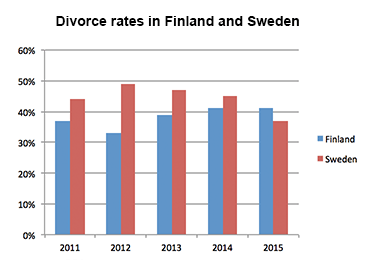
The bar chart shows the divorce rates in two European countries from 2011 to 2015.
Summarise the information by selecting and reporting the main features, and make comparisons where relevant.

Sample Answer
The bar graph provides information about the percentages of divorces in Finland and Sweden between 2011 and 2015.
Overall, Sweden experienced a downward trend, while Finland showed an upward trend throughout the period. Both countries’ divorce rates had some fluctuations. Although Finland initially had a lower rate, it outraced Sweden at the end of the period.
Sweden’s divorce rate was about 45% in 2011, being higher than Finland’s rate by approximately 8%. Then, it rose to almost fifty percent in 2012. However, the figure showed a gradual decrease to about 47% in 2013 and continued to decline steadily to the end of the period, reaching around 45% in 2014 and hitting a low point of about 37% in 2015.
The percentage of divorces in Finland was less than 40% in 2011, and it decreased in 2012, when about one third of marriages in Finland ended with a divorce (as opposed to almost a half in Sweden). However, the figure experienced a steady growth during the next two years. It rose to approximately 39% in 2013, then increased by around 3% in 2014, and remained steady for the next year, outracing the rate of Sweden.
(190 words)
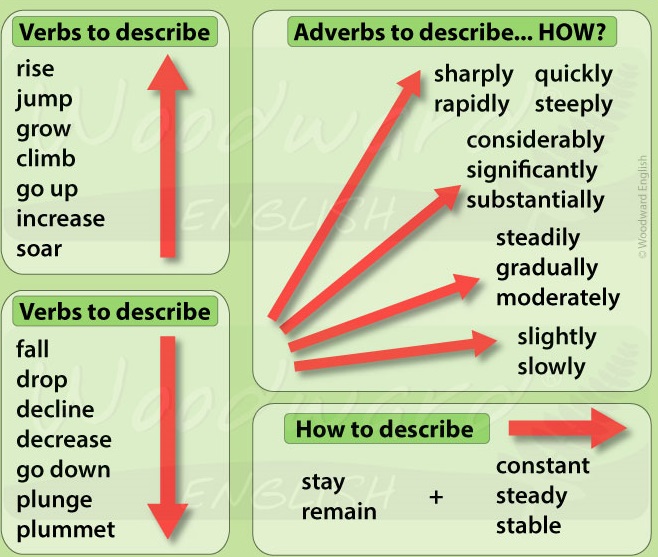
Vocabulary to describe the changes in Bar chart

Subscribe our Youtube Channel for more IELTS audio visual lessons.