Tag Archives: ielts task 1

THE LINE GRAPH COMPARES THE USAGE OF FIVE DIFFERENT WAYS OF INFORMATION AND COMMUNICAL TECHNOLOGY AROUND THE WORLD DURING 1998 TO 2008 IN PERCENTUM FORM.

The line graph compares the usage of five different ways of information and communical technology around the world during 1998 to 2008 in percentum form.

THE LINE GRAPH COMPARES THE USAGE OF FIVE DIFFERENT WAYS OF INFORMATION AND COMMUNICAL TECHNOLOGY AROUND THE WORLD DURING 1998 TO 2008 IN PERCENTUM FORM.

The line graph compares the usage of five different ways of information and communical technology around the world during 1998 to 2008 in percentum form.

SAMPLE ANSWER 1

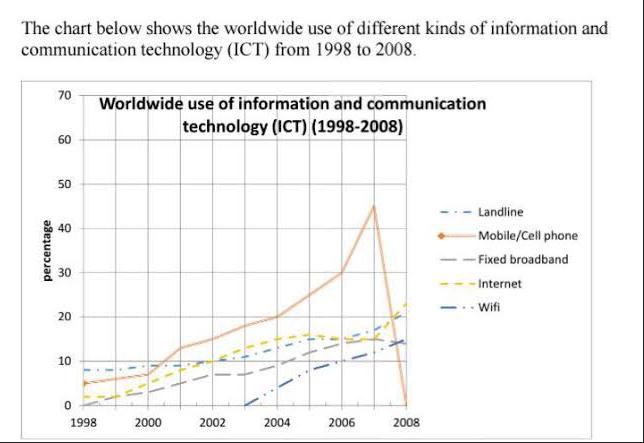
The line graph compares the usage of five different ways of information and communication technology around the world during 1998 to 2008 in percentum form.
Overall, while the data for mobile/cell phones rose with some fluctuations, the recorded percentage was minimum for wifi.
To commence with, the percentage for mobile/cell phone was approximately 5 in 1998 however it experienced many years of up and down and reached at the peak with about 45% in 2006 whereas the figure plunged to 0 in next two years. The fixed broadband with a rather lower start at 0% tended to increase considerably to 15% in 2006 but stopped at roughly 13% in 2008 with a small decline.
The data experienced a rapid incline for the use of the internet. In 1998, the usage was roughly 2% although this figure increased briskly to about 22% in 2008. By contrast, there was not any data for the use of wifi till 2003 where it inclined sharply from 0% to nearly 15% albeit the figure for the usage of landline accounted for roughly 8% however it reached to exactly 20% in last year after having significant growth in all years.


HOW TO WRITE IELTS TASK 1 (COMPLETE EXPLANATION)

AUDIO VISUAL LESSON FOR IELTS TASK 1 (COMPLETE GUIDE)


THE LINE GRAPH COMPARES THE USAGE OF FIVE DIFFERENT WAYS OF INFORMATION AND COMMUNICATION TECHNOLOGY AROUND THE WORLD DURING 1998 TO 2008 IN PERCENTUM FORM.

SAMPLE ANSWER 2

The line diagram looks at the utilization of five distinct methods of data and correspondence innovation all over the planet during 1998 to 2008 in percentum structure.
Generally speaking, while the information for versatile/mobile phones rose for certain vacillations, the recorded rate was least for wifi.
To initiate with, the rate for portable/cell was roughly 5 of every 1998 anyway it encountered numerous long periods of all over and reached at the top with around 45% in 2006 though the figure plunged to 0 in next two years. The fixed broadband with a somewhat lower start at 0% would in general build extensively to 15% in 2006 yet halted at generally 13% in 2008 with a little decrease.
The information encountered a fast slope for the utilization of the web. In 1998, the utilization was generally 2% albeit this figure expanded energetically to around 22% in 2008. On the other hand, there was no information for the utilization of wifi till 2003 where it slanted forcefully from 0% to almost 15% yet the figure for the use of landline represented generally 8% anyway it came to precisely 20% in last year subsequent to having huge development in throughout the years.


SAMPLE ANSWER 3

The line graph checks out the use of five particular techniques for information and correspondence advancement all around the planet during 1998 to 2008 in percentum structure.
By and large, talking, while the data for adaptable/cell phones rose for specific instabilities, the recorded rate was least for wifi.
To start with, the rate for versatile/cell was about 5 of each 1998, in any case, it experienced various significant stretches of everywhere and reached at the top with around 45% in 2006 however the figure plunged to 0 in next two years. The fixed broadband with a fairly lower start at 0% would overall form widely to 15% in 2006 yet ended at commonly 13% in 2008 with a little reduction.
The data experienced a quick slant for the use of the web. In 1998, the usage was for the most part 2% but this figure extended vivaciously to around 22% in 2008. Then again, there was no data for the use of wifi till 2003 where it skewed powerfully from 0% to practically 15% yet the figure for the utilization of landline addressed commonly 8%, in any case, it came to exactly 20% in last year resulting to having immense advancement in overtime.

Writing task 1 – Bar chart – Households owning and renting accommodation in england and wales 1918 to 2011

Writing Task 1

WRITING TASK 1 – BAR CHART – HOUSEHOLDS OWNING AND RENTING ACCOMMODATION IN ENGLAND AND WALES 1918 TO 2011

You should spend about 20 minutes on this task.


The chart below shows the percentage of households in owned and rented accommodation in England and wales between 1918 to 2011.

Summarise the information by selecting and reporting the main features, and make comparisons where relevant.


Write at least 150 words.

Sample Answer 1

WRITING TASK 1 – BAR CHART – HOUSEHOLDS OWNING AND RENTING ACCOMMODATION IN ENGLAND AND WALES 1918 TO 2011

The given bar chart depicts the comparison of buying or renting homes in England and Wales from 1918 to 2011.

1918 the rented households was raised near about 78 percentage. After that it leveled of between 1934 to 1953. From 1961 to 1981 it dramatically fallen to 35 percentage. This accommodation seems the same until 2001. In 2011 there was a slight increase in rented households and it rose up to 38%.

The same year the bought ones has raise from 21% to 32% in 1918 to 1952. In 1939 to 1953 was graduate state in the percentage. Then it starts to leveled up to 4% In 1991. At 2001 to 2011 there was a declination in the owned accommodation and it was 62%.

Generally, both of the rented and owned households has boosted and dropped through the years from 1918 to 2011. The was a year that the were the same percentage and it was 1971 which 50%.

(151 words)

This is an answer which achieved a Band 6.0 score. Here is the examiner’s comment:

The candidate has identified all the main features and trends, including the fact that in 1971 the number of households in owned and rented households was the same. Comments are supported by dates and percentages of households and there is a short overview at the end of the script. Organisation is clear as the writer deals with each category in turn. The range of vocabulary is adequate but there are frequent spelling errors [ stated/stayed | yeas/year | leveled/levelled ]. These do not noticeably impede communication, however. There is a mix of grammatical structures and some complex sentence forms, though these are not always accurate: the meaning is still clear, however.


Sample Answer 2

The given bar graph delineates the correlation of purchasing or leasing houses in England and Wales from 1918 to 2011.

1918 the leased family units was raised around 78 rate. At that point it leveled of between 1934 to 1953. From 1961 to 1981 it significantly dropped to 35 rate. This settlement expressed the equivalent until 2001. In 2011 there was a slight increment in leased family units and it was up to 38%.

That year the possessed ones has raise from 21% to 32% in 1918 to 1952. In 1939 to 1953 was graduate state in the rate. At that point it starts to leveled up to 4% In 1991. At 2001 to 2011 there was a decrease in the claimed settlement and it was 62%.

For the most part, both of the leased and claimed families has raised and dropped during that time from 1918 to 2011. The was a year that the were a similar rate and it was 1971 which half.

(150 words).

This is an answer which achieved a Band 6.5 score. Here is the examiner’s comment:

The applicant has recognized all the principle highlights and patterns, incorporating the way that in 1971 the quantity of family units in possessed and leased families was the equivalent. Remarks are upheld by dates and rates of family units and there is a short review toward the finish of the content. Association is clear as the essayist manages every class thus. The scope of jargon is satisfactory yet there are visit spelling blunders [ expressed/stayed | yeas/year | leveled/leveled ]. These don’t recognizably block correspondence, be that as it may. There is a blend of linguistic structures and some perplexing sentence structures, however these are not generally precise: the significance is still clear, be that as it may.


Sample Answer 3

The given reference diagram outlines the connection of buying or renting houses in England and Wales from 1918 to 2011.

That year the had ones has raise from 21% to 32% in 1918 to 1952. In 1939 to 1953 was graduate state in the rate. By then it starts to leveled up to 4% In 1991. At 2001 to 2011 there was an abatement in the guaranteed settlement and it was 62%.

1918 the rented nuclear families was raised around 78 rate. By then it leveled of between 1934 to 1953. From 1961 to 1981 it fundamentally dropped to 35 rate. This settlement communicated the proportional until 2001. In 2011 there was a slight addition in rented nuclear families and it was up to 38%.

Generally, both of the rented and guaranteed families has raised and dropped during that time from 1918 to 2011. The was a year that the were a comparative rate and it was 1971 which half.

(155 words)

This is an answer which achieved a Band 6.0 score. Here is the examiner’s comment:

The candidate has perceived all the guideline features and examples, fusing the path that in 1971 the amount of nuclear families in had and rented families was the identical. Comments are maintained by dates and paces of nuclear families and there is a short survey around the completion of the substance. Affiliation is clear as the writer deals with each class in this manner. The extent of language is agreeable yet there are visit spelling botches [ communicated/stayed | yeas/year | leveled/leveled ]. These don’t unmistakably square correspondence, nevertheless. There is a mix of phonetic structures and some baffling sentence structures, anyway these are not commonly exact: the hugeness is still clear, nevertheless.


Sample Answer 4

The given reference graph plots the association of purchasing or leasing houses in England and Wales from 1918 to 2011.

For the most part, both of the leased and ensured families has raised and dropped during that time from 1918 to 2011. The was a year that the were a similar rate and it was 1971 which half.

1918 the leased family units was raised around 78 rate. By then it leveled of between 1934 to 1953. From 1961 to 1981 it on a very basic level dropped to 35 rate. This settlement conveyed the relative until 2001. In 2011 there was a slight expansion in leased family units and it was up to 38%.

That year the had ones has raise from 21% to 32% in 1918 to 1952. In 1939 to 1953 was graduate state in the rate. By then it starts to leveled up to 4% In 1991. At 2001 to 2011 there was a decrease in the ensured settlement and it was 62%.

(152 words)

This is an answer which achieved a Band 7.0 score. Here is the examiner’s comment:

The up-and-comer has seen all the rule highlights and models, melding the way that in 1971 the measure of family units in had and leased families was the indistinguishable. Remarks are kept up by dates and paces of family units and there is a short study around the culmination of the substance. Alliance is clear as the essayist manages each class as such. The degree of language is pleasing yet there are visit spelling messes up [ imparted/stayed | yeas/year | leveled/leveled ]. These don’t undeniably square correspondence, by the by. There is a blend of phonetic structures and some confusing sentence structures, in any case these are not ordinarily accurate: the tremendousness is still clear, by and by.


Like and Subscribe our Youtube Channel Way To Crack IELTS

Writing

WRITING TASK 1

You should spend about 20 minutes on this task.


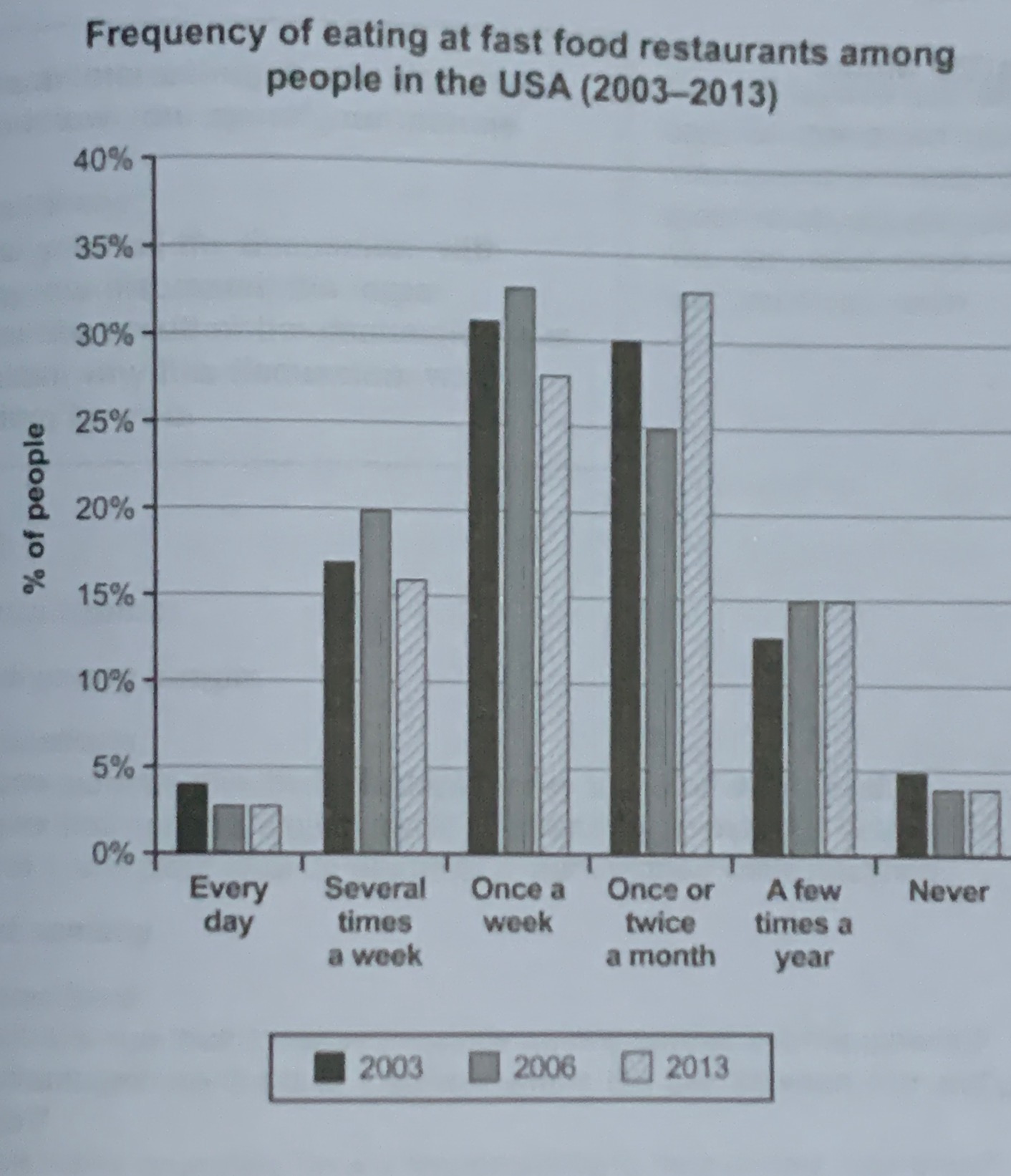
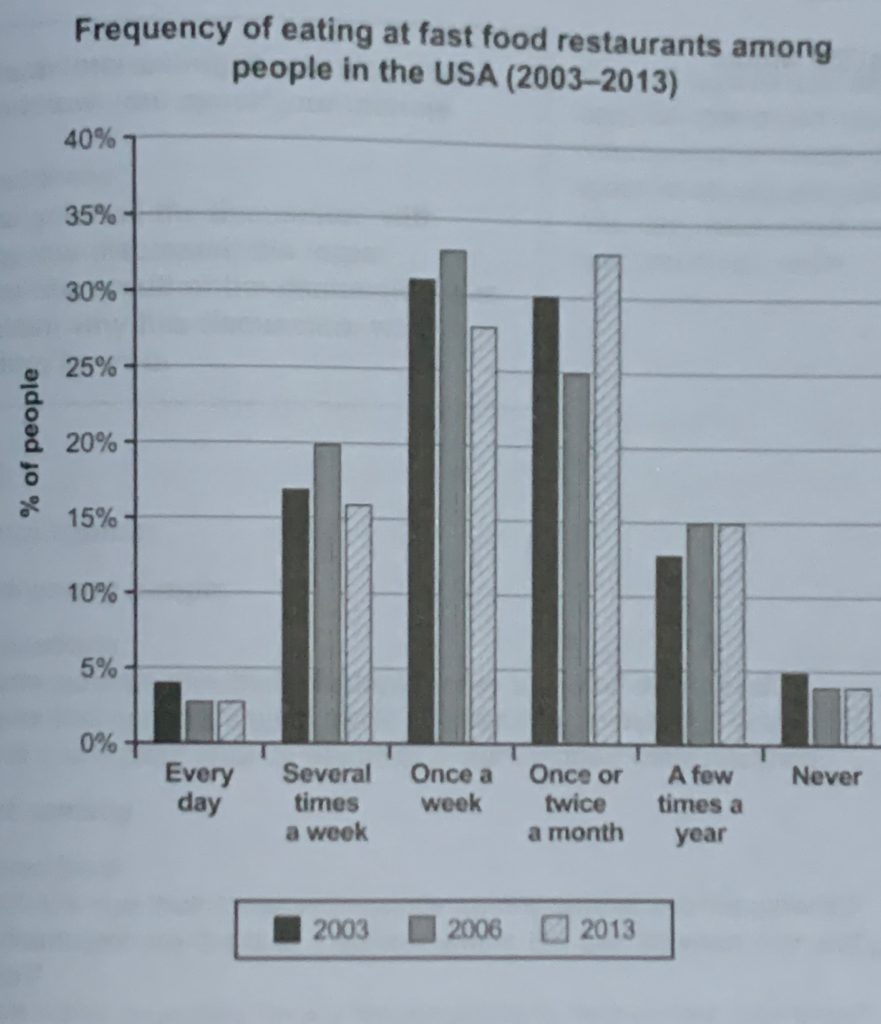
The chart below shows how frequently people in the USA ate in fast food restaurants between 2003 and 2013.

Summarise the information by selecting and reporting the main features, and make comparisons where relevant.


Write at least 150 words.

SAMPLE ANSWER

Writing Task 1 – Bar Graph

The given chart visualizes how often the US citizens be at the fast food restaurants in the year 2003, 2006 and 2013.

From 2003 to 2006, the percentage of people who have never eaten at a fast food restaurant has dropped by 1%, but on the other hand during the same period the number of customers who eat fast food everyday has fallen to about 3% of the population. Since 2006, no other changes have occurred in these section of the chart.

The major changes can be seen in the groups, who prefer to eat in a fast food restaurants on a weekly basis and in the groups in which people visit the fast food restaurants once or twice a month or once a few months. While in 2006 most of the United States citizens ate at such facilities at least once a week, in 2013 most of the population did so only once or twice a month. It’s clear that the fast food restaurants were most popular in 2006 and least popular in 2013. However, the number of people who eat in such restaurants only a few times every year did not change.

As a whole, with the exception of people who rarely or never eat fast food and in addition, the small portion of the population who eat every day, the highest of going to fast food restaurants was reached in 2006 in contrast with 2013 when most of the population spent time in them only once or twice a month.

(235 words).


SAMPLE ANSWER 2

The diagram pictures how frequently the US residents be at the drive-through joints in the year 2003, 2006 and 2013.

From 2003 to 2006, the level of individuals who have never eaten at a drive-through eatery has fallen by 1%, however then again during a similar period the quantity of customers who eat cheap food ordinary has tumbled to about 3% of the populace. Since 2006, no different changes have happened in these fragments of the graph.

The significant changes can be found in the gatherings, who eat in a drive-thru eateries on a week by week premise and in the gatherings wherein individuals visit the drive-through joints on more than one occasion per month or once a couple of months. While in 2006 the greater part of the US residents ate at such offices in any event once per week, in 2013 the vast majority of the populace did so just a single time or two times every month. Obviously the drive-through eateries were generally well known in 2006 and least famous in 2013. In any case, the quantity of individuals who eat in such cafés just a couple of times each year didn’t change.

All in all, except for individuals who once in a while or never eat cheap food and also, the little piece of the populace who eat each day, the pinnacle of going to drive-through joints was reached in 2006 conversely with 2013 when the majority of the populace invested energy in them just a single time or two times per month.

(230 Words)

This is an answer to achieve a BAND 6.5 score. Here is the examiner’s comment:

The competitor has given an away from and a review of the key phases of the procedure. Each stage is distinguished and depicted. There is an unmistakable in general movement, which each stage being motioned by proper markers. These markers are sufficient, yet a higher score may be accomplished by changing their situation in each sentence, as opposed to continually setting them toward the start. The scope of jargon is sufficient for the assignment and there are endeavors to be utilized more assortment. There is a blend of straightforward and complex sentence structures, including exact utilization of uninvolved structures. There are a few mistakes, however in any case the degree of exactness is acceptable. A similar degree of precision, over a more extensive scope of sentence structures, would build the score on Grammatical Range and Accuracy.


SAMPLE ANSWER 3

The outline pictures how as often as possible the US occupants be at the drive-through joints in the year 2003, 2006 and 2013.

From 2003 to 2006, the degree of people who have never eaten at a drive-through restaurant has fallen by 1%, anyway on the other hand during a comparative period the amount of clients who eat modest food customary has tumbled to about 3% of the masses. Since 2006, the same changes have occurred in these pieces of the diagram.

The huge changes can be found in the get-togethers, who eat in a drive-through diners on seven days by week premise and in the social events wherein people visit the drive-through joints time and again every month or once a few months. While in 2006 most of the US occupants ate at such workplaces in any occasion once every week, in 2013 by far most of the people did so only a solitary time or multiple times each month. Clearly the drive-through diners were commonly notable in 2006 and least well known in 2013. Regardless, the amount of people who eat in such bistros only a few times every year didn’t change.

All things considered, aside from people who on occasion or never eat modest food and furthermore, the little bit of the masses who eat every day, the zenith of going to pass through joints was reached in 2006 then again with 2013 when most of the masses put vitality in them only a solitary time or two times each month.


SAMPLE ANSWER 4

The layout pictures how as frequently as conceivable the US inhabitants be at the drive-through joints in the year 2003, 2006 and 2013.

From 2003 to 2006, the level of individuals who have never eaten at a drive-through café has fallen by 1%, at any rate then again during a relative period the measure of customers who eat humble food standard has tumbled to about 3% of the majority. Since 2006, similar changes have happened in these bits of the graph.

The immense changes can be found in the parties, who eat in a drive-through coffee shops on seven days by week premise and in the get-togethers wherein individuals visit the drive-through joints consistently or once a couple of months. While in 2006 the greater part of the US tenants ate at such work environments in any event once consistently, in 2013 by a long shot the majority of the individuals did so just a singular time or on different occasions every month. Plainly the drive-through burger joints were normally eminent in 2006 and least notable in 2013. Notwithstanding, the measure of individuals who eat in such bistros just a couple of times each year didn’t change.

Taking everything into account, beside individuals who once in a while or never eat unassuming food and moreover, the smidgen of the majority who eat each day, the apex of going to go through joints was reached in 2006 on the other hand with 2013 when the majority of the majority put imperativeness in them just a single time or multiple times every month.

Like and Subscribe our Youtube Channel Way To Crack IELTS.