
IELTS GENERAL WRITING TASK 1 – COMPLETE GUIDE

IELTS GENERAL WRITING TASK 1 – COMPLETE GUIDE
Get our Latest Post/Blogs here.
Download IELTS Practice Material for Free.
IELTS General Writing TASK 1 : Complete Guide : TYPES OF LETTERS
What type of letter should I write?
In IELTS GENERAL WRITING TASK 1 – COMPLETE GUIDE, there are three types of letters:
- Formal letter
- Semi-formal letter
- Informal letter
In IELTS General WRITING TASK 1 complete guide, here you will learn how to identify the genre of letter you are asked to write and what are beginnings-endings and tone of letter you should use. You’ll also see sample letters of each type.
IELTS GENERAL TASK 1
Before you begin writing, it is important that you fully understand which type of letter you must write.

Main Differences
IELTS GENERAL WRITING TASK 1 – COMPLETE GUIDE
To outline the main differences between the formal, semi-formal, and informal letter and also help you decide which letter type you should use, see the following table:
| Formal | Semi- Formal | Informal |
| You do not know the person’s name you are writing to (e.g. bank, foreign university) | You know the person, but he or she is not a close friend to you (e.g. teacher, landlord, manager, colleague) | You know him or her personally (e.g. friends, family) |
| Greetings: Dear Sir or Madam | Greetings: Dear Mr Smith, Dear Mrs Smith | Greetings: Dear Mom, Dear Peter, My dear friend |
| Letter endings: Yours faithfully | Letter endings: Yours sincerely / Sincerely yours (not Yours truly) | Endings: With best wishes, / See you soon, / Take care, / All the best, |
| Your name: Mr. David Brown (always with a family name, but the title is optional) | Your name: David Brown (always with a family name, but the title is optional) | Your name: David (no title and no family name) |
| The tone of the letter is formal. Be polite. You can’t use contractions (use ‘I am writing’ not ‘I’m writing’). | The tone of the letter is polite. Mostly formal language, however use a couple of phrases that are on the informal side. | The tone of the letter is informal. You can use contractions (I’m writing), but not abbreviations (see ya) and acronyms (OMG). Do not use academic language. |
Start the letter appropriately.
IELTS GENERAL WRITING TASK 1 – COMPLETE GUIDE
Open a formal and semi-formal letter with a formal sentence and paragraph. Get down to business and say why you are writing. Don’t try to be friendly, as you do not know the person you are writing to.
Formal:
Dear Sir/Madam,
I am writing to inquire about…
I am writing in connection with…
Semi-formal
Dear Mr Carter,
I am writing to inform you that…
I am writing to…
Open an informal letter with a general, friendly paragraph. Acknowledge your friendship first, before explaining the reason for your letter. In fact, the first paragraph could include just friendly small talk, unrelated to the reason for your writing.
Spell commonly used words correctly. Learn and practice the correct spelling of words you are likely to use on the exam. Examples are: “sincerely”, “faithfully”, “in connection with”, “apologize”, and so on. This is an easy way to boost your score.
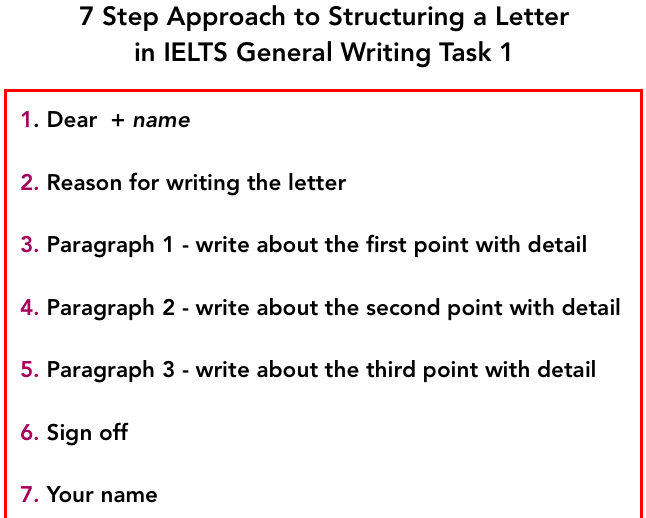
Divide your letter into paragraphs.
Usually you need four paragraphs:
- Introduction
- Problem / Situation
- Solution / Action
- Conclusion

Important point need to take care of, while writing IELTS General Writing Task 1 :
IELTS GENERAL WRITING TASK 1 – COMPLETE GUIDE
- Indenting: Do NOT leave a line space between paragraphs. Start writing a little to the right of the left margin.
- Use clear handwriting. Make sure your writing is neat and legible, so your words can be read easily and do not appear to have spelling mistakes. Get feedback from a teacher on your handwriting. Pay special attention to how you form and connect letters such as a, e, i, u, n, r, and w.
- Write at least 150 words. Practice writing letters till you know what 150 words feels like and looks like. You will lose marks if you write less. You will not lose marks if you write more.
- Include all three bulleted points. If you exclude even one of the points given to you in the question prompt, you will get a lower grade. Answer all the points.
Vocabulary for IELTS General Writing Task 1:
IELTS GENERAL WRITINGTASK 1 – COMPLETE GUIDE
Apologizing
Please accept my sincere apologies for…
I am very sorry about…
Sorry for…
Asking for help
I’d be grateful if you could…
I would appreciate it if you could…
Could you please…
Asking for information
I am writing to enquire about…
I am writing to find out about…
I would like to know about…
Closing
I look forward to hearing from you,
I look forward to seeing you,
I look forward to meeting you,
Complaining
I am writing to express my dissatisfaction with…
I am writing to express my annoyance with…
I’m not happy with…
Expressing satisfaction
I was delighted to learn that…
I was thrilled to hear that…
I was very glad to hear that…
Expressing concern
I am writing to express my concern about…
I was very sorry to learn that…
I was really sorry to hear that…
Giving bad news
I regret to advise you that…
I regret to inform you that…
I am sorry to tell you that…
Giving good news
I am pleased to advise you that…
I am delighted to inform you that…
I am happy to tell you that…
Giving reasons
This is due to…
This is a result of
This is because…
Making suggestions
Perhaps it would be useful to…
Perhaps it would be possible to…
It might be helpful to…
Thanking
I am extremely grateful for…
I really appreciate…
Thank you for…
Thanks.
Thank you.
Thank you very much.
Thank you kindly.
I can’t thank you enough.
No words can express my gratitude.
I am extremely grateful for…
I very much appreciate your ______ing
For more detailed explanation you can subscribe to our youtube channel Way To Crack IELTS.
For practice, you can download IELTS General book in pdf form for practice.
For reference you can also check the sample answer of the IELTS General writing Task 1.