Tag Archives: ielts

Which English Test Should I pass for Study Abroad?

Which English Test Should I pass for Study Abroad?

Which English Test Should I pass for Study Abroad?

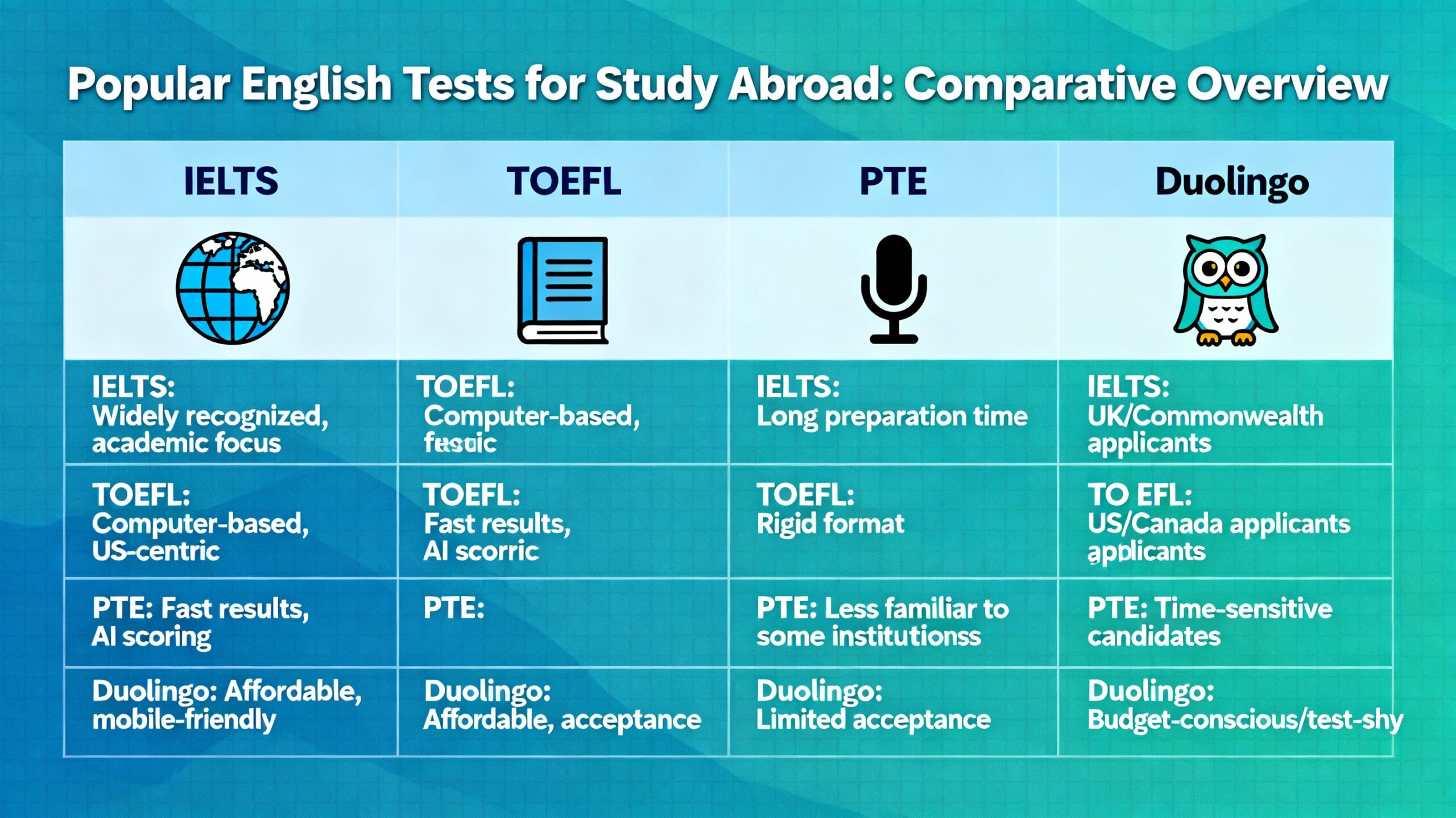
For study abroad, the most commonly accepted English proficiency tests are IELTS, TOEFL, and PTE. The choice depends on your destination country and university requirements:
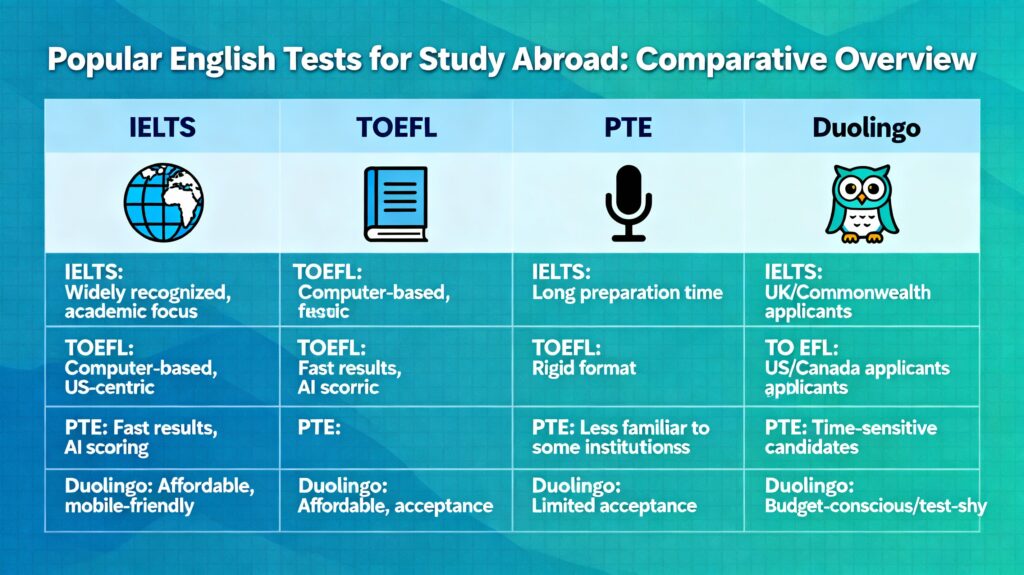
  • IELTS (International English Language Testing System) is the most popular and widely accepted globally by over 12,000 institutions. It tests reading, writing, speaking, and listening skills and is accepted in the UK, Australia, Canada, the US, and many more countries.​

  • TOEFL (Test of English as a Foreign Language) is primarily preferred by US universities. It is an internet-based test that also assesses the four language skills and is recognized globally.​

  • PTE (Pearson Test of English) is computer-based with AI scoring, accepted by universities in the UK, Australia, New Zealand, and Canada. It offers fast results and secure testing.​

  • Duolingo English Test is a newer, online test taken from home, accepted by over 4000 institutions for convenience and affordability but is less widely recognized than IELTS or TOEFL.​

Get our Latest Post/Blogs here

You should check the exact English test requirements of your target university and country. IELTS tends to be the most preferred overall, especially in Commonwealth countries, whereas TOEFL is more common in the US.​

In summary, the best English test to pass for study abroad depends on your chosen destination and university, with IELTS, TOEFL, and PTE being the top options to consider.

Looking to crack the IELTS exam with confidence? At www.waytocrackielts, we provide all the tools you need to succeed. From in-depth study guides to realistic practice tests and expert tips, our mission is to help you achieve your desired band score.

Why Choose www.waytocrackielts?

  • Comprehensive coverage of Listening, Reading, Writing, and Speaking modules.

  • Proven strategies to maximize your score.

  • Regular practice tests modeled on the latest IELTS formats.

  • Personalized feedback to improve your writing and speaking skills.

  • Flexible learning with online resources accessible anytime, anywhere.

Get Started Today!

Join thousands of students who have achieved their dreams with www.waytocrackielts. Whether you’re a beginner or looking to improve your score, we’re here to guide you every step of the way.

Visit www.waytocrackielts and start your journey to IELTS success now!

IELTS (International English Language Testing System), TOEFL (Test of English as a Foreign Language), PTE (Pearson Test of English), and the Duolingo English Test are the four major English language exams that students commonly choose when planning to study abroad. Each test has its own structure, format, and recognition level, so the “best” option depends largely on your target country, university, and personal preferences as a test-taker. Understanding the differences will help you select the exam that maximizes your chances of admission while matching your strengths and comfort with technology, timing, and question types.

IELTS is the most popular and widely accepted English proficiency test globally, recognized by more than 12,000 institutions worldwide, including universities, colleges, immigration authorities, and professional bodies. It assesses all four language skills: Listening, Reading, Writing, and Speaking through a structured test that can be taken on paper or computer, with the Speaking test conducted face-to-face with an examiner. IELTS is accepted in major destinations such as the UK, Australia, Canada, New Zealand, and the US, making it one of the safest choices if you are applying to multiple countries or are still exploring your options. Due to its high recognition and long-standing reputation, many students and institutions consider IELTS a benchmark for academic and migration-related English proficiency.

TOEFL, on the other hand, has traditionally been the preferred test for universities in the United States, although it is now accepted in many other countries as well. The TOEFL iBT (internet-based test) is fully computer-delivered, with integrated tasks that often combine listening, reading, and speaking skills in academic contexts. Like IELTS, it evaluates reading, writing, speaking, and listening, but with a more lecture- and campus-focused style that mirrors typical North American university settings. If your primary goal is admission to US universities, especially at the undergraduate or graduate level, TOEFL can be a strong option, though many American institutions now accept both IELTS and TOEFL interchangeably.

PTE Academic is a fully computer-based test that uses advanced AI scoring, making it appealing to students who prefer a fast, technology-driven exam experience. All sections—Speaking, Writing, Reading, and Listening—are taken on a computer, with responses evaluated by automated scoring systems designed to ensure consistency and reduce human bias. PTE is widely accepted by universities in the UK, Australia, New Zealand, Canada, and an increasing number of institutions in other countries. One of its biggest advantages is quick results, often available within a few days, which is particularly useful if you are close to an application deadline or visa cut-off. Many students also appreciate the secure testing environment and frequent test dates.

The Duolingo English Test is the newest among these options and stands out for its convenience and affordability. It is an online exam that you can take from home using a computer with a camera and microphone, as long as you follow strict identity and environment rules. Duolingo assesses reading, writing, listening, and speaking through adaptive questioning and a short video interview section. It is now accepted by over 4,000 institutions worldwide, including a growing number of universities in the US, Canada, and Europe. However, its recognition is still not as universal as IELTS or TOEFL, so it is important to check each university’s official requirements before relying on Duolingo alone. For students on a tight budget or those facing test-center limitations, Duolingo can be a flexible and cost-effective solution.

When deciding which test is best for study abroad, always start by checking the official English test requirements for your target universities and destination countries. Some universities list multiple accepted exams with minimum score equivalents, while others may strongly recommend or only accept one specific test. In many cases, IELTS is the most preferred overall, particularly in Commonwealth countries such as the UK, Australia, and Canada, whereas TOEFL has historically been more common in the US. PTE is rapidly gaining ground in countries like Australia and the UK, and Duolingo is expanding its presence among institutions that value remote, secure, and affordable testing options.

No matter which exam you choose, proper preparation is crucial for getting the score you need. This is where www.waytocrackielts.com can play a major role in your success, especially if IELTS is your primary focus. At www.waytocrackielts.com, you get access to in-depth study guides that clearly explain each part of the test, realistic practice tests that mirror the latest IELTS exam format, and expert tips that help you avoid common mistakes. The platform is designed to take you from understanding the basics of the exam to mastering advanced strategies that can significantly boost your band score.

There are several reasons to choose www.waytocrackielts.com as your preparation partner. The site offers comprehensive coverage of all four IELTS modules: Listening, Reading, Writing, and Speaking, so you can build balanced skills rather than focusing on just one area. You can learn proven strategies to maximize your score, such as time management techniques in Reading, high-scoring structures for Writing Task 1 and Task 2, and fluency-building methods for Speaking. Regular practice tests modeled on the latest IELTS patterns ensure that you become familiar with question types, timing, and pressure conditions similar to the real exam. In addition, personalized feedback helps you identify your weaknesses, particularly in Writing and Speaking, where expert comments on grammar, coherence, pronunciation, and vocabulary can quickly raise your band level.

Another key advantage of www.waytocrackielts.com is flexibility. All resources are available online, so you can study anytime, anywhere, fitting your preparation around school, work, or other commitments. Whether you are a complete beginner learning about IELTS for the first time or a repeat test-taker aiming to move from Band 6.5 to Band 7.5 or higher, the content is structured to support all stages of your journey. You can also explore related posts and blogs on PTE, immigration news, and study-abroad tips through the latest articles linked on the site, helping you stay updated on changing requirements and opportunities.

If you are serious about cracking the IELTS exam with confidence, now is the right time to start. Join thousands of students who have achieved their study-abroad dreams with support from www.waytocrackielts.com. With comprehensive learning materials, realistic practice, targeted strategies, and expert guidance, you get everything needed to reach your desired band score. Visit www.waytocrackielts.com today and begin your journey towards IELTS success and a brighter future overseas.

HOW TO WRITE AN OPINION ESSAY: AN ULTIMATE GUIDE

OUR YOUTUBE CHANNEL

FOLLOW OUR INSTAGRAM PAGE

LIKE OUR FACEBOOK PAGE

JOIN OUR TELEGRAM GROUP

OUR WHATSAPP GROUP

Compare IELTS and PTE – Which is better for Study Abroad?

Compare IELTS and PTE

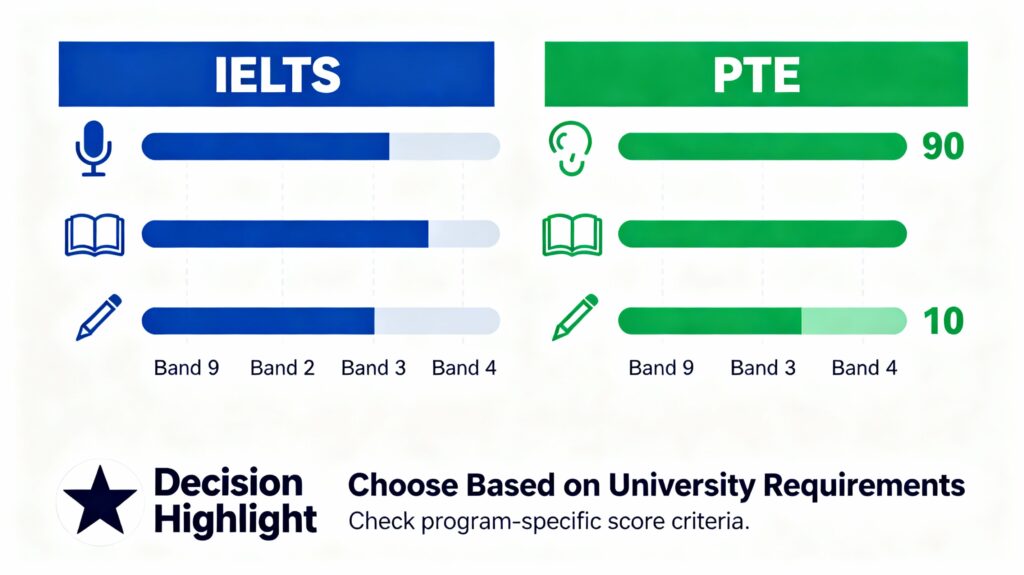
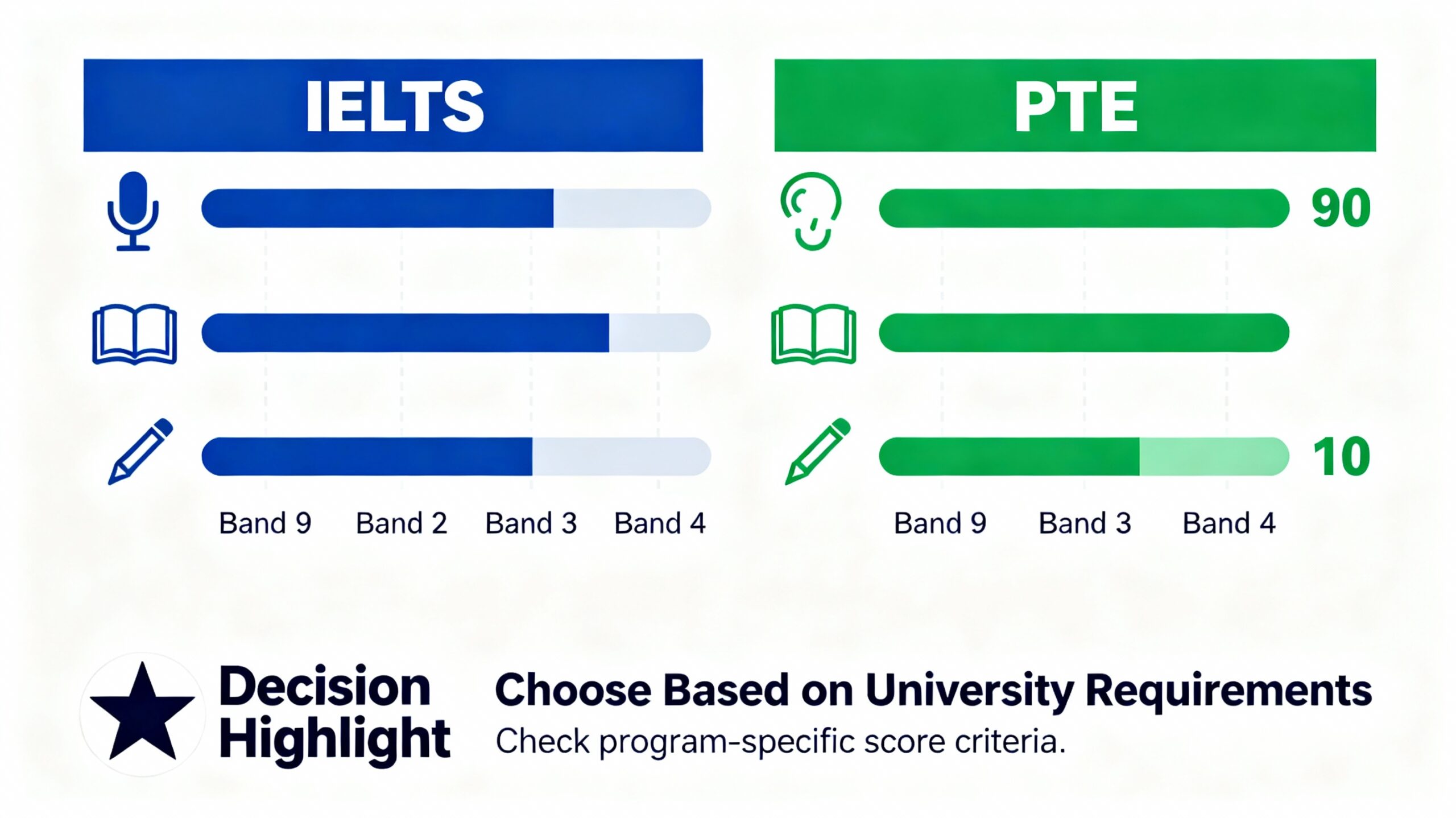
IELTS and PTE are both widely accepted English proficiency tests for study abroad, but IELTS edges out due to broader global university acceptance (over 10,000 institutions vs. PTE’s 3,000+), while PTE suits tech-savvy test-takers with its faster results and computer format.​

For studying abroad, both IELTS and PTE are widely accepted English proficiency tests, but there are important differences to consider:

Get our Latest Post/Blogs here.

Acceptance:

  • IELTS is accepted by over 11,500 organizations worldwide, including universities, immigration departments, and employers. It has broader global acceptance, especially in countries like the UK, Australia, Canada, New Zealand, and the USA.

  • PTE is accepted by over 3,300 organizations globally and is gaining acceptance rapidly, including many universities in the USA, UK, Australia, and Canada.​

Test Format:

  • IELTS offers both paper-based and computer-based testing options, with the speaking test conducted face-to-face with an examiner.

  • PTE is fully computer-based, including the speaking section, which involves speaking into a microphone with AI marking.​

Scoring and Results:

  • IELTS scores range from band 1 to 9, with most universities requiring a band score between 6.0 to 7.5 for admissions.

  • PTE scores range from 10 to 90 points; equivalently, a band 7.0 in IELTS roughly corresponds to a PTE score of around 65-67.

  • PTE results are available faster (typically within 48 hours) compared to IELTS (usually 7-13 days).​

Ease and Preference:

  • IELTS is preferred by those comfortable with traditional formats and human interaction during the speaking test.

  • PTE suits those who prefer computer-based tests, quick results, and integrated skills tasks.

If your target universities accept both, choose based on your personal comfort with test format, result timelines, and university score requirements. IELTS has wider acceptance, especially for immigration, whereas PTE offers convenience and speed.​

In brief, for study abroad:

  • IELTS: Best for wider global acceptance and option of test modes.

  • PTE: Best for quicker results and fully computer-based testing.

Which is better for Study Abroad

IELTS and PTE both assess English skills in listening, reading, writing, and speaking, but they differ in format, scoring, and ease depending on test-taker preferences. Generally, many find PTE easier because it is fully computer-based, uses AI for scoring, offers faster results (typically within 1-2 days), and has integrated skills tasks that require quick responses. However, PTE requires comfort with computers and good typing skills.

IELTS offers both paper-based and computer-based options, with face-to-face speaking tests, and is considered more traditional with human examiners grading writing and speaking sections. It may be easier for those who prefer structured answers and paper navigation, and it is more widely recognized globally by universities, immigration departments, and employers.

In summary:

  • PTE is easier for those comfortable with computers, prefers fast results, and AI-based marking.

  • IELTS is better for those who favor traditional formats, human interaction, and broader global acceptance.

  • Neither exam is inherently easier universally; it depends on your strengths and preference.

Key Differences

Feature IELTS Academic PTE Academic
Format Paper/computer; face-to-face speaking Fully computer-based; mic speaking
Duration 2 hours 45 minutes 2 hours
Scoring Bands 0-9 Points 10-90 (IELTS 6.0 ≈ PTE 50-58)
Results Time 3-13 days Within 48 hours
Acceptance 10,000+ unis; all major countries 3,000+ unis; growing in UK/Australia
Speaking Human examiner AI scoring

IELTS vs PTE for study abroad: Compare formats, scores, acceptance (10K+ unis for IELTS), and results speed. Discover which test suits your university goals in 2025!

Pro Tip: Bookmark this this post for future updates and news related to IELTS

Download IELTS Practice Material for Free


HOW TO WRITE AN OPINION ESSAY: AN ULTIMATE GUIDE

OUR YOUTUBE CHANNEL

FOLLOW OUR INSTAGRAM PAGE

LIKE OUR FACEBOOK PAGE

JOIN OUR TELEGRAM GROUP

OUR WHATSAPP GROUP

What is the difference between IELTS Academic and General Training?

Get our Latest Post/Blogs here.

IELTS Academic and General Training

The key difference between IELTS Academic and General Training lies in their purpose and content:

  • The key difference between IELTS Academic and General Training lies in their purpose and content, tailored to distinct goals for English language proficiency.

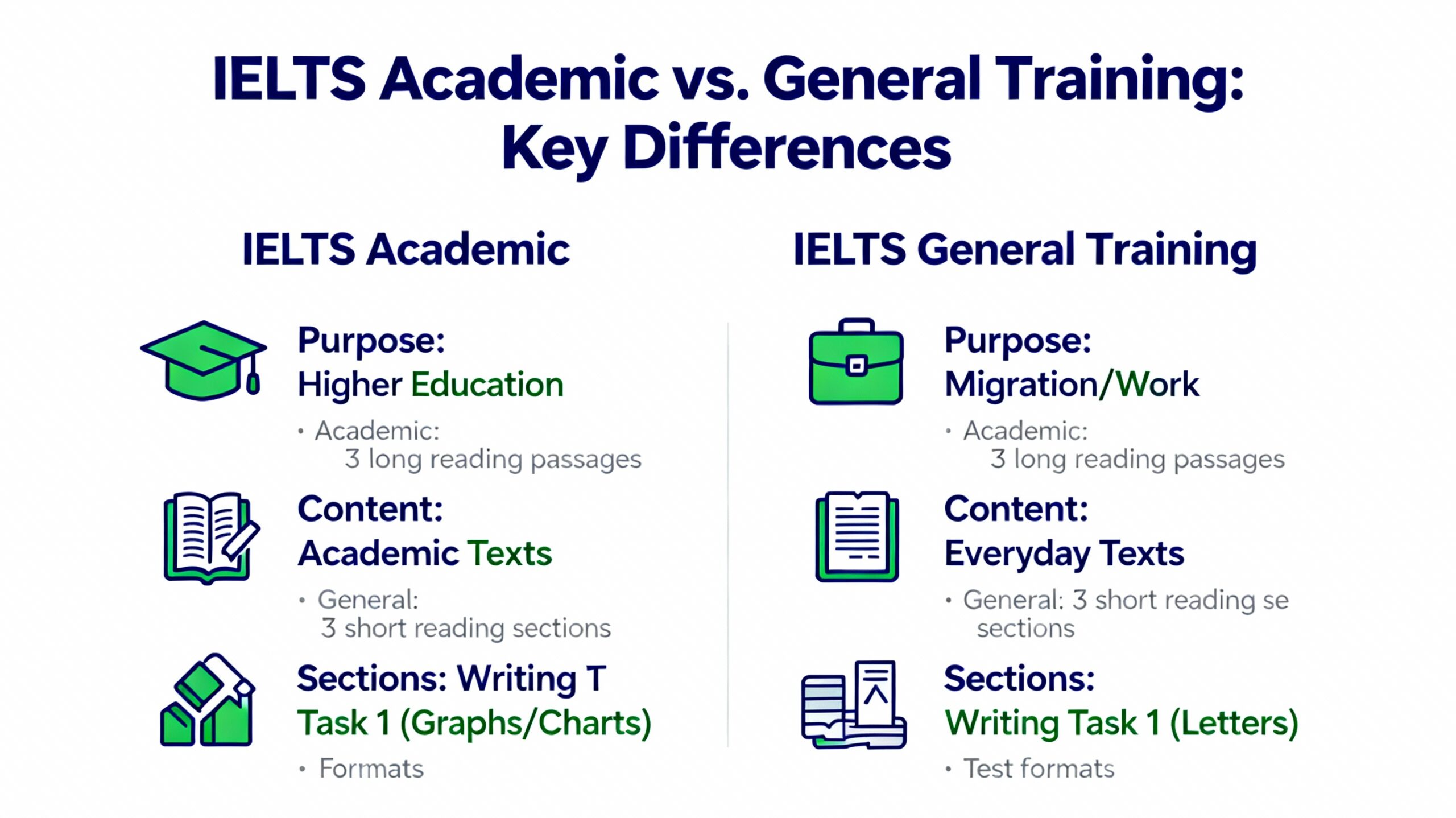
    IELTS Academic suits candidates pursuing higher education or professional registration in English-speaking countries. It rigorously tests academic English skills essential for university lectures, research papers, and scholarly discussions. The Reading section features three lengthy passages drawn from books, journals, newspapers, and magazines—often dense with complex vocabulary, arguments, and inferences that mirror real academic reading demands. Writing Task 1 challenges test-takers to analyze and summarize visual data like line graphs, bar charts, pie charts, tables, or diagrams, requiring precise description of trends, comparisons, and key features in at least 150 words. Task 2 demands a 250-word essay responding to a viewpoint, argument, or problem on topics such as education, technology, environment, or society, emphasizing critical thinking and formal academic language. This version is typically more demanding due to its focus on analytical and abstract content, preparing users for rigorous study environments.

    In contrast, IELTS General Training targets those planning migration, employment, or training in English-speaking nations, emphasizing practical, everyday language skills. The Reading section comprises 2-3 short sections with 4-6 texts from real-world sources like advertisements, company handbooks, guides, notices, and newspapers, testing comprehension of straightforward information. Writing Task 1 requires composing a 150-word letter—formal, semi-formal, or informal—handling scenarios like job applications, complaints, requests for information, or accommodation issues. Task 2 mirrors Academic’s essay format but on general interest topics like family, work-life balance, travel, or consumer issues, allowing more relatable responses. Overall, General Training feels more accessible, prioritizing functional communication over scholarly depth.

    Both formats share identical Listening and Speaking modules. Listening involves 40 questions across four recordings—conversations and monologues with diverse accents—testing note-taking and detail capture over 30 minutes plus 10 for transfer. Speaking is a 11-14 minute face-to-face interview in three parts: personal questions, a 1-2 minute cue card monologue, and abstract discussion, assessing fluency, pronunciation, grammar, and vocabulary uniformly. Test duration (2 hours 45 minutes), band scores (0-9 per section, overall average), and validity (2 years) remain consistent.

    Feature IELTS Academic IELTS General Training
    Purpose Study, professional registration Migration, work, training
    Reading 3 long academic texts 4-6 shorter everyday texts
    Writing Task 1 Data description (graphs/charts) Letter writing (real-life scenarios)
    Writing Task 2 Essay on academic topics Essay on general topics
    Difficulty More challenging, academic focus Easier, practical focus
    Listening & Speaking Same format Same format


    Beyond content, preparation strategies differ. Academic test-takers should practice academic vocabulary (e.g., “hypothesis,” “mitigate”) and data interpretation via resources like Cambridge IELTS books or official practice tests. General Training users benefit from role-playing letters and skimming daily notices. Regardless of version, consistent practice—aiming for 2-3 hours daily—mock tests, error analysis, and feedback from tutors elevate scores. Time management is crucial: allocate wisely in Reading (20 minutes per passage) and Writing (20 for Task 1, 40 for Task 2).

    Choose Academic for undergraduate/graduate programs or bodies like nursing councils; opt for General Training for skilled migration (e.g., Australia’s points system) or non-degree work visas. Verify requirements via university websites or immigration portals, as some accept both. With targeted prep, band 7+ is achievable in either—start early for optimal results.

  • Pro Tip: Bookmark this this post for future updates and news related to IELTS Academic and IELTS General.

HOW TO WRITE AN OPINION ESSAY: AN ULTIMATE GUIDE

OUR YOUTUBE CHANNEL

FOLLOW OUR INSTAGRAM PAGE

LIKE OUR FACEBOOK PAGE

JOIN OUR TELEGRAM GROUP

OUR WHATSAPP GROUP

How to score better in IELTS Academic Exam – Tips

IELTS Academic Exam

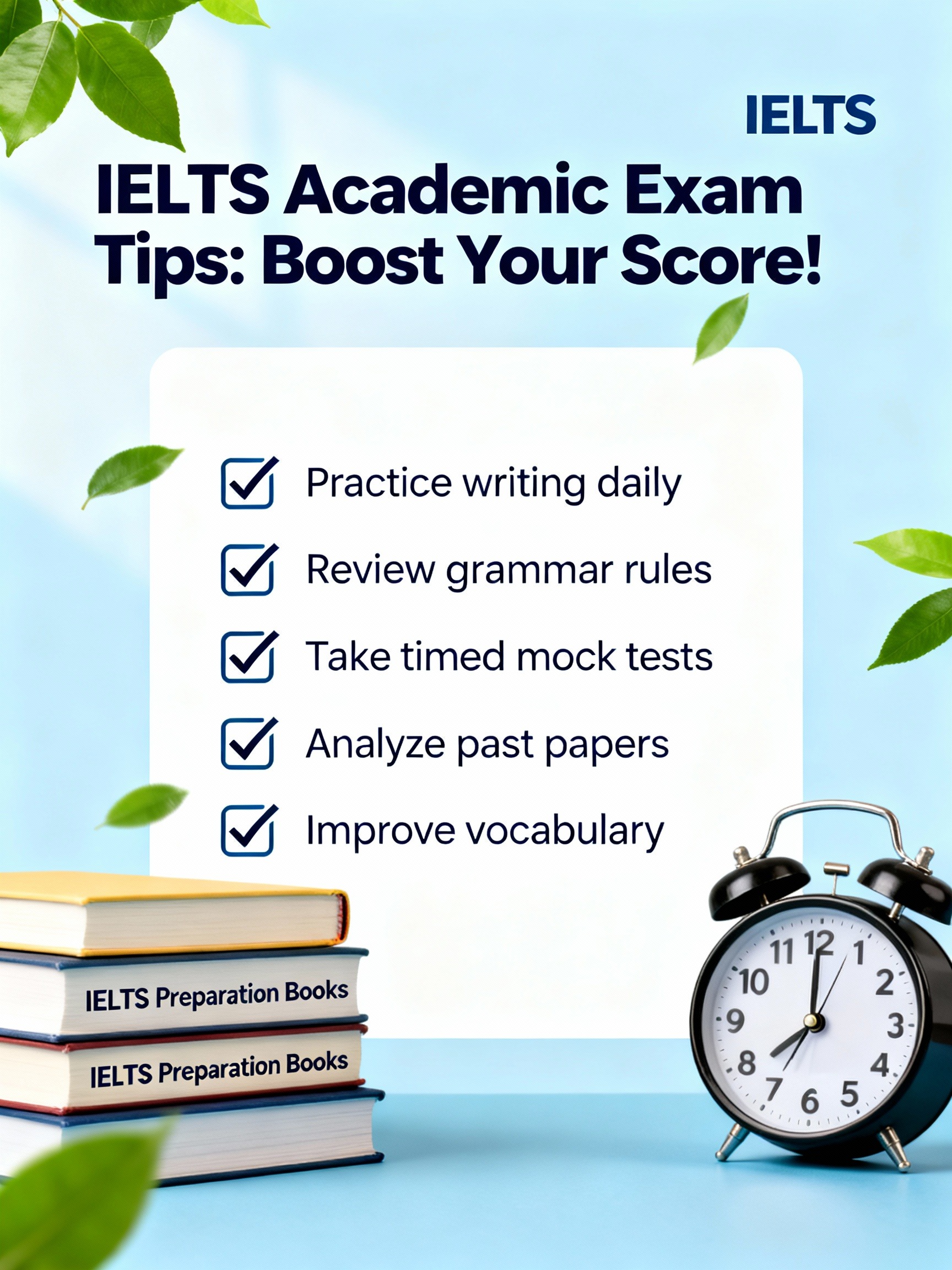
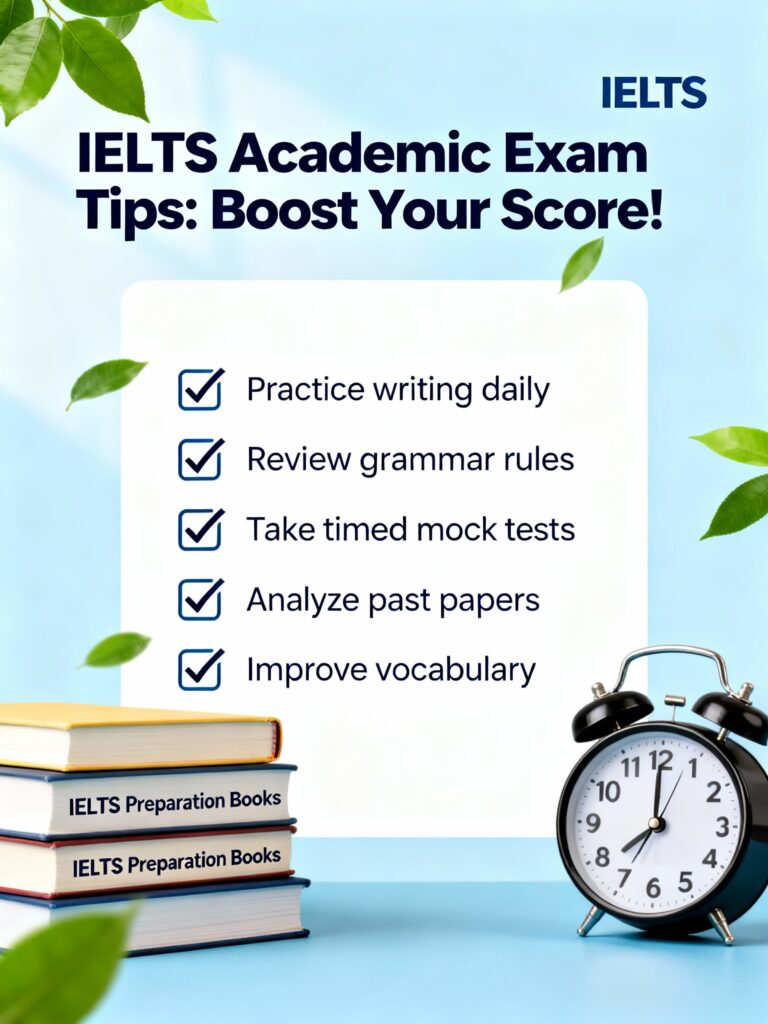
To score better in the IELTS Academic exam, focus on targeted preparation for each section: Listening, Reading, Writing, and Speaking, using proven strategies and consistent practice. 

Understanding IELTS Academic Sections

Each section of the IELTS Academic test evaluates specific language skills:

  • Listening: Assesses understanding of spoken English in a variety of accents and situations.

  • Reading: Tests ability to interpret academic texts, diagrams, and extract key details.

  • Writing: Measures ability to describe visual information (Task 1) and construct well-structured arguments or discussions (Task 2).

  • Speaking: Examines fluency, pronunciation, grammar, and coherence in conversational English.


Get our Latest Post/Blogs here.


Effective Preparation Strategies

  • Take multiple full-length IELTS practice tests to familiarize yourself with the test format and timing.

  • Review sample answers and examiner comments to understand what scores higher in writing and speaking.

  • Build vocabulary specifically for academic topics and practice paraphrasing to maximize reading and writing scores along with audio visual methods.

  • Join IELTS preparation courses, either in-person or online, for expert feedback and peer interaction.

Section-Wise Tips

Listening

  • Practice understanding diverse English accents (British, American, Australian).

  • Listen for keywords, instructions, and transitions in audio passages.

  • Take notes rapidly; focus on numbers, names, and dates as these are frequently tested.

Reading

  • Skim passages for main ideas before reading questions.

  • Highlight keywords in questions to locate information quickly.

  • Develop scanning skills to find specific details or answers efficiently.

Writing

  • Plan your essay structure with clear introductions, body paragraphs, and conclusions before you start writing.

  • Address all parts of the question and support arguments with examples and explanations.

  • Practice summarizing graphs, tables, and charts for Task 1 and forming balanced opinions for Task 2.

Speaking

  • Practice speaking English regularly, preferably with native speakers or teachers.

  • Develop answers beyond simple responses; add details and explanations.

  • Record yourself and evaluate fluency, pronunciation, and grammar for improvement.

Additional Resources

  • Use official IELTS study materials and reputable online resources for targeted practice.

  • Set a study schedule and track progress in mock tests.

  • Maintain confidence and keep anxiety in check during test day by following relaxation techniques and thorough revision of all modules.

Score higher in the IELTS Academic exam by mastering the test format, building exam skills for each module, and following a focused practice plan with regular feedback.​

Understand the test and your target

  • Learn band descriptors for each skill (especially Writing and Speaking) so you know what “Band 7/8” actually requires.​

  • Take a timed full-length mock test to identify weak sections and set a realistic band target for each module.​

Listening improvement tips

  • Practice with official IELTS recordings and mixed accents (British, Australian, North American) several times a week.​

  • Train prediction skills: read questions first, underline keywords, and check spelling and word limits carefully in answers.​

Reading improvement tips

  • Develop skimming (main idea) and scanning (specific details) using academic articles and past IELTS passages under 60-minute timing.​

  • Focus on paraphrasing: build a vocabulary notebook of synonyms and practise True/False/Not Given and Matching Headings regularly.​

Writing improvement tips

  • For Task 1 (Academic), learn standard structures for line graphs, bar charts, tables, and processes, describing key trends and making clear comparisons.​

  • For Task 2, plan 3–5 minutes, write clear topic sentences, support each idea with examples, and then check grammar, linking words, and task response at the end.​

Speaking improvement tips

  • Practise daily with common IELTS topics, recording yourself to check fluency, pronunciation, and range of grammar and vocabulary.​

  • Extend answers with reasons and examples, avoid memorised speeches, and simulate full Speaking tests with a partner or tutor when possible.

These methods will improve overall performance and help achieve a better band score in the IELTS Academic exam.


HOW TO WRITE AN OPINION ESSAY: AN ULTIMATE GUIDE

OUR YOUTUBE CHANNEL

FOLLOW OUR INSTAGRAM PAGE

LIKE OUR FACEBOOK PAGE

JOIN OUR TELEGRAM GROUP

OUR WHATSAPP GROUP

How should you interpret your Ielts score

At the end of each Listening and Reading Answer Key you will find a chart which will help you assess whether, on the basis of your Practice Test results, you are ready to take the IELTS test.

Get our Latest Post/Blogs here.

Download IELTS Practice Material for Free.

In Interpreting your score, there are a number of points you should bear in mind. Your performance in the real IELTS test will be reported in two ways: there will be a Band Score from 1 to 9 for each of the components and an Overall Band Score from 1 to 9, which is the average of your scores in the four components. However, institutions considering your application are advised to look at both the overall band scores and the bands for each component in order to determine whether you have the language skills needed for a particular course of study. For example, if your course involves a lot of reading and writing, but no lectures, listening skills might be less important and a score of 5 in listening might be acceptable if the Overall Band score was 7. However, for a course which has lots of lectures and spoken instructions, a score of 5 in listening might be unacceptable even though the Overall Band Score was 7.

Once you have marked your tests, you should have some idea of whether your listening and reading skills are good enough for you to try the IELTS test. If you did well enough in one component, but not in others, you will have to decide for yourself whether you are ready to take the test.

The Practice Tests have been checked to ensure that they are of approximately the same level of difficulty as the real test IELTS test. The Practice Tests can only give you an idea of your possible future performance and it is ultimately up to you to make decisions based on your score.

Different institutions accept different IELTS score for different types of courses. We have based our recommendations on the average scores which the majority of institutions accept. The institutions to which you are applying may, of course, require a higher or lower score than most other institutions.


Further Information

For more information about IELTS or any other Cambridge English Language Assessment examination, write to:

Cambridge English Language Assessment

1 Hills Road

Cambridge

CB1 2EU

United Kingdom

https://support.cambridgeenglish.org

http://www.ielts.org


Contact  Vision Overseas.

For online Material Contact us on WHATSAPP: 

Vikrant Dhanda :+91- 9996648607


HOW TO WRITE AN OPINION ESSAY: AN ULTIMATE GUIDE

OUR YOUTUBE CHANNEL

FOLLOW OUR INSTAGRAM PAGE

LIKE OUR FACEBOOK PAGE

JOIN OUR TELEGRAM GROUP

OUR WHATSAPP GROUP