way to crack ielts

IELTS UPGRADE READING PRACTICE TEST 8


Like and Subscribe our Youtube Channel Way To Crack IELTS.


Join our Whatsapp Group for regular updates.

Join us on Telegram for One-to-one Speaking and Speaking interviews on Video call with experts and students for practice.


IELTS UPGRADE READING PRACTICE TEST 8

READING PASSAGE 1

You should spend about 20 minutes on Questions 1 – 14, which are based on Reading Passage 1 below.

A

The climate of the Earth is always changing. In the past it has altered as a result of nat­ural causes. Nowadays, however, the term ‘climate change’ is generally used when referring to changes in our climate which have been identified since the early part of the twentieth century. The changes we’ve seen over recent years and those which are predicted to occur over the next 100 years are thought by many to be largely a result of human behaviour rather than due to natural changes in the atmosphere. And this is what is so significant about current climatic trends; never before has man played such a significant role in determining long-term weather patterns – we are entering the unknown and there is no precedent for what might happen next.

B

The greenhouse _effect is very important when we talk about climate change as it relates to the gases which keep the Earth warm. Although the greenhouse effect is a naturally occurring phenomenon, it is believed that the effect could be intensified by human activity and the emission of gases into the atmosphere. It is the extra green­ house gases which humans have released which are thought to pose the strongest threat. Certain researchers, such as Dr Michael Crawley, argue: ‘even though this nat­ural phenomenon does exist it is without a doubt human activity that has worsened its effect; this is evident when comparing data regarding the earth’s temperature in the last one hundred years with the one hundred years prior to that.’ Some scientists, however, dispute this as Dr Ray Ellis suggests: ‘human activity may be contributing a small amount to climate change but this increase in temperature is an unavoidable fact based on the research data we have compiled.

C

Scientists around the globe are look­ ing at all the evidence surrounding climate change and using advanced technology have come up with pre­ dictions for our future environment and weather. The next stage of that work, which is just as important, is looking at the knock-on effects of potential changes. For example, are we likely to see an increase in precip­itation and sea levels? Does this mean there will be an increase in flooding and what can we do to protect ourselves from that? How will our health be affected by climate change, how will agricultural practices change and how will wildlife cope? What will the effects on coral be? Professor Max Leonard has suggested, ‘while it may be controversial some would argue that climate change could bring with it positive effects as well as negative ones’.

D

There are many institutions around the world whose sole priority is to take action against these environmental problems. Green Peace is the organisation that is probably the most well-known. It is an international organisation that campaigns in favour of researching and promoting solutions to climate change, exposes the companies and governments that are blocking action, lobbies to change national and international policy, and bears witness to the impacts of unnecessary destruction and detrimental human activity.

E

The problem of climate change is without a doubt something that this generation and the generations  to come need to deal with. Fortunately, the·  use of renewable energy is becoming increasingly popular, which means that less energy is consumed as renewable energy is generated from natural reso urces – such a sunlight, wind, rain, tides, and geot­ hermal heat-which can be naturally replenished. Another way to help the environment, in terms of climate change, is by travelling light. Walking or riding a bike instead of driv­ ing a car uses fewer fossil fuels which release carbon dioxide into the atmosphere. In addi­ tion, using products that are made from recycled paper, glass, metal and plastic reduces carbon emissions because they use less energy to manufacture than products made from C011Jpletely new materials. Recycling paper also saves trees and lets them continue to limit climate change naturally as they remain in the forest, where they remove carbon from the atmosphere. Professor Mark Halton, who has completed various studies in this field, has stated: ‘with all this information and the possible action that we can take, it isn’t too late to save our planet from over-heating and the even worse side-effects of our own activity’.

Questions 1 – 5

Reading Passage 1 has 5 paragraphs, A E. Which paragraph contains the following information? Write the correct letter A E in the boxes below.

NB You may use any letter more than once. .

  1.  A  natural phenomenon that could also affect climate change.
  2.   Steps we can take to help reverse the situation.
  3.  An explanation of what climate change is.
  4. Organisations that want to help.
  5. Possible effects of climate change.

Questions 6 – 9

Look at the following people (Questions 6 9) and the list of statements below. Match each person with the correct statement, A D.

Write the correct letter, A D, in spaces 6 9.

  1. Professor Max Leonard
  2. Dr Michael Crawley
  3. Professor Mark Halton
  4. Dr Ray Ellis

A We have the ability to change the situation.

B Climate change is inevitable.

C Humans have made the situation much worse.

D Climate change might not be all bad.

E Human activity and natural weather phenomena have combined with equal influence to shape climate change

F While we may not be too late to save our planet, there are bound to be some extreme side-effects of past human activity, one way or the other.


Questions 10 13

Do the following statements agree with the information given in Reading Passage 1? In spaces 10 – 13 below, write

YES – if the statement agrees witwthe information

NO – if the statement contradicts the information

NOT GIVEN – if there is no information on this

10. Man is not entirely responsible for global warming.

11. Scientists have come up with new evidence about the negative effects of carbon-free sources of energy such as nuclear power

12. One of the purposes of Green Peace is to find out which companies and governments are doing things which don’t help the actions of environmentalists.

13. Most people aren’t willing to start using renewable energy.


READING PASSAGE 2

You should spend about 20 minutes on Questions 14 26, which are based on Reading Passage 2 below.

PRIVATE SCHOOLS

Most countries’ education systems have had what you might call educational disasters, but, sadly, in many areas of certain countries these ‘disasters’ are still evident today. The English education system is unique due to the fact that there are still dozens of schools which are known as private schools and they perpetuate privilege and social division. Most countries have some private schools for the children of the wealthy; England is able to more than triple the average number globally. England has around 3,000 private schools and just under half a million children are educated at them whilst some nine million children are educated at state schools. The over­ whelming majority of students at private schools also come from middle-class families.

The result of this system is evident and it has much English history embedded within it. The facts seem to speak for themselves. In the private system almost half the students go on to University, whilst in the state sys­tem only about eight percent make it to further educa­tion. However, statistics such as these can be deceptive due to the fact that middle class children do better at examinations than working class ones, and most of them stay on at school after 16. Private schools therefore have the advantage over state schools as they are entirely ‘middle class’, and this creates an environment of success where students w9rk harder and apply them­ selves more diligently to their school work. Private schools are extortionately expensive, being as much as £18,000 a year at somewhere such as Harrow or Eton, where Princes William and Harry attended, and at least £8,000 a year almost everywhere else. There are many parents who are not wealthy or even comfortably off but are willing to sacrifice a great deal in the cause of their children’s schooling. It baffles many people as to why they need to spend such vast amounts when there are perfectly acceptable state schools that don’t cost a penny. One father gave his reasoning for sending his son to a private school; ‘If my son. gets a five-percent-better chance of going to University then that may be the difference between success and failure.” It would seem to the average person that a £50,000 minimum total cost of second level educa­tion is a lot to pay for a five-percent-better chance. Most children, given the choice, would take the money and spend it on more enjoyable things rather than shelling it out on a school that is too posh for its own good!

However, some say that the real reason that parents fork out the cash is prejudice: they don’t want their little kids mixing with the “workers”, or picking up an undesirable accent. In addition to this, it wouldn’t do if at the next din­ ner party all the guests were boasting about sending their kids to the same place where the son of the third cousin of Prince Charles is going, and you say your kid i·s going to the state school down the road, even if you could pocket the money for yourself instead, and, as a result, be able to serve the best Champagne with the smoked salmon and duck.

It is a fact, however, that at many of the best private schools, your money buys you something. One school, with 500 pupils, has 11 science laboratories; another school with 800 pupils, has 30 music practice rooms; another has 16 squash courts, and yet another has its own beach.

Private schools spend £300 per pupil a year on invest­ ment in buildings and facilities; the state system spends less than £50. On books, the ratio is 3 to 1.

One of the things that your money buys which is difficult to quantify is the appearance of the school, the way it looks. Most private schools that you will find are set in beautiful, well-kept country houses, with extensive grounds and gardens. In comparison with the state schools, they tend to look like castles, with the worst of the state schools looking like public lavatories, perhaps even tiled or covered in graffiti. Many may even have an architectural design that is just about on the level of an industrial shed.

Questions 14 20

Choose the correct letter A, B, C or D.

14. The English educational system differs from other ones

A it tries to make state and private education equal.

B more students are educated at private schools than state schools.

C it contributes to creating a class system within society.

D it is more expensive to run.


15. There are more private school children who go to university because

A the lessons and teachers at the private schools are much better.

B their parents are very rich and can help them.

C they have more teaching hours.

D the schools create a successful environment.


16. A lot of parents often send their children to private schools

A because they are not well-informed

B to show how much money they have to their friends

C to increase their chances of succeeding in the university exams.

D because of the better sports facilities.


17. It is suggested that some parents of children at private schools are

A prejudiced and superficial

B more intelligent that those with children at state schools.

C well-brought up and cultivated.

D overly protective.


18. Private schools

A always have their own beaches.

B teach sports that state schools do not.

C spend more money per student than state schools.

D spend more money on hiring good teachers.


19. The writer thinks that private-school buildings

A are very attractive and luxurious.

B generally do not look very nice.

C are too big for the amount of students who attend the school.

D are not – built to suit student’s needs.


20. In general, what do you think the writer’s opinion of private schools is?

A It isn’t fair that those without money can’t attend them.

B They divide social classes but they offer better facilities and a more creative environment.

C There is little difference between private and state schools.

D They have the best teachers.


Questions 21 26

Complete the sentences below.

Choose ONE WORD ONLY from the passage for each answer.

The fact that there are so many private schools in England, in comparison to other countries, makes the English educational system 2l…………………………… .. ·

Most students in these schools are from 22…………………… families. These students seem to do better at exams although statistics can be 23 ………………. .

One of the advantages of private schools is that they seem to provide students with a better, more positive environment that encourages them to 24……………………………………………. themselves to their school work with more enthusiasm.

A lot of not very well-off parents make huge sacrifices for their children’s 25…………….. to help them go to respectable universities . Unfortunately, many state school buildings some times have the appearance of an industrial 26 ………………. .


READING PASSAGE 3

You should spend about 20 minutes on Questions 27 40, which are based on Reading Passage 3 below.

Martin Luther King

A

Martin Luther King was born on January 15, 1929, in Atlanta, Georgia. He was the son of the Reverend Martin Luther King, Sr. and Alberta Williams King. He had an older sister, Willie Christine King, and a younger brother Alfred Daniel Williams King. Growing up in Atlanta, King attended Booker T. Washington High School. He skipped ninth and twelfth grade, and entered Morehouse College at age fifteen without formally graduating from high school. From the time that Martin was born, he knew that black people and white people had different rights in certain parts of America. If a black family wanted to eat at a restaurant, they had to sit in a separate section of the restaurant. They had to sit at the back of the cinema, and even use separate toilets. Worse, and perhaps even more humiliating still, in many southern states, if a black man was on a bus and all the seats were taken, he would have to endure the indignity of relinquishing his own seat to a white man. King could never understand the terrible injustice of this.

In 1948, he graduated with a Bachelor of Arts degree in sociology. Later, King began doctoral studies in systematic theology at Boston University and received his Doctor of Philosophy on June 5, 1955. King married Coretta Scott, on June 18, 1953 and they had four children.

B

Returning to the South to become pastor of a Baptist Church in Montgomery, Alabama, King first achieved national renown when he helped mobilise the black boycott of the Montgomery bus system in 1955. This was organised after Rosa Parks, a black woman, refused to give up her seat on the bus to a white man – in the segregated south, black people could only sit at the back of the bus. The 382-day boycott led the bus company to change its regulations, and the Supreme Court declared such segrega- tion unconstitutional.

C

In 1957 King was active in the organisation of the Southern Leadership Christian Conference (SCLC), formed to co-ordinate protests against discrimination. He advocated non-violent direct action based on the methods of Gandhi, who led protests against British rule in India culminating in India’s independence in 1947. In 1963, King led mass protests against dis­ criminatory practices in Birmingham, Alabama, where the white population were violently resisting desegregation. The city was dubbed ‘Bombingham’ as attacks against civil rights protesters increased, and King was arrested and jailed for his part in the protests.

D

After his release, King participated in the enormous civil rights march, in Washington, in August 1963, and delivered his famous ‘I have a dream’ speech, predicting a day when the promise of freedom and equality for all woyJd become a reality in America. In 1964 he was awarded the Nobel Peace Prize. In 1965, he led a campaign to register blacks to vote. The same year the US Congress passed the Voting Rights Act out­ lawing the discriminatory practices that had barred blacks from voting in the south.

E

As the civil rights movement became increasingly radicalised, King found that his message of peaceful protest was not shared by many in the younger generation. King began to protest against the Vietnam War and poverty levels in the US. On March 29, 1968, King went to Memphis, Tennessee, in support of the black sanitary public works employees who had been on strike since March 12 for higher wages and better treat­ment. In one incident, black street repair­ men had received pay for two hours when they were sent home because of bad weath­ er, but white employees had been paid for the full day. King could not bear to stand by and let such patent acts of racism go unno­ ticed. He moved to unite his people, and all the peoples of America on the receiving end of discriminatory practices, to protest for their rights, peacefully but steadfastly.

F

On his trip to Memphis, King was booked into room 306 at the Lorraine Motel, owned by Walter Bailey. King was shot at 6:01 p.m. April 4, 1968 while he was standing on the motel’s second-floor balcony. King was rushed to St. Joseph’s Hospital, where doc­ tors opened his chest and performed manu­ al heart massage. He was pronounced dead at 7:05 p.m. King’s autopsy revealed that although he was only 39 years old, he had the heart of a 60 year old man.

Question 27-31

Choose the correct letter A, B, C or D.

27. From a young age Martin Luther King

A wanted to protest for the rights of black people.

B could not understand why black people were treated differently.

C was not allowed to go to the cinema or to restaurants.

D was aware that black people were being humiliated in many northern states.


28. What initially made Martin Luther King famous?

A the black boycott of the Montgomery bus system

B becoming a pastor at a Baptist Church

C when Rosa Parks refused to give up her seat on a bus

D when he persuaded Rosa Parks not to give up her bus seat to a white man


29. What influenced Martin Luther King regarding non-violence?

A India’s independence in 1947

B Christianity

C the Southern Leadership Christian Conference

D the methods of Gandhi


30. What did Martin Luther King fight for in 1965?

A the right of black people to vote

B the actions of the US Congress

C the right to win the Nobel Peace Prize

D the right of black people to travel abroad


31. How did Martin Luther King feel about the civil rights movement?

A It was helping the war in Vietnam.

B It brought the younger generation together.

C It had been exploited by politicians who wanted to get more votes.

D The protesters sometimes behaved too violently.


Questions 32 34

Do the following statements agree with the information given in Reading Passage 3?

In spaces 32 34 below, write

YES – if the statement agrees witwthe information

NO – if the statement contradicts the information

NOT GIVEN – if there is no information on this

32. The black boycott of the Montgomery bus system was a success.

33. In 1963 the white people in Alabama wanted desegregation.

34. Martin Luther King achieved a lot in his protest against Vietnam War


Questions 35 40

Reading Passage 2 has 6 paragraphs.

Choose the correct heading for each paragraph A F, from the list of headings. Write the correct number, i – viii, in spaces 35 40 below.

35. Paragraph A

36. Paragraph B

37. Paragraph C

38. Paragraph D

39. Paragraph E

40. Paragraph F

i – The memorable speech

ii – Unhappy about violence

iii –  A tragic incident

iv – P rotests and action

V  –  The background of an iconic man

vi – Making his mark internationally

vii – Difficult childhood

viii – Black street repairmen


Link for ——-> Youtube Reading video


For audio-visual lessons, Subscribe our Youtube Channel Way To crack IELTS.

Follow our Official Pages on Facebook and Instagram.

I hope this post was helpful.

Thanks


Must Go Through ——> TENSE


IELTS UPGRADE READING PRACTICE TEST 8

IELTS UPGRADE READING PRACTICE TEST 8

IELTS UPGRADE READING PRACTICE TEST 8


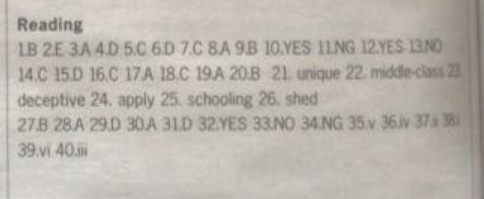
Here are the answers in the picture below


Like and Subscribe our Youtube Channel Way To Crack IELTS.


Join our Whatsapp Group for regular updates.

Join us on Telegram for One-to-one Speaking and Speaking interviews on Video call with experts and students for practice.

Get our Latest Post/Blogs here.

FUTURE PERFECT CONTINUOUS TENSE

FUTURE PERFECT CONTINUOUS TENSE

FUTURE PERFECT CONTINUOUS TENSE

FUTURE PERFECT CONTINUOUS TENSE

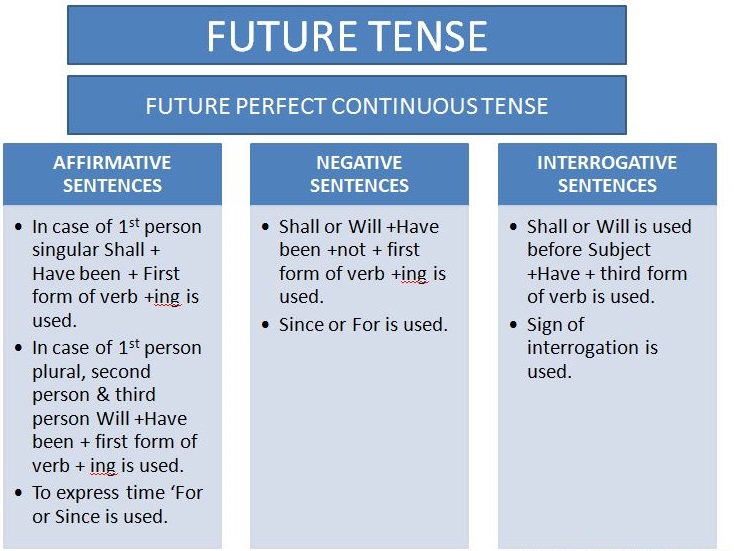
The future perfect continuous, also sometimes called the future perfect progressive, is a verb tense that describes actions that will continue up until a point in the future. The future perfect continuous consists of will/shall + have + been + the verb’s present participle (verb root + -ing).

When we describe an action in the future perfect continuous tense, we are projecting ourselves forward in time and looking back at the duration of that activity. The activity will have begun sometime in the past, present, or in the future, and is expected to continue in the future.

Future Perfect Continuous Tense के वाक्यो के अन्त मे हिन्दी मे “से रहा होगा”, “से रहे होंगे”, “से रही होगी” आता है ।

Structure of Sentence

Subject + will/shall + have + been + First Form of verb + ing + Object + since/for.

With He/She/It/You/They/Plural noun/Singular Noun need to use “will” along with “have + beenFirst Form of verb + ing.

With I/We/ need to use “shall” along with “have + beenFirst Form of verb + ing.

Since is used for definite time period for example with “Days of week“, “Month of year“, “Exact year“, “Exact Clock Timings“.

For is used for indefinite time period for example “2 hours“, “4 days“, “6 weeks“, “7 months“, “9 years“.

Examples

  • मै दो घण्टे से खेल रहा हूंगा।
  • I shall have been playing for two hours.
  • हम तीन बजे से फिल्म देख रहे होंगे।
  • We shall have been watching the film since three o’clock.
  • वह सुबह से बुन रही होगी।
  • She will have been knitting since morning.

Future Perfect Continuous Tense – Negative Sentence

For negative sentences we insert ‘not’ after the first auxiliary verb.

Structure of Sentence

Subject + will/shall + have + not + been + First Form of verb + ing + Object + since/for.

With He/She/It/You/They/Plural noun/Singular Noun need to use “will” along with “have + beenFirst Form of verb + ing.

With I/We/ need to use “shall” along with “have + beenFirst Form of verb + ing.

Since is used for definite time period for example with “Days of week“, “Month of year“, “Exact year“, “Exact Clock Timings“.

For is used for indefinite time period for example “2 hours“, “4 days“, “6 weeks“, “7 months“, “9 years“.

Examples

  • वह कल से नाच नही रही होगी।
  • She will have not been dancing since yesterday.
  • उसे सुबह से सर्दी नही लग रही होगी।
  • He will have not been feeling cold since morning.
  • भिखारी कई दिन से यहां पर नही खडा होगा।
  • The beggar will have not been standing here for several days.

Future Perfect Continuous Tense – Interrogative Sentence

For converting Future Perfect Continuous Tense sentences into interrogative sentences the formula is that you add ”will/shall” at the starting of the sentence followed by ‘Subject‘ and then ‘have + been‘. Rest of the rule remains the same.

Structure of Sentence

Will/shall + Subject + have + been + First Form of verb + ing + Object + since/for + ?.

With He/She/It/You/They/Plural noun/Singular Noun need to use “will” along with “have + beenFirst Form of verb + ing.

With I/We/ need to use “shall” along with “have + beenFirst Form of verb + ing.

Since is used for definite time period for example with “Days of week“, “Month of year“, “Exact year“, “Exact Clock Timings“.

For is used for indefinite time period for example “2 hours“, “4 days“, “6 weeks“, “7 months“, “9 years“.

Examples

  • क्या आप दोपहर से सो रहे होंगे?
  • Will you have been sleeping since noon?
  • क्या वह 1991 से बूढा हो रहा होगा?
  • Will he have been growing old since 1991?
  • क्या पिछले तीन वर्षो से किमतें बढ रही होगी?
  • Will the prices have been increasing for the last three years?

Future Perfect Continuous Tense – Interrogative Negative Sentence

In Future Perfect Continuous Tenseinterrogative negative sentences are just like interrogative affirmative sentences with only use of “not” after subject.

Structure of Sentence

Will/shall + Subject + not + have + been + First Form of verb + ing + Object + since/for + ?.

With He/She/It/You/They/Plural noun/Singular Noun need to use “will” along with “have + beenFirst Form of verb + ing.

With I/We/ need to use “shall” along with “have + beenFirst Form of verb + ing.

Since is used for definite time period for example with “Days of week“, “Month of year“, “Exact year“, “Exact Clock Timings“.

For is used for indefinite time period for example “2 hours“, “4 days“, “6 weeks“, “7 months“, “9 years“.

Examples

  • क्या हम आपस मे तीन दिन से नही मिल रहे होंगे?
  • Shall we not have been meeting each other for three days?
  • क्या मै तीन वर्ष से कम्प्यूटर चलाना नही सिख रहा हूंगा?
  • Shall I not have been learning to operate computer for three years?
  • क्या आप पिछले तीन महीने से डाक्टर के पास नही जा रहे होंगे?
  • Will you not have been going to the doctor for the last two months?

Future Perfect Continuous Tense (Passive Form)

Most reference books say that the Future perfect continuous tense has no passive form.

Link for—–> Past Perfect ContinuousTense


For audio-visual lessons, Subscribe our Youtube Channel Way To crack IELTS.

Follow our Official Pages on Facebook and Instagram.

I hope this post was helpful.

Thanks

FUTURE PERFECT TENSE

FUTURE PERFECT TENSE

FUTURE PERFECT TENSE

FUTURE PERFECT TENSE

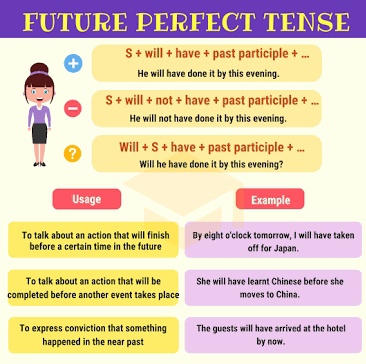
The Future Perfect tense expresses action in the future before another action in the future. This is the past in the future.

Future Perfect Tense के वाक्यो के अन्त मे हिन्दी मे “चुका होगा”, “चुके होंगे”, “चुकी होगी”, “चुका हूंगा” आता है ।

Structure of Sentence

Subject + will/shall + have + Past Participle + Object.

With He/She/It/You/They/Plural noun/Singular Noun need to use “will“.

With I/We/ need to use “shall“.

Examples

  • मै भोजन कर चुका हूंगा।
  • I shall have eaten food.
  • हम खेल चुके होंगे।
  • We shall have played.
  • वह सो चुका होगा।
  • He will have slept.

Future Perfect Tense – Negative Sentence

For converting Future Perfect Tense sentences into negative sentences the formula is that you add ‘not’ before the verb and the rest of the rule remains the same.

Structure of Sentence

Subject + will/shall + not + have + Past Participle + Object.

With He/She/It/You/They/Plural noun/Singular Noun need to use “will“.

With I/We/ need to use “shall“.

Examples

  • मै भोजन नही कर चुका हूंगा।
  • I shall not have eaten food.
  • हम खेल नही चुके होंगे।
  • We shall not have played.
  • वह सो नही चुका होगा।
  • He will not have slept.

Future Perfect Tense – Interrogative Sentence

For converting Future Perfect Tense sentences into interrogative sentences the formula is that you add ‘Will/ Shall’ at the start of the sentence followed by the subject and the rest of the rule remains the same. The sentence ends with a question mark (?).

Structure of Sentence

Will/shall + Subject + have + Past Participle + Object.

With He/She/It/You/They/Plural noun/Singular Noun need to use “will“.

With I/We/ need to use “shall“.

Examples

  • क्या वह स्कूल से आ चुका होगा?
  • Will he have come back from school?
  • क्या माली घास काट चुका होगा?
  • Will the gardener have cut the grass?
  • क्या मै खेल चुका हूंगा?
  • Shall I have played?

Future Perfect Tense – Interrogative Negative Sentence

For converting Future Perfect Tense sentences into negative interrogative sentences the formula is that you add Will/ Shall at the start of the sentence, then the subject and then ‘not be’ and the rest of the rule remains the same. The sentence ends with a question mark (?).

Structure of Sentence

Will/shall + Subject + not + have + Past Participle + Object.

With He/She/It/You/They/Plural noun/Singular Noun need to use “will“.

With I/We/ need to use “shall“.

Examples

  • क्या मै खेल नही चुका हूंगा?
  • Had I not played?
  • क्या माली घास नही काट चुका होगा?
  • Will the gardener not have cut the grass?
  • क्या मै खेल नही चुका हूंगा?
  • Shall I not have played?

FUTURE PERFECT TENSE

Future Perfect Tense (Passive Form)

The future perfect tense forms are made by putting ‘will / shall + have’ before the past participle form of the verb. These sentences can be changed into the passive if the active verb has an object. The passive verb form in the future perfect tense is made by putting ‘will / shall + have been’ before the past participle form of the verb.

Structure Of Sentence

Object + will/shall + have + been + the Past Participle form of the verb + by + Subject.

With He/She/It/You/They/Plural noun/Singular Noun need to use “will“.

With I/We/ need to use “shall“.

Examples

  1. She will have cooked food. (Active)
  2. Food will have been cooked by her. (Passive)
  3. They will have bought a car. (Active)
  4. A car will have been bought by them. (Passive)
  5. I shall have seen the circus. (Active)
  6. The circus will have been seen by me. (Passive)

Link for—–> Past Perfect Tense


Like and Subscribe our Youtube Channel Way To Crack IELTS.

Follow our Official Pages on Facebook and Instagram.

I hope this post was helpful.

Thanks

FUTURE CONTINUOUS TENSE

FUTURE CONTINUOUS TENSE

FUTURE CONTINUOUS TENSE

FUTURE CONTINUOUS TENSE

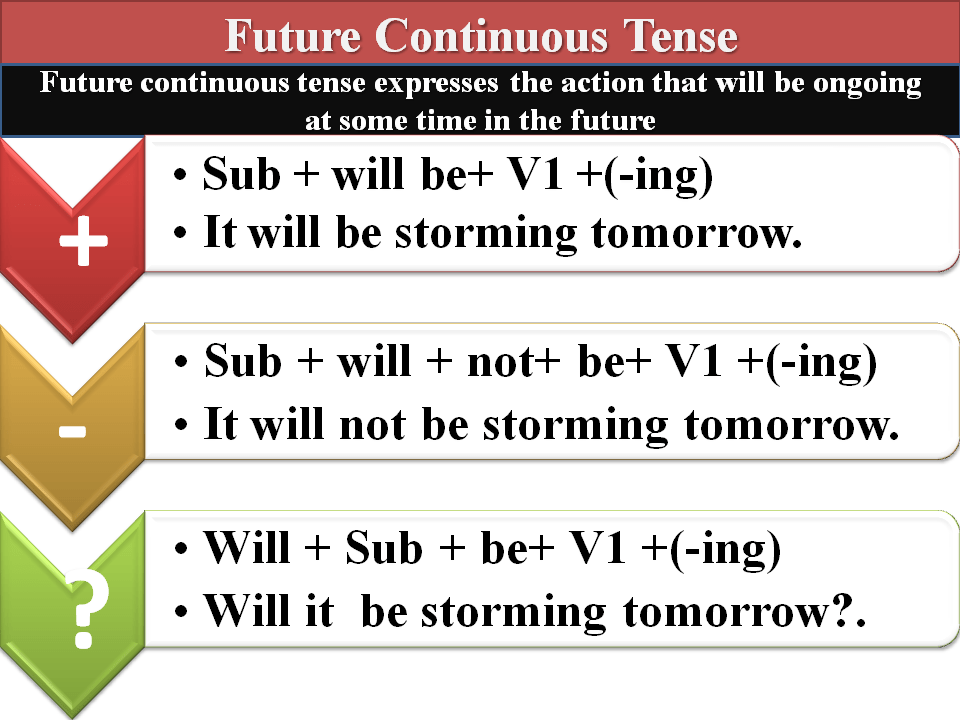
The future continuous tense, sometimes also referred to as the future progressive tense, is a verb tense that indicates that something will occur in the future and continue for an expected length of time.

Future Continuous Tense के वाक्यो के अन्त मे हिन्दी मे “रहा होगा”, “रहे होंगे”, “रही होगी” आता है ।

Structure of Sentence

Subject + will/shall + be + First Form Of Verb + ing + Object

With He/She/It/You/They/Plural noun/Singular Noun need to use “will” along with First Form of Verb.

With I/We/ need to use “shall” along with First Form of Verb.

FUTURE CONTINUOUS TENSE – Examples

  • मै खाना खा रहा होगा।
  • I shall be eating food.
  • हम खेल रहे होंगे।
  • We shall be playing.
  • चूहे दौड रहे होंगे।
  • Rats will be running.

Future Continuous Tense – Negative Sentence

For converting Future Continuous Tense sentences into negative sentences the formula is that you add ‘not’ before the verb and the rest of the rule remains the same.

Structure of Sentence

Subject + will/shall + not + be + First Form Of Verb + ing + Object

With He/She/It/You/They/Plural noun/Singular Noun need to use “will” along with First Form of Verb.

With I/We/ need to use “shall” along with First Form of Verb.

Examples

  • बच्चे सो नही रहे होंगे।
  • Children will not be sleeping.
  • हम स्नान नही कर रहे होंगे।
  • We shall not be bathing.
  • मै आज स्कूल नही जा रहा होगा।
  • I shall not be going to school today.

Future Continuous Tense – Interrogative Sentence

For converting these sentences into interrogative sentences the formula is that you add Will/ Shall at the start of the sentence followed by the subject  and the rest of the rule remains the same. The sentence ends with a question mark (?).

Structure of Sentence

Will/shall + Subject + be + First Form Of Verb + ing + Object

With He/She/It/You/They/Plural noun/Singular Noun need to use “will” along with First Form of Verb.

With I/We/ need to use “shall” along with First Form of Verb.

Examples

  • क्या मै हँस रहा होगा?
  • Shall I be laughing?
  • क्या हम बाजार जा रहे होंगे?
  • Shall we be going to market?
  • क्या वह विदेश जा रहा होगा?
  • Will he be going to a foreign country?

Future Continuous Tense – Interrogative Negative Sentence

In Future Progressive Tense, interrogative negative sentences are just like interrogative affirmative sentences with only use of “not” after subject.

Structure of Sentence

Will/shall + Subject + not + be + First Form Of Verb + ing + Object

With He/She/It/You/They/Plural noun/Singular Noun need to use “will” along with First Form of Verb.

With I/We/ need to use “shall” along with First Form of Verb.

Examples

  • क्या वे जन्म दिन नही रहे होंगे?
  • Will they not be celebrating their birthday?
  • क्या बच्चे फूल नही रहे होंगे?
  • Will children not be plucking flowers?
  • क्या वह कपडे नही घो रही होगी?
  • Will she not be washing clothes?

Future Continuous Tense (Passive Form)

Most reference books say that the past perfect continuous tense has no passive form.

Link for—–> Past continuous Tense


For audio-visual lessons, Subscribe our Youtube Channel Way To crack IELTS.

Follow our Official Pages on Facebook and Instagram.

SIMPLE (INDEFINITE) FUTURE TENSE

SIMPLE (INDEFINITE) FUTURE TENSE

SIMPLE (INDEFINITE) FUTURE TENSE

SIMPLE (INDEFINITE) FUTURE TENSE

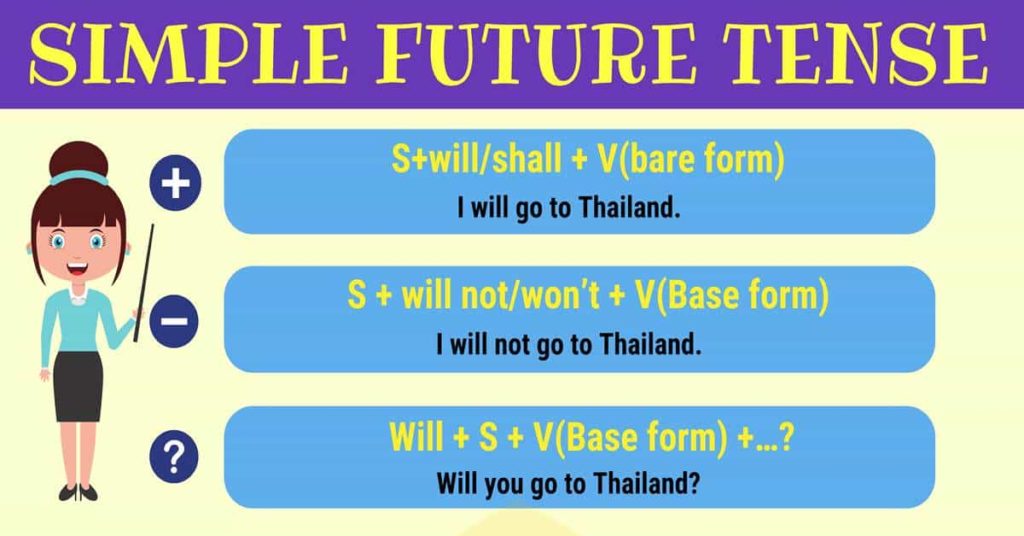
The simple future tense is used when an action is promised/thought to occur in the future.

Simple Future Tense के वाक्यो के अन्त मे गा, गे, गी आता है ।

Structure of Sentence

Subject + will/shall + First Form of Verb + Object

With He/She/It/You/They/Plural noun/Singular Noun need to use “will” along with First Form of Verb.

With I/We/ need to use “shall.

Examples

  • मै प्रतिदिन स्नान करूँगा |
  • I shall take bath everyday.
  • हम उसका पता जानेंगे ।
  • We shall know his address.
  • आप नींद मे बोलोगे |
  • You will talk in your sleep.

Simple Future Tense – Negative Sentence

The future is the tense used to express future events. We use the future simple structure to introduce predictions, beliefs or intentions about the future.

When expressed in its negative form, the verb denies something about the subject.

Structure of Sentence

Subject + will/shall + not + First Form of Verb + Object

With He/She/It/You/They/Plural noun/Singular Noun need to use “will” along with First Form of Verb.

With I/We/ need to use “shall.

Examples :

  • तुम उत्तर नहीं जानोगे |
  • You will not know the answer.
  • हम तुम पर विश्वास नही करेंगे ।
  • We shall not believe you.
  • सर्दी मे फूळ नही खिलेंगे |
  • Flowers will not bloom in winter.

Simple Future Tense – Interrogative Sentence

We use the future simple, in the interrogative form, to ask for predictions, beliefs or intentions about the future.

When we use future simple in its interrogative form, we start with will followed by the subject and the verb in its base form (the sentence ends with a question mark).

Structure of Sentence

will/shall + Subject + First Form of Verb + Object

With He/She/It/You/They/Plural noun/Singular Noun need to use “will” along with First Form of Verb.

With I/We/ need to use “shall.

Examples:

  • क्या बालक पानी मे तैरेंगे ।
  • Will boys swim in water?
  • क्या आपको सर्दी लगेगी ।
  • Will you feel cold?
  • क्या घंटी आठ बजे बजेगी ।
  • Will the bell ring at 8.00 ?

Simple Future Tense – Interrogative-Negative Sentence

In Simple Future Tense, interrogative negative sentences are just like interrogative affirmative sentences with only use of ” not ” after subject.

Structure of Sentence

Will/shall + Subject + not + First Form of Verb + Object

With He/She/It/You/They/Plural noun/Singular Noun need to use “will” along with First Form of Verb.

With I/We/ need to use “shall.

Examples:

  • क्या मै प्रतिदिन दाढी नही बनाउंगा ?
  • Shall I not shave everyday?
  • क्या हम भगवान से प्रार्थना नही करेंगे?
  • Shall we not pray to God?
  • क्या वे यहां पर ताजा रस नहीं बेचेंगे ?
  • Will they not sell fresh juice here?

Simple Future Tense (Passive Form)

The passive verb form in the simple future tense is made by putting will / shall + be before the past participle form of the verb.

Structure Of Sentence

Object + will/shall + be + the Past Participle form of the verb + by + Subject

With He/She/It/You/They/Plural noun/Singular Noun need to use “will” along with First Form of Verb.

With I/We/ need to use “shall.

Examples :

  • Shweta will play chess. (Active)
  • Chess will be played by Shweta. (Passive)
  • We shall know his address. (Active)
  • His address will be known by us. (Passive)
  • I shall take bath. (Active)
  • Bath will be taken by me. (Passive)

Today’s grammar lesson could be beneficial for, how to boost your IELTS score through mastering the present tenses.

Like and Subscribe our Youtube Channel Way To Crack IELTS.

PAST PERFECT CONTINUOUS TENSE

PAST PERFECT CONTINUOUS TENSE

PAST PERFECT CONTINUOUS TENSE

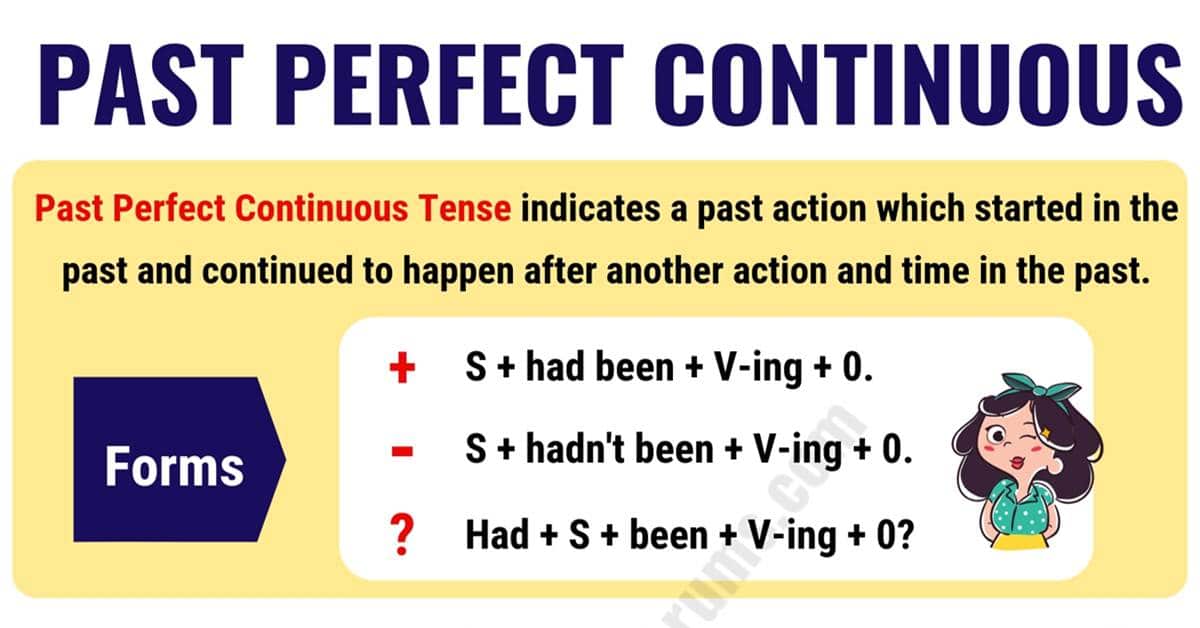
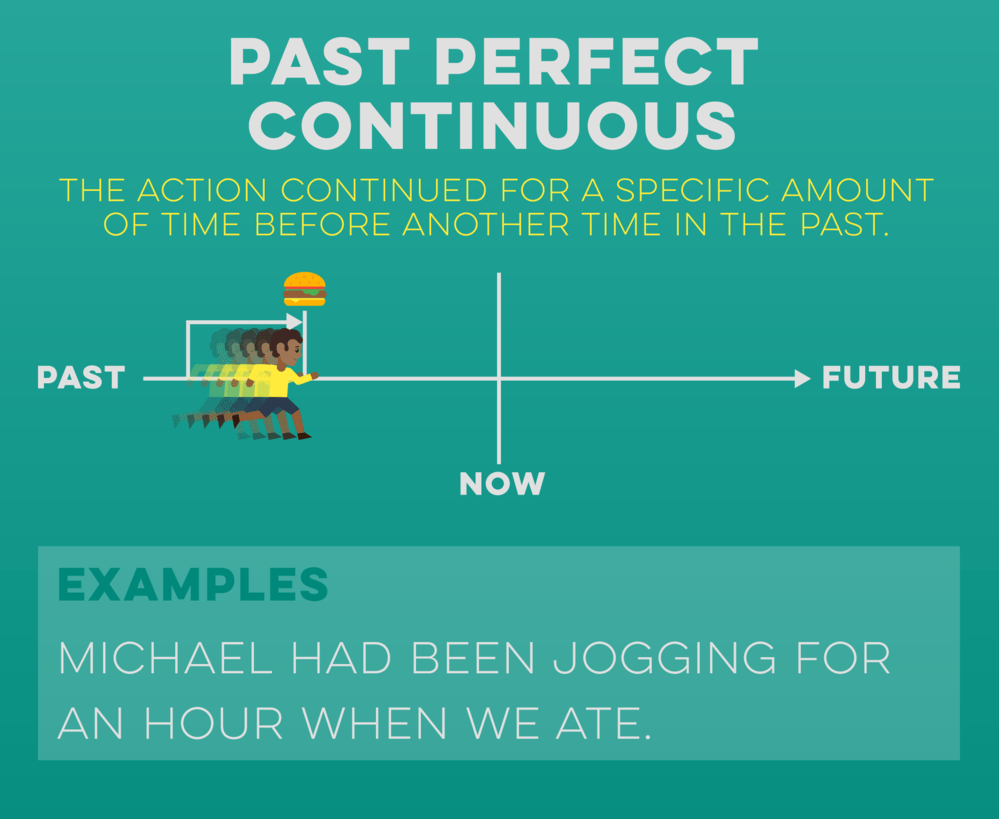
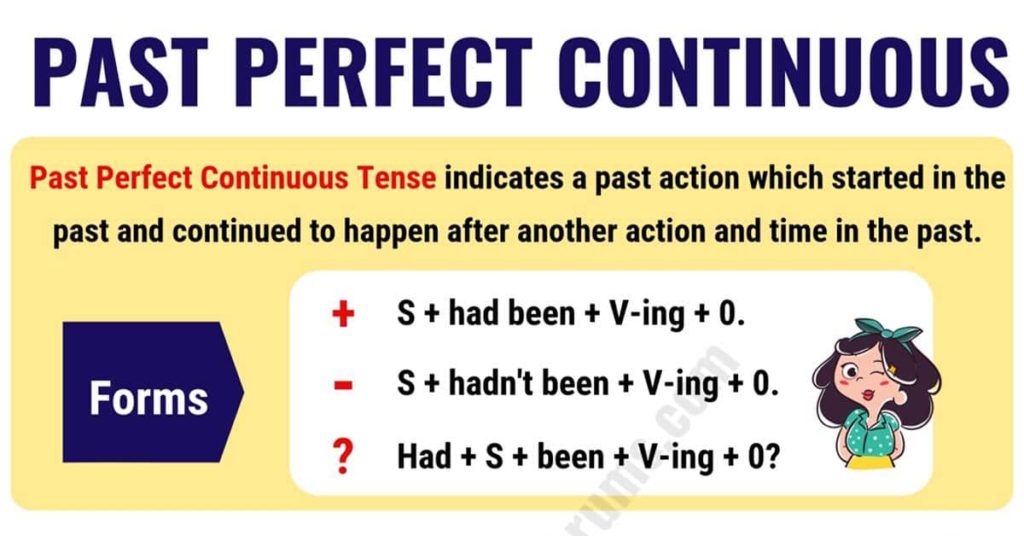
The past perfect continuous tense (also known as the past perfect progressive tense) shows that an action that started in the past continued up until another time in the past.

Unlike the present perfect continuous, which indicates an action that began in the past and continued up to the present, the past perfect continuous is a verb tense that indicates something that began in the past, continued in the past, and also ended at a defined point in the past.

Past Perfect Continuous Tense के वाक्यो के अन्त मे हिन्दी मे “से रहा था”, “से रहे थे”, “से रही थी” आता है ।

Structure of Sentence

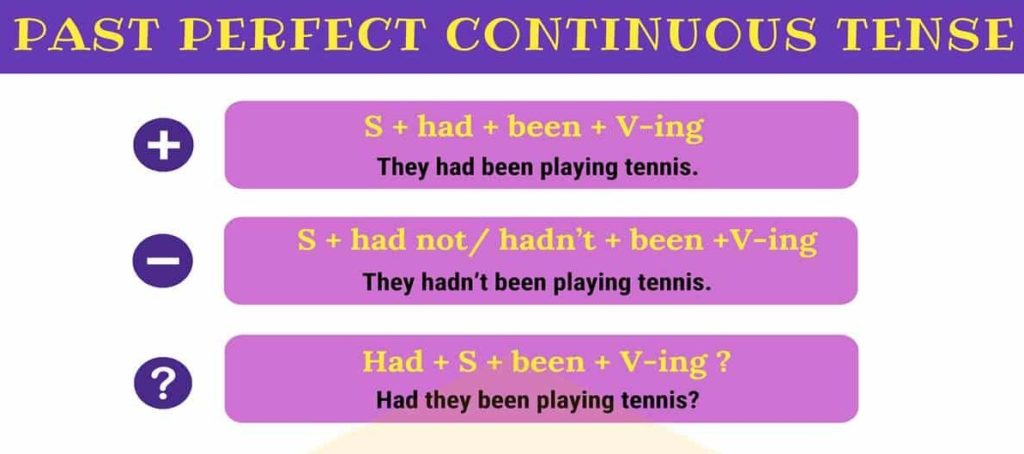
Subject + had + been + First Form of verb + ing + Object + since/for.

With He/She/It/I/We/You/They/Plural noun/Singular Noun need to use “had” along with First Form of verb + ing.

Since is used for definite time period for example with “Days of week“, “Month of year“, “Exact year“, “Exact Clock Timings“.

For is used for indefinite time period for example “2 hours“, “4 days“, “6 weeks“, “7 months“, “9 years“.

Examples

  • मै दो घण्टे से खेल रहा था।
  • I had been playing for two hours.
  • हम तीन बजे से फिल्म देख रहे थे।
  • We had been watching the film since three o’clock.
  • वह सुबह से बुन रही थी।
  • She had been knitting since morning.

Past Perfect Continuous Tense – Negative Sentence

For negative sentences we insert ‘not’ after the first auxiliary verb.

Structure of Sentence

Subject + had + not + been + First Form of verb + ing + Object + since/for.

With He/She/It/I/We/You/They/Plural noun/Singular Noun need to use “had” along with First Form of verb + ing.

Since is used for definite time period for example with “Days of week“, “Month of year“, “Exact year“, “Exact Clock Timings“.

For is used for indefinite time period for example “2 hours“, “4 days“, “6 weeks“, “7 months“, “9 years“.

Examples

  • वह कल से नाच नही रही थी।
  • She had not been dancing since yesterday.
  • उसे सुबह से सर्दी नही लग रही थी।
  • He had not been feeling cold since morning.
  • भिखारी कई दिन से यहां पर नही खडा था।
  • He had not been feeling cold since morning.

Past Perfect Continuous Tense – Interrogative Sentence

For converting these sentences into interrogative sentences the formula is that you add have at the starting of the sentence followed by ‘Subject’ and then ‘been’. Rest of the rule remains the same.

Structure of Sentence

Had + ‘Subject’ + been + verb (1st form) with ‘ing’ + object (optional) + since / for + time duration?

With He/She/It/I/We/You/They/Plural noun/Singular Noun need to use “had” along with First Form of verb + ing.

Since is used for definite time period for example with “Days of week“, “Month of year“, “Exact year“, “Exact Clock Timings“.

For is used for indefinite time period for example “2 hours“, “4 days“, “6 weeks“, “7 months“, “9 years“.

Examples

  • क्या आप दोपहर से सो रहे थे?
  • Had you been sleeping since noon?
  • क्या वह 1991 से बूढा हो रहा था?
  • Had he been growing old since 1991?
  • क्या पिछले तीन वर्षो से किमतें बढ रही थी?
  • Had the prices been increasing for the last three years?

Past Perfect Continuous Tense – Interrogative Negative Sentence

In Past Perfect Continuous Tenseinterrogative negative sentences are just like interrogative affirmative sentences with only use of “not” after subject.

Structure of Sentence

Had + ‘Subject’ + not + been + verb (1st form) with ‘ing’ + object (optional) + since / for + time duration?

With He/She/It/I/We/You/They/Plural noun/Singular Noun need to use “had” along with First Form of verb + ing.

Since is used for definite time period for example with “Days of week“, “Month of year“, “Exact year“, “Exact Clock Timings“.

For is used for indefinite time period for example “2 hours“, “4 days“, “6 weeks“, “7 months“, “9 years“.

Examples

  • क्या हम आपस मे तीन दिन से नही मिल रहे थे?
  • Had we not been meeting each other for three days?
  • क्या मै तीन वर्ष से कम्प्यूटर चलाना नही सिख रहा था?
  • Had I not been learning to operate computer for three years?
  • क्या आप पिछले तीन महीने से डाक्टर के पास नही जा रहे थे?
  • Had you not been going to the doctor for the last two months?

Past Perfect Continuous Tense (Passive Form)

Most reference books say that the past perfect continuous tense has no passive form.

For audio-visual lessons, Subscribe our Youtube Channel Way To crack IELTS.

Follow our Official Pages on Facebook and Instagram.

Past Perfect Tense Explained

Past Perfect Tense

Past Perfect Tense

Past perfect Tense

Past Perfect Tense

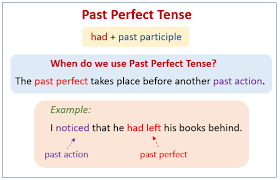
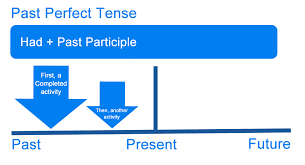
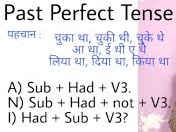
The past perfect is a verb tense used to talk about actions that were completed before some point in the past.

When to Use the Past Perfect

So what’s the difference between a past perfect and a simple past? When you’re talking about some point in the past and want to reference an event that happened even earlier, using the past perfect allows you to convey the sequence of the events. It’s also clearer and more specific.

Past Perfect Tense के वाक्यो के अन्त मे हिन्दी मे “चुका था”, “चुके थे”, “चुकी थी”, “आ था”, “ई थी”, “ए थे” आता है ।

Structure of Sentence

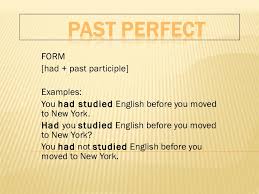
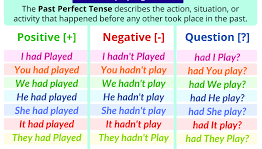
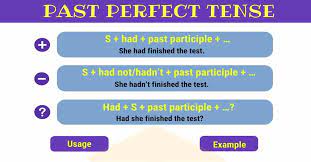
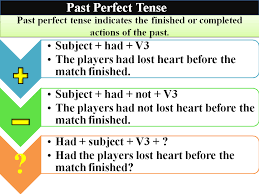
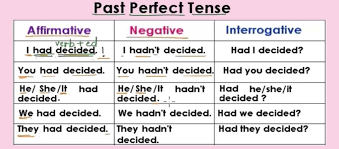
Subject + had + Past Participle + Object.

With He/She/It/I/We/You/They/Plural/Singular Noun need to use “had” along with Past Participle.

Examples

  • मै भोजन कर चुका था।
  • I had eaten food.
  • हम खेल चुके थे।
  • We had played.
  • वह सो चुका था।
  • He had slept.

Past Perfect Tense – Negative Sentence

Making the past perfect negative is simple! Just insert not between had and past participle.

Structure of Sentence

Subject + had + not + Past Participle + Object.

Examples

  • मैने यह नाटक नही देखा था।
  • I had not seen this play.
  • उसने नृत्य नही सीखा था।
  • She had not learnt to dance.
  • तुमने कभी शरारत नही की थी।
  • You had never made a mischief.

Past Perfect Tense – Interrogative Sentence

Auxiliary verb used remains same as in positive and negative sentences- i.e. ‘had’. Also, the past participle or third form of main verb is used and the sentences should start with the auxiliary verb in the beginning.

Structure of Sentence

Had +Subject + Past Participle + Object + ?.

Examples

  • क्या वह स्कूल से आ चुका था?
  • Had he come back from school?
  • क्या माली घास काट चुका था?
  • Had the gardener cut the grass?
  • क्या मै खेल चुका था?
  • Had I played?

Past Perfect Tense – Interrogative Negative Sentence

Auxiliary verb used remains same as in positive and negative sentences- i.e. ‘had’. Also, the past participle or third form of main verb is used along with ‘not’ and the sentences should start with the auxiliary verb in the beginning.

Had +Subject + not + Past Participle + Object + ?.

Examples

  • क्या मै खेल नही चुका था?
  • Had I not played?
  • क्या हमने उनसे बात नही की थी?
  • Had we not spoken to him?
  • क्या वह कुत्ते के काटने से नही मरा था?
  • Had he not died of a dog bite?

Past Perfect Tense (Passive Form)

In the past perfect form with the passive, we always use ‘had been’ + the past participle form.

Structure Of Sentence

Object + had + been + the Past Participle form of the verb + by + Subject.

Examples

  1. She had cooked food. (Active)
  2. Food had been cooked by her. (Passive)
  3. They had bought a car. (Active)
  4. A car had been bought by them. (Passive)
  5. I had seen the circus. (Active)
  6. The circus had been seen by me. (Passive)

Link for—–> Present Perfect Tense


Like and Subscribe our Youtube Channel Way To Crack IELTS.

Follow our Official Pages on Facebook and Instagram.

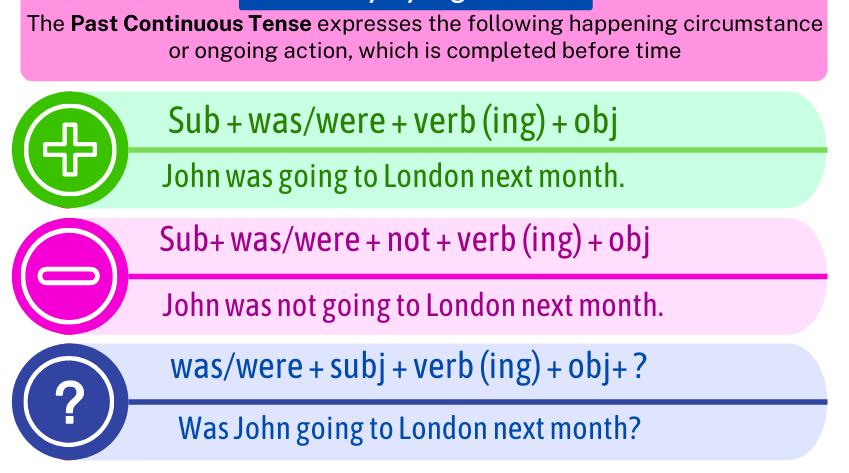
WHAT IS PAST CONTINUOUS TENSE

WHAT IS PAST CONTINUOUS TENSE

WHAT IS PAST CONTINUOUS TENSE

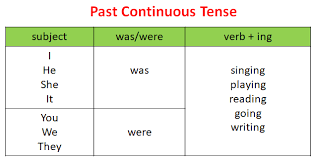
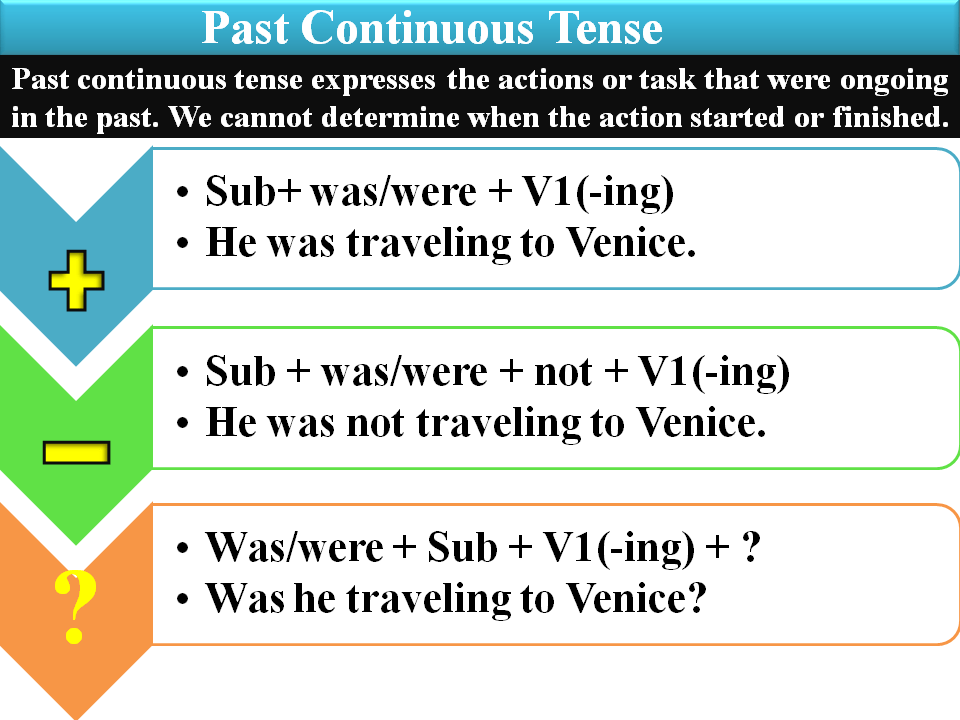
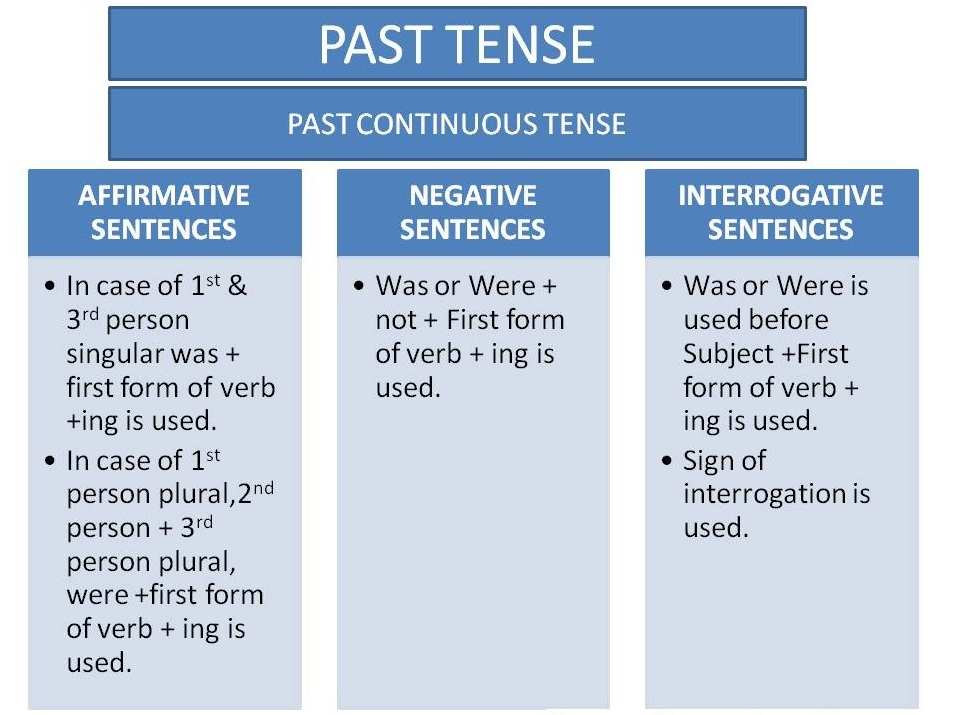
The past continuous tense, also known as the past progressive tense, refers to a continuing action or state that was happening at some point in the past. The past continuous tense is formed by combining the past tense of to be (i.e., was/were) with the verb’s present participle (-ing word).

Present Continous Tense के वाक्यो के अन्त मे हिन्दी मे “रहा था”, “रहे थे”, “रही थी” आता है ।

Structure of Sentence

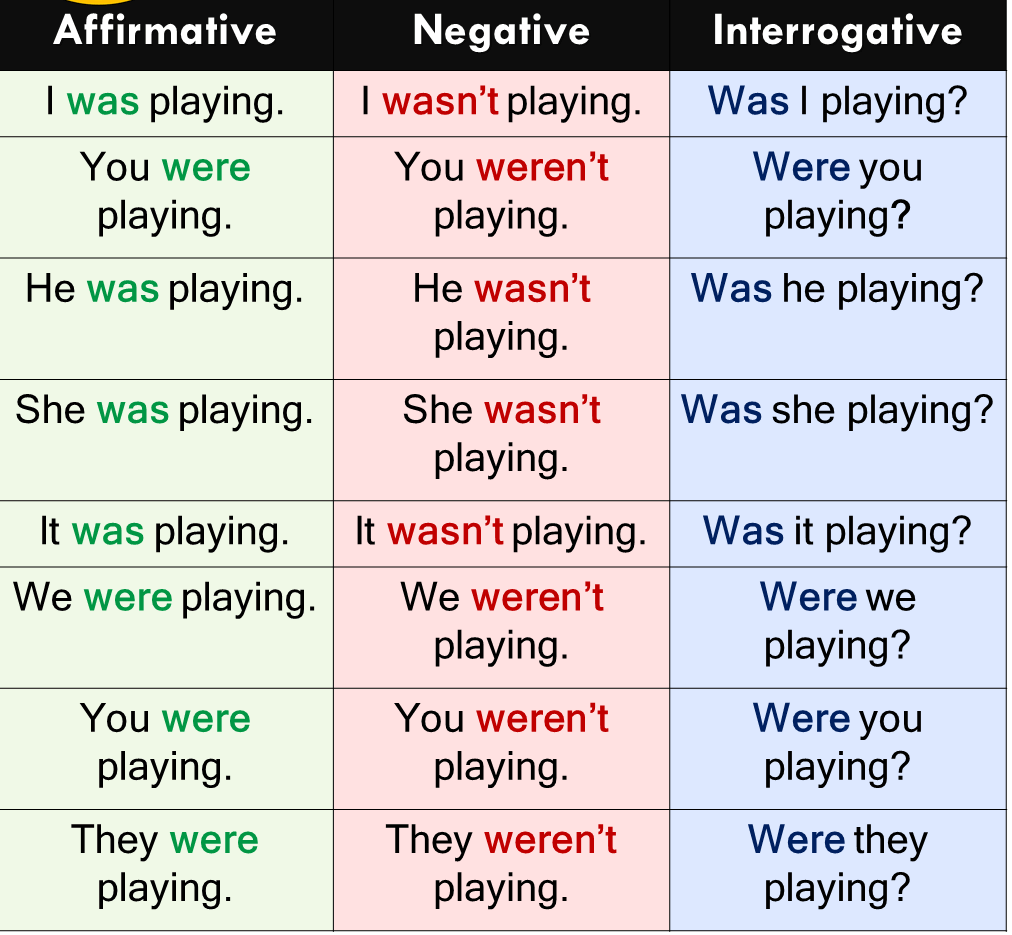
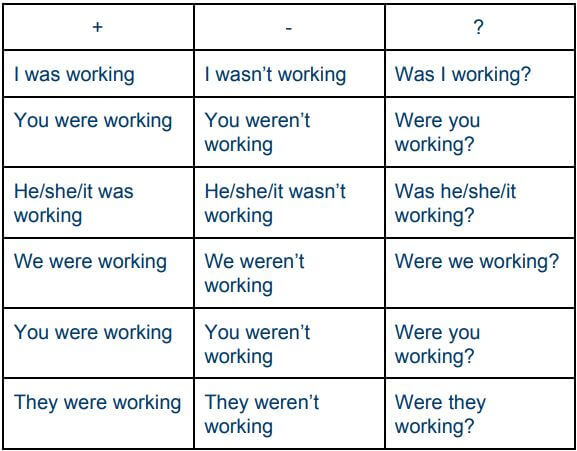
Subject + was/were + First Form Of Verb + ing + Object

With He/She/It/I/Singular Noun need to use “was” along with First Form of Verb and “ing”.

With We/You/They/Plural noun need to use “were” along with First Form of Verb and “ing”.

PAST CONTINOUS TENSE – Examples

  • मै खाना खा रहा था।
  • I was eating food.
  • हम खेल रहे थे।
  • We were playing.
  • चूहे दौड रहे थे।
  • Rats were running.

Past Continous Tense – Negative Sentence

The past continuous (or progressive) is the tense used to express situations that occurred in the past and were in progress at any moment during a period of time.

When expressed in its negative form, the verb denies that something was happening in a past period of time.

Structure of Sentence

Subject + was/were + not + First Form Of Verb + ing + Object

With He/She/It/I/Singular Noun need to use “was” along with First Form of Verb and “ing”.

With We/You/They/Plural noun need to use “were” along with First Form of Verb and “ing”.

Examples

  • बच्चे सो नही रहे थे।
  • Children were not sleeping.
  • हम स्नान नही कर रहे थे।
  • We were not bathing.
  • मै आज स्कूल नही जा रहा था।
  • I was not going to school today.

Past Continous Tense – Interrogative Sentence

The past continuous (or progressive) is the tense used to express situations that take place in the past and were in progress at any moment during a period of time.

When expressed in its interrogative form, it is used to ask questions about things that were happening in a past period of time.

Structure of Sentence

Was/were + subject + First Form Of Verb + ing + Object + ?

With He/She/It/I/Singular Noun need to use “was” along with First Form of Verb and “ing”.

With We/You/They/Plural noun need to use “were” along with First Form of Verb and “ing”.

Examples

  • क्या मै हँस रहा था?
  • Was I laughing?
  • क्या हम बाजार जा रहे थे?
  • Were we going to market?
  • क्या वह विदेश जा रहा था?
  • Was he going to a foreign country?

Past Continous Tense – Interrogative Negative Sentence

In Past Progressive Tense, interrogative negative sentences are just like interrogative affirmative sentences with only use of  “not”  after subject.

Structure of Sentence

Was/were + subject + not +First Form Of Verb + ing + Object + ?

With He/She/It/I/Singular Noun need to use “was” along with First Form of Verb and “ing”.

With We/You/They/Plural noun need to use “were” along with First Form of Verb and “ing”.

Examples

  • क्या वे जन्म दिन नही रहे थे?
  • Were they not celebrating their birthday?
  • क्या बच्चे फूल नही रहे थे?
  • Were children not plucking flowers?
  • क्या वह कपडे नही घो रही थी?
  • Was she not washing clothes?

Past Continous Tense (Passive Form)

In the passive voice in past continuous requires two auxiliaries: to be (was/were) and the second auxiliary is being and the main verb changes to past participle.

Structure Of Sentence

Object + was/were + being + the Past Participle form of the verb + by + Subject.

‘was’ is used with he/she/it/I/singular noun.

‘were’ is used with we/you/they/plural noun.

Examples

  1. He was drawing a picture. (Active)
  2. A picture was drawn by him. (Passive)
  3. You were writing a letter. (Active)
  4. A letter was written by you. (Passive)
  5. I was eating food. (Active)
  6. Food was eaten by me. (Passive)

Get our Latest Post/Blogs here.

Like and Subscribe our Youtube Channel Way To Crack IELTS.

Follow our Official Pages on Facebook and Instagram.

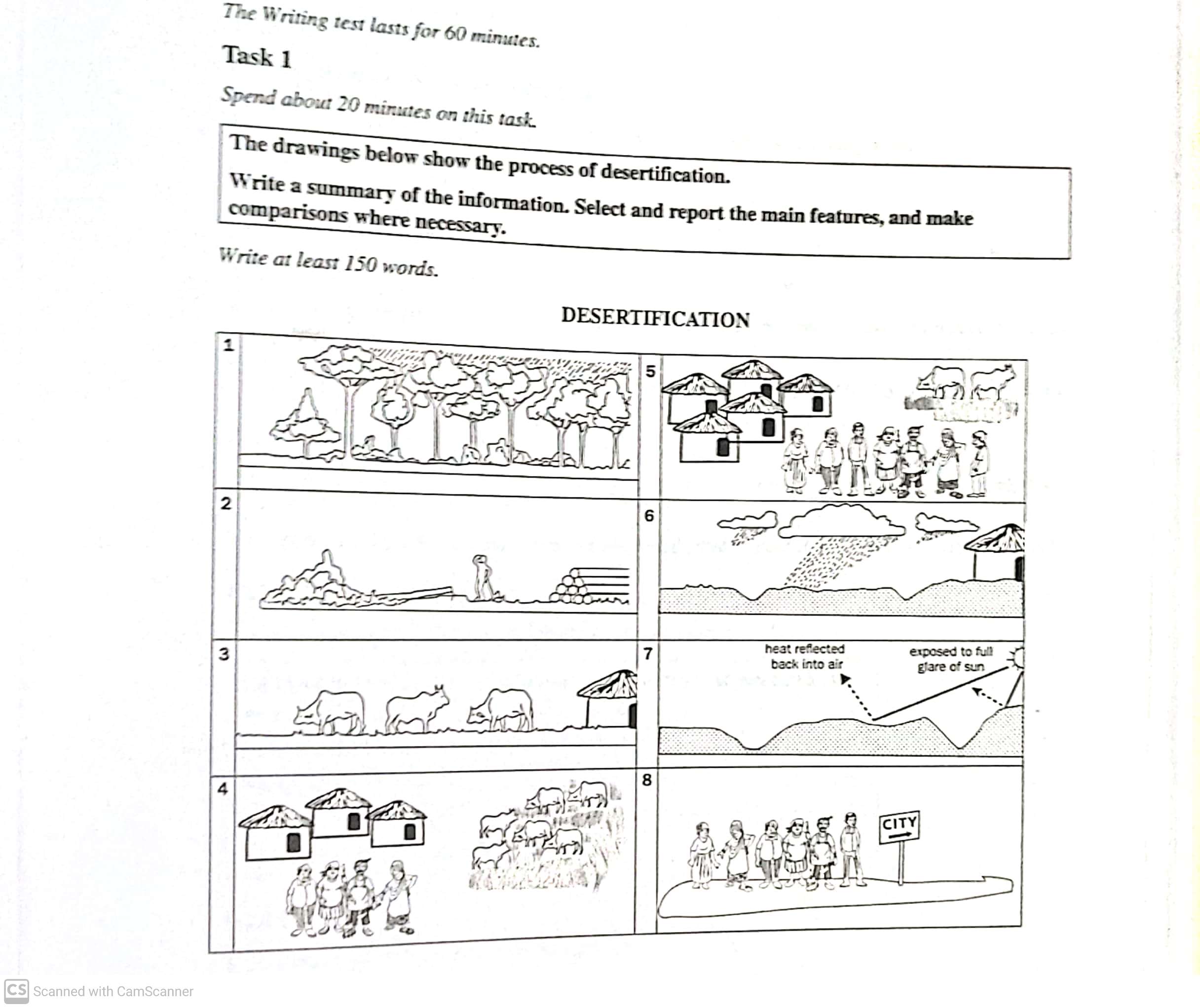
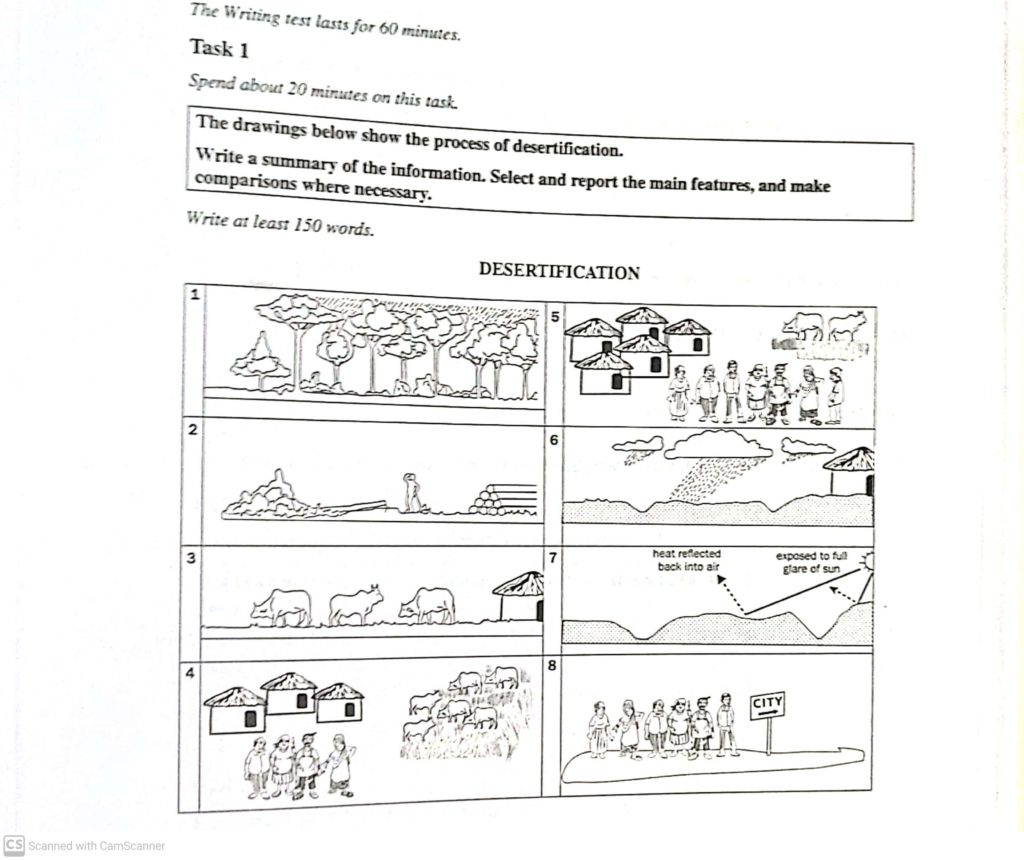
The Drawings Below shows the process of desertification

THE DRAWINGS BELOW SHOWS THE PROCESS OF DESERTIFICATION

THE DRAWINGS BELOW SHOWS THE PROCESS OF DESERTIFICATION

TASK 1

Spend about 20 minutes on this task.

The drawings below show the process of desertification.

Write a summary of the information. Select and report the main features, and make comparisons where necessary.

Write at least 150 words.

SAMPLE ANSWER

The process diagram illustrates the steps involved in the desertification that takes place during the whole outgrowth. The entire process mainly consists of eight steps starting with trees in the forest and terminating at the migration of the people.

First of all, it is evident from the given diagram that trees in the forest are visible in the maiden picture of the drawing. Then in the second step of the drawing trees are cut down by humans with the help of axe and other tools. After that, the vacant field from the forest is used by the humans for farming, grazing field for domestic animals, and housing of the people. Next to it, half of the total field has been acquired by people for farming and the other half for housing and gatherings.

On the other hand, it can be seen that more fields have been covered for housing and gathering as compared to farming and grazing field for animals. In the further step, a few houses can be seen, also it is raining on the vacant bumpy fields. At the second last step of the process, that whole area is left by people and it is totally exposed to the full glare of the sun because of it heat reflects back to air which results in rising of temperature, and the land is converted in the desert. At last, people migrate to the city as the lush green place is totally converted in the desert.

SAMPLE ANSWER

The interaction outline shows the means associated with the desertification that happens during the entire outgrowth. The whole cycle mostly comprises of eight stages beginning with trees in the woodland and ending at the relocation of individuals.

As a matter of first importance, it is obvious from the given graph that trees in the timberland are noticeable in the lady image of the drawing. At that point in the second step of the drawing trees are chopped somewhere near people with the assistance of hatchet and different instruments. From that point onward, the empty field from the timberland is utilized by the people for cultivating, eating field for homegrown creatures, and lodging of individuals. Close to it, half of the absolute field has been obtained by individuals for cultivating and the other half for lodging and social occasions.

Then again, it very well may be seen that more fields have been covered for lodging and assembling when contrasted with cultivating and munching fields for creatures. In the further advance, a couple of houses can be seen, likewise, it is coming down on the empty uneven fields. At the subsequent last advance of the cycle, that entire territory is left by individuals and it is completely presented to the full glare of the sun in light of it heat reflects back to air which brings about ascending of temperature, and the land is changed over in the desert. Finally, individuals relocate to the city as the lavish green spot is completely changed over in the desert.


Here’s how you can write IELTS Task 1 Process Chart.

If you like our blog do not forget share it friends.

For audio visual lessons, Like and Subscribe our Youtube Channel Way To Crack IELTS.

Please Like our page on Facebook.

Do not forget to Follow us on Instagram.

idioms

Idioms

An idiom is a group of words whose meaning is different from the meaning of the words. Idioms should be used sparingly and they reveal your proficiency in writing.

Idiom

Here are some of the idioms that you can use in your IELTS speaking as well as writing. Also these idioms you can use in your daily life. Following are the common idioms along with the meaning and examples.

  • A slap on the wrist (a very mild punishment)
    • He should be in jail for what he did, but he got off with just a slap on the wrist.
  • Flesh and blood (one’s own family)
    • She’s my own flesh and blood; I can’t believe she treated me that way!
  • Once in a blue moon (rarely)
    • I think my grandson doesn’t love me anymore, he comes to see me only once in a blue moon.
  • Rule of thumb (a rough estimate)
    • During our boot camp in the jungle, we used to drink a glass of water every two hours as a rule of thumb.
  • A drop in the bucket (a very small quantity where something big is needed)
    • What we were paid for our work was a drop in the bucket compared to what the company earned.
  • A fool and his money are easily parted (it is easy for a foolish person to lose his/her money)
    • Mike likes living in style – but then a fool and his money are easily parted.
  • A blessing in disguise (something good that is not recognised or expected at first)
    • Being caught in that traffic jam was a blessing in disguise. If I hadn’t missed the flight, I would have been on that plane when it crashed.
  • A doubting thomas (A skeptic who needs physical or personal evidence in order to believe something)
    • He’s such a doubting Thomas that he won’t believe unless he sees things through his eyes.
  • A house divided against itself cannot stand (it will not work out, if everyone does not unite)
    • I wish Ben and Jerry would learn to get along. After all, a house divided against itself cannot stand.
  • A leopard can’t change its spots (you cannot change your identity)
    • The teacher tried to be kind to her students, but a leopard can’t change its spots, she was still very mean.
  • A penny saved is a penny earned (by not wasting money, you are saving money)
    • I’m going to give you $20, but I want you to put it in the bank; a penny saved is a penny earned!
  • A picture paints a thousand words (a visual presentation is far more descriptive than words)
    • Jane’s reaction in the picture is so weird about her boss – someone truly said that a picture paints a thousand words.
  • A piece of cake (a task that can be accomplished very easily)
    • The boy found the project to be a piece of cake because it was incredibly easy.
  • Actions speak louder than words (it is better to actually do something than just talk about it)
    • He keeps saying he loves me, but actions speak louder than words.
  • Add fuel to the fire (do something to make a bad situation even worse than it is)
    • The presidential candidate’s provocative speech in these violent times is only going to add fuel to the fire.
  • Against the clock (accomplish/do something in spite of limited time available)
    • The team was working against the clock to finish the project on time.
  • All bark and no bite (only threats, no real actions)
    • She said that she will call the police if those people ever bother her again, but she didn’t. She’s all bark and no bite.
  • All Greek to me (meaningless and incomprehensible)
    • My teacher was explaining a complicated math to the classroom, but I didn’t get it, it was all Greek to me.
  • All in the same boat (when everyone is facing the same situation)
    • I know this is difficult work, but we are all in the same boat here, so we’ll have to do this together.
  • An axe to grind (to gave a dispute with someone)
    • I think he is gunning for the top job because he has an axe to grind with some of his colleagues.
  • Apple of my eye (someone who is cherished above all others)
    • My youngest daughter, Cherie is the apple of my eye.
  • As high as a kite (high ranking)
    •  I was as high as a kite when I heard I’d got the job.
  • At the drop of a hat (do something immediately)
    • We’re all packed and ready to go; we can leave at the drop of a hat.
  • Back seat driver (people who criticise from sidelines like someone giving unwanted advice)
    • Daisy is such a backseat driver, she needs to stop interfering – no one asked for her advice.
  • Back to square one (having to start all over again)
    • I failed at calculus, so I guess it’s back to square one.
  • Beat a dead horse (to force an issue that has already ended)
    • He already told you no; don’t beat a dead horse.
  • Beating around the bush (not speaking directly about the issue)
    • If you want to ask me, just ask; don’t beat around the bush.
  • Bite off more than you can chew (to take on a task that is too laborious)
    • By accepting two part-time jobs, he is clearly biting off more than he can chew.
  • Blood is thicker than water (blood relations are closer than other relations)
    • When my best friend and my brother got in a fight I had to help my brother; blood is thicker than water.
  • The last straw (the last chance)
    • She has been unhappy with him for a long time but when he crashed her car, it was the last straw.
  • To make a long story short (Briefly)
    • To make a long story short, I ran into Tony and we decided to go to the game together.
  • Scapegoat (someone innocent who is inflicted for others’ failure)
    • Some scapegoating campaigns, however, have been so extensive that they have had disastrous sociopolitical and human rights consequences.

If you find these idioms helpful, do not forget to share this with your near and dear ones’.

Do not forget to Like, Subscribe and share our Youtube channel “Way To Crack IELTS“.