

Present Perfect Tense
Present Perfect Tense

Present perfect Tense
Present Perfect Tense
The Present Perfect tense is a rather important tense in English, but it gives speakers of some languages a difficult time. That is because it uses concepts or ideas .
The present perfect is used to indicate a link between the present and the past. The time of the action is before now but not specified, and we are often more interested in the result than in the action itself.
Present Perfect Tense के वाक्यो के अन्त मे हिन्दी मे “चुका है”, “चुके है”, “चुकी है”, “चुके हो”, “आ है”, “ई है”, “ए है” आता है ।
Structure of Sentence
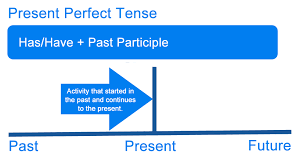
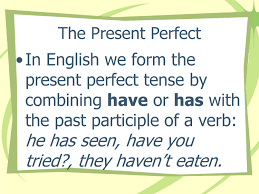
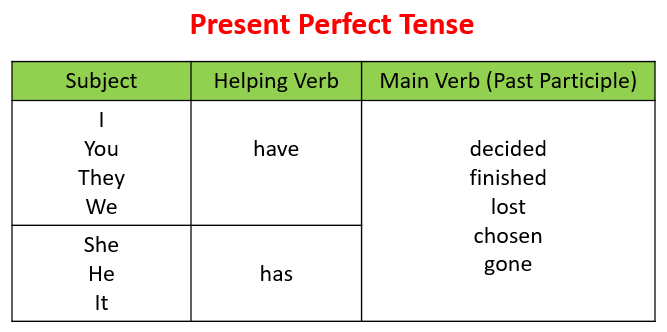
Subject + has/have + Past Participle + Object.
With He/She/It/Singular Noun need to use “has” along with Past Participle.
With I/We/You/They/Plural noun need to use “have” along with Past Participle.
Examples
- मै भोजन कर चुका हूं।
- I have eaten food.
- हम खेल चुके है।
- We have played.
- वह सो चुका है।
- He has slept.

Present Perfect Tense – Negative Sentence
We use the present perfect, in the negative form, to deny completed actions that have occurred in the past, are connected to the present, and still have effects on it. When we use the present perfect in its negative form, we start with the subject, followed by have not and a past participle.
Structure of Sentence
Subject + has/have + not + Past Participle + Object.
Examples
- मैने यह नाटक नही देखा है।
- I have not seen this play.
- उसने नृत्य नही सीखा है।
- She has not learnt to dance.
- तुमने कभी शरारत नही की है।
- You have never made a mischief.

Present Perfect Tense – Interrogative Sentence
We use the present perfect, in the interrogative form, to ask about completed actions which have occurred in the past, are connected to the present and still have effects on it.
Structure of Sentence
Has/have +Subject + Past Participle + Object + ?.
Examples
- क्या वह स्कूल से आ चुका है?
- Has he come back from school?
- क्या माली घास काट चुका है?
- Has the gardener cut the grass?
- क्या मै खेल चुका हूं?
- Have I played?

Present Perfect Tense – Interrogative Negative Sentence
For converting these sentences into negative interrogative sentences the formula is that you add has at the starting of the sentence and ‘not’ after the subject. The rest of the rule remains the same.
Has/have +Subject + not + Past Participle + Object + ?.
Examples
- क्या मै खेल नही चुका हूं?
- Have I not played?
- क्या हमने उनसे बात नही की है?
- Have we not spoken to him?
- क्या वह कुत्ते के काटने से नही मरा है?
- Has he not died of a dog bite?

Present Perfect Tense (Passive Form)
In the present perfect form with the passive, we always use ‘has/have been’ + the past participle form.
Structure Of Sentence
Object + has/have + been + the Past Participle form of the verb + by + Subject.
Examples
- She has cooked food. (Active)
- Food has been cooked by her. (Passive)
- They have bought a car. (Active)
- A car has been bought by them. (Passive)
- I have seen the circus. (Active)
- The circus has been seen by me. (Passive)
Like and Subscribe our Youtube Channel Way To Crack IELTS.
Follow our Official Pages on Facebook and Instagram.