Tag Archives: way to crack ielts

How to write Advantage and disadvantage essay

How to write Advantage and disadvantage essay

Here is the post on how to write advantage and disadvantage essay IELTS writing Task 2

The first step to scoring well in IELTS writing task 2 general is to correctly identify the type of essay being asked to write. In advantages and disadvantages essay type, IELTS examiners want you to discuss both advantages and disadvantages separately and at the end, you need to write conclusive statements for the latest IELTS writing task 2. 

Therefore, you must find out relevant points of advantages and disadvantages respectively after reading the question.

How to Structure IELTS Writing?

There are 3 types of advantages and disadvantages essay questions that require a different approach to solve them.

Essay Type 1:

Discuss its Positive Impacts and Negative Effects:

This type of question requires you to describe the positive impacts in one paragraph while the negative effects in the other paragraph. In the latest IELTS writing task 2, you should not mention your personal opinion on this question.

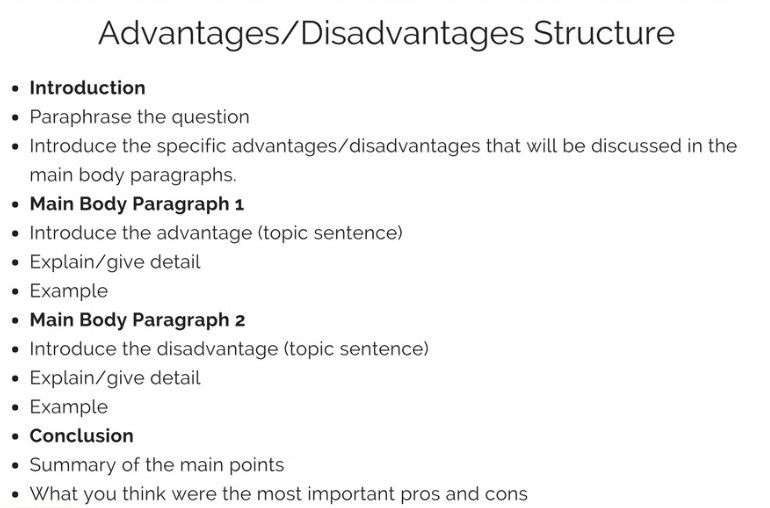
The Best Structure you can use for this type of Essays:

Introduction
  • Paraphrase the question
  • Outline the sentence
Advantages
  • The topic of the sentence (advantage 1)
  • Explain how it is an advantage
  • Write an example
Disadvantages
  • The topic of the sentence (disadvantage1)
  • Explain how it is a disadvantage
  • Write an example
Conclusion

Write a summary of the main points

Four paragraphs are sufficient to explain your point of view.

You may use any other structure you are comfortable with but this structure is approved by the IELTS examiners for the latest IELTS writing task 2 to help the students write effectively and cohesively.

Essay Type 2:

Do the Positive Impacts of this Advancement Outweigh its Negative Effects?

This type of question requires you to describe the advantages in one paragraph while disadvantages in the other paragraph, but you need to explain which of the two, advantages or disadvantages, is stronger than the other. You should not mention your personal opinion on this question for IELTS writing task 2 general.


The Best Structure you can use for this Type of Essays:

Introduction
  • Paraphrase the Question
  • Write a thesis statement (which one outweighs the other)
  • Outline the sentence
Body Paragraph 1 (The Strong Side)
  • The topic of the sentence
  • Explain how it is a strong side
  • Write an example
Body Paragraph 2 (The Weak Side)
  • The topic of the sentence
  • Explain how it is not a strong side
  • Write an example
Conclusion

Write a summary of the main points and restate the position.

Essay Type 3:

Discuss the Advantages and Disadvantages of this Essay

This type of question requires you to describe the advantages in one paragraph while disadvantages in the other paragraph. Furthermore, you should mention your personal opinion also in this question.


The Best Structure you can use for this Type of Essays:

Introduction
  • Paraphrase the question
  • Write a thesis statement (your opinion)
  • Outline the sentence
Advantages
  • The topic of the sentence
  • Explain how it is an advantage
  • Write an example
Disadvantages
  • The topic of the sentence
  • Explain how it is a disadvantage
  • Write an example
Body Paragraph 2 (Disadvantages)
  • Explain your opinion
  • Explain or give an example
Conclusion

Sentence 1- Write a summary of the main points.

Vocabulary and Phrases for IELTS Writing Task 2:

Useful Vocabulary for Joining Supportive Ideas

  • In addition
  • Moreover
  • What is more
  • Furthermore
  • Besides this

Useful Vocabulary for Joining Opposite Ideas

  • However
  • On the other hand
  • In contrast
  • Nevertheless

Important

To get a good mark in the grammar section we need to show some examples of complex structures. The following are two possible ways to do this:

Use Coordinating Conjunctions to form compound sentences.

FANBOYS: for, and, nor, but, or, yet, so

Use Subordinating Conjunctions to form complex sentences.

E.g: because, while, whereas, as, after, since, although

Key Points for Task 2 Writing

  • Task 2 essays carry 67% of the marks for the IELTS Writing Test.
  • You should write 250 – 280 words
  • You have 1 hour to complete both writing tasks but should not spend more than 40 minutes on this task as you will need 20 minutes for Task 1.
  • Writing fewer than 240 words will result in marks being deducted.
  • Here is the sample answer for IELTS Writing Task 2 Advantage and Disadvantage.
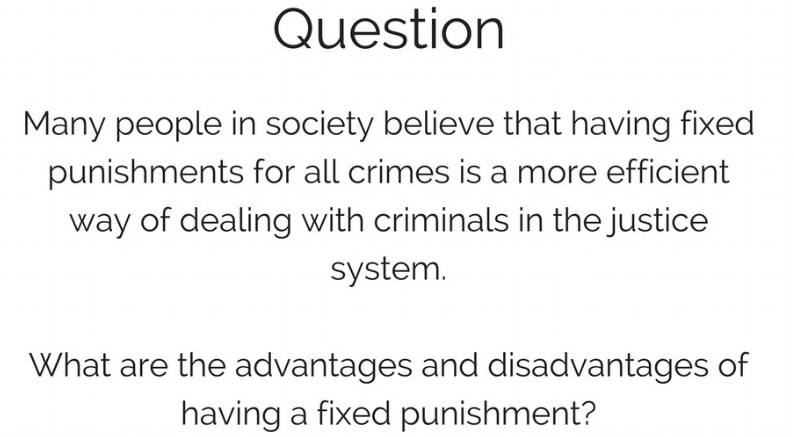
HOW TO WRITE ADVANTAGE AND DISADVANTAGE ESSAY : SAMPLE Question

Sample Answer :

Here is the sample for the how to write advantage and disadvantage essay :

There is an ongoing debate on the merits of having a rigid discipline system in place for all crimes committed. This essay will firstly discuss, how having fixed punishments could lead to a more competent judiciary system as the biggest advantage. Secondly, this essay will discuss how this may lead to people being punished in the same way for both minor and major crimes as the primary disadvantage.

On the one hand, the main advantage of having a standardised punishment system could lead to a downward trend in crime, as the system would serve as a deterrent. This would allow the courts to easily hand out justice to all criminals, in order to make the judiciary system more powerful. For example, in some states in the USA, there are tough sanctions in place for criminals, including death by lethal injection. In 2014, the New York Times reported that up to 65% of criminals who were incarcerated for high-level crimes (murder, manslaughter) received the lethal injection.

On the other hand, the primary disadvantage of having fixed punishments is that people who have committed low-level crimes may also be given harsh sentences, in the same way as those who have been sentenced for high-level crimes. This may make the system unjust, as the punishment should befit the crime. For instance, a person who may have acted in self defence, should have their case heard in full, before being given a punishment befitting of someone who has been part of a violent act.

In conclusion, fixed punishment offers an interesting choice for effective crime deterrence and a faster judicial process.  However, its inherent flaw in generalising all crime without carefully considering mitigating circumstances would compromise the very essence of justice and should warrant a closer study before fully implementing it to any modern judicial system.

(Word Count = 302 / Band Score 9)

How to Describe a Table in IELTS Writing Task 1?

How to Describe a Table in IELTS Writing Task 1?

This post is about how to describe a table in IELTS writing task 1?

Important factors for scoring good band scores in IELTS Writing Task 1 Table:

Task achievement: The essay should identify a major point of interest in the data and supports with relevant figures from the table.

Coherence and cohesion: The essay should organise into paragraphs which are connected logically. There is an overall description at the beginning or at end of the answer.

Lexical resource: The essay should use vocabulary appropriate to comparing data such as ‘accounted for’ and ‘witnessed a significant rise’. Native-like collocation is used throughout the model answer.

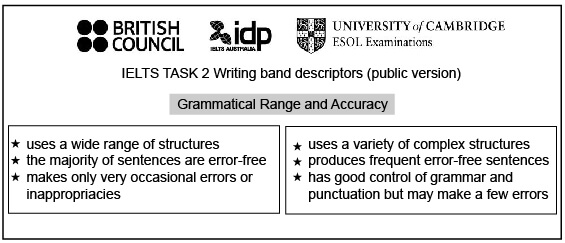
Grammatical range and accuracy: The essay should include many examples of complex sentences that combine a main point with supporting evidence in two clauses.

In IELTS writing task 1 of academic module, you find different types of diagrammatic questions. Table is one of such questions that can be asked in IELTS writing task 1. Table questions appear in different ways in the exam. There can be a single table or two tables. It can also be the case that you have a table with a combination of other diagram such as bar chart, line graph or pie chart. Whatever the question is, you can follow the below easy steps in order to describe a table effectively.

The first step to follow in any type of question in IELTS writing task 1 is to read the question carefully and understand it well. In the question statement, you will find the basic information of what the table is about and then you can check the table heading which would also give you more clarity of the question. Afterwards, you can check the main headings of columns and rows with a slight glare at the figures. Do not analyse the figures deeply at this stage.

How to Describe a Table in IELTS Writing Task 1 : Tips and Tricks

We will have a look at the following parts:

  • Introduction
  • General Overview
  • In-depth analysis
  • General tips

Introduction

Your introduction should be quite impressive as it makes the first impression on the examiner. It could potentially make or break your overall score!

If there are multiple graphs and each one presents a different type of data, you can write which graph represents what type of data and use ‘while’ to show a connection.

For example: The given bar graph shows the amount spent on fast food items in 2009 in the UK, while the pie chart presents a comparison of people’s ages who spent more on fast food.

For multiple graphs and/ or table(s), you can write what they present in combination instead of saying which each graph depicts.

Your introduction alone should be about 20 to 30 words.

General overview

You can write your introduction (paraphrasing the question) and General overview in the same paragraph, or you can also write both in separate paragraphs. It doesn’t really matter which you chose, but you will have to write both!

Never provide any data (give numbers, percentages or quantity) in your general overview. You only start discussing the data in detail in the in-depth part. So, you should give the most striking features of the graph that could be easily understood at a glance.

  • In your general overview do not write:
    • At first glance the graphs reveals that 70% of the male were employed in 2001, while 40 thousand women in this year had jobs.
  • Instead write:
    • At first glance the graphs reveals that more men were employed than their female counterparts in 2001 and that almost two-third of the females were jobless in the same year.

Your Introduction (paraphrasing the question + general overview) should have a word count of about 75 – 80 words.

In-depth analysis

Your in-depth analysis is the next part of your writing and the biggest chunk of the task. So, it should have about 75-80 words. Combined with the 75-80 words of your introduction and General overview you have your 150 to 160 words. This means you have covered the 150 word count.

Depending on the question, you can either use 1 or 2 paragraphs for the body of the in-depth analysis. Just remember to group things together logically.

General tips

Take time to analyse and plan your writing, these are essential parts of any writing. It makes sure you know what you are writing about and it saves time when you are writing.

Write in pencil, that way you can easily correct your mistakes in the final 2 minutes, as well as replace words by synonyms if you are using the same words too often.

Make your point clearly

How you structure your answer can help set the overall flow of your answer.
Usually, two main paragraphs will be used so that you can describe each group of data. That means that one group of data would be described in one paragraph whilst the second group of data would be a new a paragraph.

This keeps things organised and helps you keep track of your overall point.

Compare & Contrast with Exceptions

For example, the first paragraph could be comparing the data whilst the second paragraph is talking this in more detail, whilst a final summary sentence ties it all nicely.

This helps you stay on track and easily cover all the IELTS bases too.

Be a master and prepare fully with these tips

Use practice tests – the more experience, the better!

Review sample essays.

Time yourself as you practice more and more.

Try answering the question without using a dictionary.

Click here for more help with your IELTS Academic Task 1 .

IELTS Table Vocabulary Phrases

Warning: Use these in context.

An inspection of the data in the first table clearly shows
It is apparent from this table that considerable …
In the third column there is a distinct trend of …
What stands out in the table is …
Closer inspection of the table shows …
As the table shows, there is a significant decrease …
There is a significant difference between column A and column B, most notably…
An inspection of the data in the table reveals that…

What stands out in this table …

…is the general pattern of
…is the difference between
…is the wide disparity between
…is the rapid increase of
…is the growth of
…is the high rate of

Fancy Sentences

The figure for 1999 is almost three times that of 2010.
The figure for 2011 is exactly four times that of 2010.
It is clear that the figures between 2001 and 2010 are broadly in the same range.

Grouping

The figures between 1999 and 2000 are very similar to those of the prior year.
The figures in column A and B are almost identical.

Have a look at some more IELTS writing task tutorials.

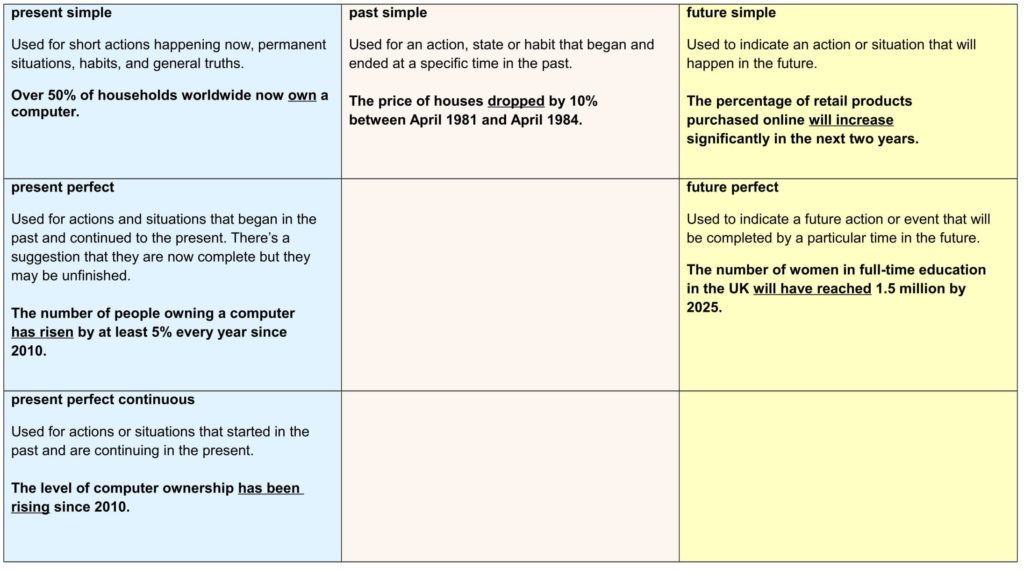
HOW TO DESCRIBE A TABLE IN IELTS WRITING TASK 1 : Tenses

Use past simple (e.g. “increased) to write about the past.

Basic Example: “The number of people increased…” or “Several houses were built in the northern area…”

Whenever you are writing about the past, use past simple (e.g. “was”, “increased”). It’s no problem if you use present perfect (e.g. “have increased) or past perfect (e.g. “had increased”) if it’s correct, but most of the time it’s unnecessary.

The choice of which tense to use will be determined by whether or not the graphic contains dates and, if it does, whether the dates are in the past or the future.

Follow these guidelines:

  • No date – use the present tense
  • Dates in the past – use the past tense
  • Dates in the future – use the future tense

The tenses you are most likely to need are:

   – Present tense – present simple, present perfect or present perfect continuous

If we don’t have dates, and so present tense must be used. 

For example,

Cooking utilises 5%, standby 5% and lighting 11% with total utilisation of 21% of the power while refrigerators need 12% electricity. All other appliances consume the rest 24% of the energy share.

   – Past tense – past simple

If the dates are in the past, you would have to use Past Tense.

For example, 

Among the full-time employed people, men had about 45 hours of leisure time on an average per week compared to the almost 38 hours of leisure time for women.

   – Future tense – future simple or the future perfect

If the dates are in the future, you would have to use future tense.

For example,

The life expectancy is predicted to rise in every country, which will be 23% and 25 per cent in 1940 in Sweden and USA respectively.

The table below gives explanations of these verb tenses and examples from Task 1 essays.

How to Describe Trends

The two most useful grammatical structures for describing trends are:

1) Noun phrase + verb + adverb

    For example,

The number of unemployed women fell significantly.

2) There + be + adjective + in + noun phrase

    For example:

There was a dramatic improvement in the percentage of people in employment.


How to Describe Increases and Decreases

The two most useful grammatical structures for describing increases and decreases are:

1) Noun phrase + verb + adverb

For example,

The popularity of social media climbed steadily.

2) There + be + noun + in + noun phrase

For example,

There was a fluctuation in university applications.

There is now a swimming pool in the location of the old factory.


How to Make Comparisons

1) More/fewer/less + noun + than

    For example,

More teenagers play computer games than a sport.

2) Most/least + adjective

    For example,

The most common childhood illness in 1979 was chickenpox.

3) More/less + adjective + than

    For example,

Cruises were more popular than beach holidays in 2012.

4) High/low/few -er + than

    For example,

lower number of teenagers play a sport than play computer games.

5) High/low/large/small -est

    For example,

The largest proportion of immigrants came from Mexico.

These sentence structures are valuable tools for getting high marks for your Writing IELTS Task 1 essay, so practice using them.

2 Common Grammatical Errors

For many students, two aspects of grammar that are a particular problem are:

  • Prepositions
  • Articles


Prepositions

There are two specific prepositions that you will probably use numerous times in your Task 1 essay when reporting change – ‘in’ and ‘of’. They are easy to get wrong.

Follow this general rule:

  • When stating the specific value of the change (number, amount, percentage etc.) – use ‘of’.
  • When stating what has changed – use ‘in’.

For example:

  • An increase of 20%.
  • An increase in the number of over 60’s taking exercise classes.
  • A drop of almost a half.
  • A drop in house prices.
  • An improvement of 45 units per week.
  • An improvement in retail sales from April to June.

‘Of’ is also used after a value. You will probably want to use proportional values in your Task 1 essay so here are some examples.

  • a small percentage of
  • just under a quarter of
  • exactly a half of
  • roughly three quarters of
  • a significant majority of
  • a high number of

Articles

Many languages do not have articles, and native speakers of those languages can find it a huge challenge to remember to use them.

In English, there are three articles – thea, and an. Each is used in specific instances.

1) With singular and plural nouns:

  • Use the before singular and plural nouns when the noun is a specific thing. For example,

The bar graph illustrates how many male and female students were studying full-time and part-time in Britain during the years 1970/1971, 1980/1 and 1990/1.

  • Use a or an before a singular noun or noun phrase when the noun is non-specific and could be any one of a group or type.
  • Use a before a noun or noun phrase beginning with a consonant. Use an before a noun or noun phrase beginning with a vowel.

For example,

Less than 30% of the population took a foreign holiday between 1975 and 1985.

There was an upward trend in families taking an annual holiday abroad after 1990.

2) Noun combinations:

Also, use a/an before adjective singular noun combinations such as these from our preposition list:

  • a small percentage of
  • an insignificant minority of
  • a high number of

The key to improving your grammar is to know your weaknesses and focus on these as you practice and when you check your work in the exam.

We now have everything we need to begin planning and writing our IELTS table chart essay.

How to Describe a Table in IELTS Writing Task 1 : Sample Question

Here’s our practice question:

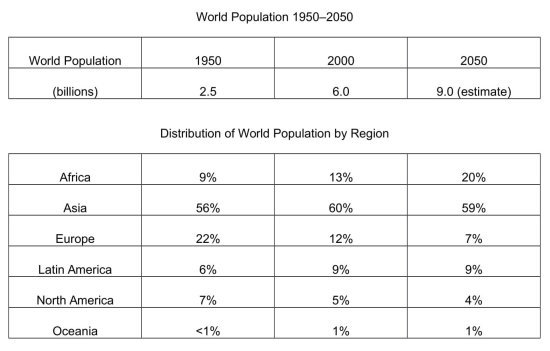
The tables below give the distribution of world population in 1950 and 2000, with an estimate of the situation in 2050.

Summarise the information by selecting and reporting the main features, and make comparisons where relevant.

Write at least 150 words.

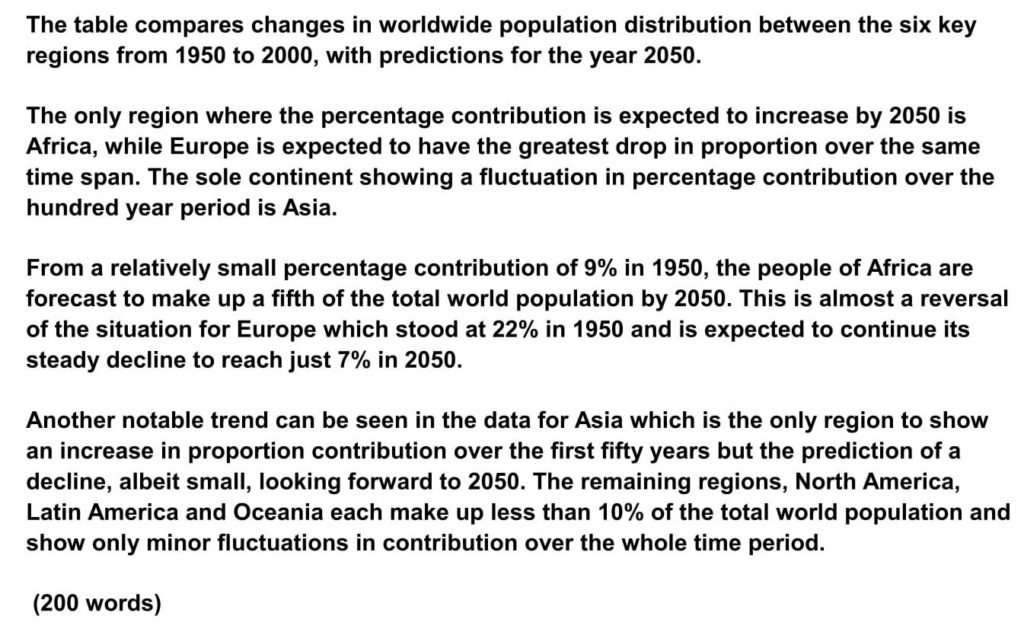
Finished IELTS Table Chart Essay

Writing task 2 – Advantages and disadvantages

WRITING TASK 2 – ADVANTAGES AND DISADVANTAGES

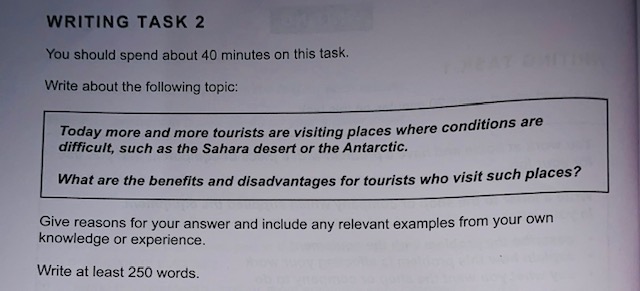
Writing Task 2

You should spend about 40 minutes on this task.

Write about the following topic:


TODAY MORE AND MORE TOURIST ARE VISITING PLACES WHERE CONDITIONS ARE DIFFICULT, SUCH AS THE SAHARA DESERT OR THE ATLANTIC.

WHAT ARE THE BENEFITS AND DISADVANTAGES FOR TOURIST WHO VISIT SUCH PLACES?


Give reasons for your answers and include any relevant examples from your own knowledge or experience.

Write at least 250 words.


Get our Latest Post/Blogs here.

Download IELTS Practice Material for Free.


Sample Answer 1

WRITING TASK 2 – ADVANTAGES AND DISADVANTAGES

The globalization is the most important topic for the whole world. They want to know what is happening around and that is the reasons behind that. The people discovering the things and getting well aware about hidden issues. The tourists are visiting the deserts more as compare to other different places. Although the conditions are bit more tough in such type of places but they are excited to know regarding each and everything.

The advantage to visit such areas is that they actually want to let people know what is the difference between the life in desert and the other normal places. It is shown in one of the Australian movie which is based on a Japanese. In movie the Japanese goes to desert for some thesis about how to survive in deserts. His car stuck in the desert. He just keeps try to get out of there and at last he get success. After moving forward some distance he see a cannel of water and he jump into that water but depth is not so much and he dies because his neck hit with stone into the water. So it make us realize that when you found a cannel in deserts especially first confirm that how deep it is.

Secondly, the cons to visit the deserts is that the casualty rate is more in deserts as compare to other discoveries. When tourists go to the dry places, they even do not know either they will return back to home or not.

The case is that the people are going to desert more because there are more things to discover like mines, minerals, medical related preventions etcetera. Here is another example that once people got diamonds from desert such was in Dubai. They took it as pebbles but when they came back to home they realize those were diamonds.

(308 words).

This is an answer which achieved a Band 6.0 score. Here is the examiner’s comment:

The candidate focuses on tourists visiting the desert, rather than on visiting places where conditions are difficult, so the prompt is not fully addressed. There is an attempt to discuss some benefits and disadvantages, but ideas are limited. The response is organised into paragraphs, but the focus of each is not always clear,while cohesive devices are sometimes faulty and the subject of reference pronouns is sometimes ambiguous Although the conditions are a bit more difficult in such type of places but they are excited. The range of lexis is sometimes limited. Yet the candidate is quite adventurous at times some research about how to survive in deserts. There are attempts to produce complex structures, but these usually contain errors.


Sample Answer 2

WRITING TASK 2 – ADVANTAGES AND DISADVANTAGES

The globalization is the most significant subject for all the individuals. They need to recognize what’s going on around and that is the purposes behind that. The individuals finding the things and getting very much aware about concealed things. The travelers are visiting the deserts more as contrast with different spots. In spite of the fact that the conditions are bit increasingly troublesome in such sort of spots however they are eager to think about each and everything.

The advantages to visit such zones is that they really need to tell individuals what is the distinction between the life in desert and other typical spots. It is appeared in one of the Australian film which is cast on a Japanese. In film the Japanese goes to abandon for some examination about how to make due in deserts. His vehicle stuck into the desert. He just keeps attempt to leave and toward the end he get Success. In the wake of pushing ahead some separation he watch a cannel of water and he bounce into that water however profundity isn’t so a lot and he passes on in light of the fact that his neck hit by stone into the water. So it cause us to understand that when you found a cannel in deserts particularly first ensure that how profound it is.

Furthermore, the disservices to visit the deserts is that the loss rate is more in deserts as contrast with different revelations. At the point when sightseers go to the desert, they even don’t know possibly they will return back to home or not.

The case is that the individuals are going to abandon more on the grounds that there are more things to find like mines, minerals, clinical related avoidances and so on. Here is another model that once individuals got precious stones from desert such was in UAE. They accepting it as rocks yet when they returned to home they understand that were precious stones.

(310 words).

This is an answer which achieved a Band 6.0 score. Here is the examiner’s comment:

The competitor centers around travelers visiting the desert, as opposed to on visiting places where conditions are troublesome, so the brief isn’t completely tended to. There is an endeavor to examine a few advantages and hindrances, however thoughts are constrained. The reaction is sorted out into passages, however the focal point of each isn’t generally clear,while strong gadgets are in some cases broken and the subject of reference pronouns is in some cases questionable Although the conditions are more troublesome in such kind of spots yet they are energized. The scope of lexis is now and then constrained. However the competitor is very daring now and again some examination about how to get by in deserts. There are endeavors to deliver complex structures, yet these normally contain blunders.


Read more blogs.

Like and Subscribe our Youtube channel Way To Crack IELTS.