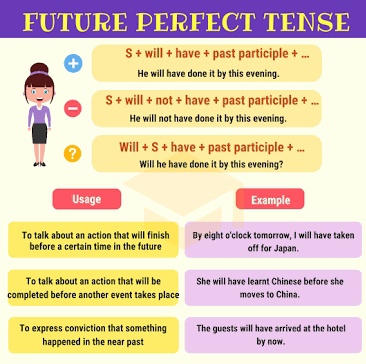
The Future Perfect tense expresses action in the future before another action in the future. This is the past in the future.
Future Perfect Tense के वाक्यो के अन्त मे हिन्दी मे “चुका होगा”, “चुके होंगे”, “चुकी होगी”, “चुका हूंगा” आता है ।
Structure of Sentence
Subject + will/shall + have + Past Participle + Object.
With He/She/It/You/They/Plural noun/Singular Noun need to use “will“.
With I/We/ need to use “shall“.
Examples
मै भोजन कर चुका हूंगा।
I shall have eaten food.
हम खेल चुके होंगे।
We shall have played.
वह सो चुका होगा।
He will have slept.
Future Perfect Tense – Negative Sentence
For converting Future Perfect Tense sentences into negative sentences the formula is that you add ‘not’ before the verb and the rest of the rule remains the same.
Structure of Sentence
Subject + will/shall + not + have + Past Participle + Object.
With He/She/It/You/They/Plural noun/Singular Noun need to use “will“.
With I/We/ need to use “shall“.
Examples
मै भोजन नही कर चुका हूंगा।
I shall not have eaten food.
हम खेल नही चुके होंगे।
We shall not have played.
वह सो नही चुका होगा।
He will not have slept.
Future Perfect Tense – Interrogative Sentence
For converting Future Perfect Tense sentences into interrogative sentences the formula is that you add ‘Will/ Shall’ at the start of the sentence followed by the subject and the rest of the rule remains the same. The sentence ends with a question mark (?).
Structure of Sentence
Will/shall+Subject + have + Past Participle + Object.
With He/She/It/You/They/Plural noun/Singular Noun need to use “will“.
For converting Future Perfect Tense sentences into negative interrogative sentences the formula is that you add Will/ Shall at the start of the sentence, then the subject and then ‘not be’ and the rest of the rule remains the same. The sentence ends with a question mark (?).
Structure of Sentence
Will/shall+Subject + not + have + Past Participle + Object.
With He/She/It/You/They/Plural noun/Singular Noun need to use “will“.
With I/We/ need to use “shall“.
Examples
क्या मै खेल नही चुका हूंगा?
Had I not played?
क्या माली घास नही काट चुका होगा?
Will the gardener not have cut the grass?
क्या मै खेल नही चुका हूंगा?
Shall I not have played?
FUTURE PERFECT TENSE
Future Perfect Tense (Passive Form)
The future perfect tense forms are made by putting ‘will / shall + have’ before the past participle form of the verb. These sentences can be changed into the passive if the active verb has an object. The passive verb form in the future perfect tense is made by putting ‘will / shall + have been’ before the past participle form of the verb.
Structure Of Sentence
Object + will/shall + have + been + the Past Participle form of the verb+ by + Subject.
With He/She/It/You/They/Plural noun/Singular Noun need to use “will“.
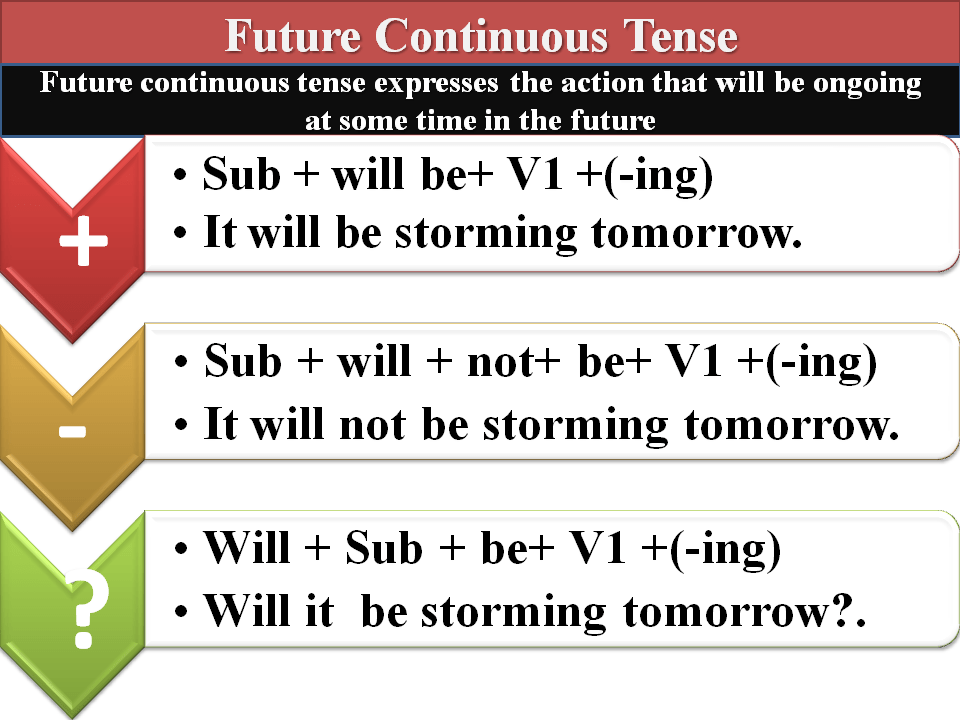
The future continuous tense, sometimes also referred to as the future progressive tense, is a verb tense that indicates that something will occur in the future and continue for an expected length of time.
Future Continuous Tense के वाक्यो के अन्त मे हिन्दी मे “रहा होगा”, “रहे होंगे”, “रही होगी” आता है ।
Structure of Sentence
Subject + will/shall + be + First Form Of Verb + ing + Object
With He/She/It/You/They/Plural noun/Singular Noun need to use “will” along with First Form of Verb.
With I/We/ need to use “shall” along with First Form of Verb.
FUTURE CONTINUOUS TENSE – Examples
मै खाना खा रहा होगा।
I shall be eating food.
हम खेल रहे होंगे।
We shall be playing.
चूहे दौड रहे होंगे।
Rats will be running.
Future Continuous Tense – Negative Sentence
For converting Future Continuous Tense sentences into negative sentences the formula is that you add ‘not’ before the verb and the rest of the rule remains the same.
Structure of Sentence
Subject + will/shall + not + be + First Form Of Verb + ing + Object
With He/She/It/You/They/Plural noun/Singular Noun need to use “will” along with First Form of Verb.
With I/We/ need to use “shall” along with First Form of Verb.
Examples
बच्चे सो नही रहे होंगे।
Children will not be sleeping.
हम स्नान नही कर रहे होंगे।
We shall not be bathing.
मै आज स्कूल नही जा रहा होगा।
I shall not be going to school today.
Future Continuous Tense – Interrogative Sentence
For converting these sentences into interrogative sentences the formula is that you add Will/ Shall at the start of the sentence followed by the subject and the rest of the rule remains the same. The sentence ends with a question mark (?).
Structure of Sentence
Will/shall + Subject + be + First Form Of Verb + ing + Object
With He/She/It/You/They/Plural noun/Singular Noun need to use “will” along with First Form of Verb.
With I/We/ need to use “shall” along with First Form of Verb.
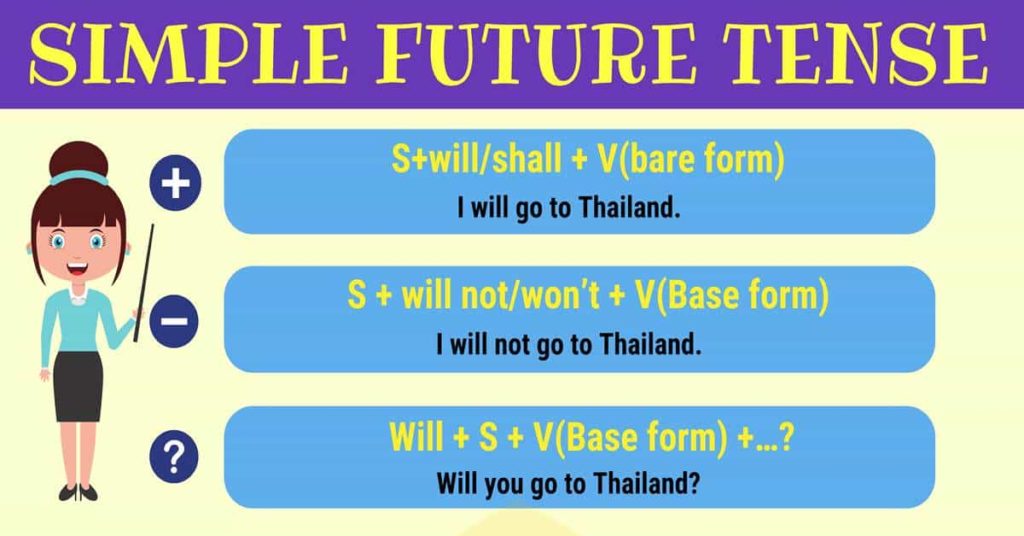
The simple future tense is used when an action is promised/thought to occur in the future.
Simple Future Tense के वाक्यो के अन्त मे गा, गे, गी आता है ।
Structure of Sentence
Subject + will/shall + First Form of Verb + Object
With He/She/It/You/They/Plural noun/Singular Noun need to use “will” along with First Form of Verb.
With I/We/ need to use “shall“.
Examples
मै प्रतिदिन स्नान करूँगा |
I shall take bath everyday.
हम उसका पता जानेंगे ।
We shall know his address.
आप नींद मे बोलोगे |
You will talk in your sleep.
Simple Future Tense – Negative Sentence
The future is the tense used to express future events. We use the future simple structure to introduce predictions, beliefs or intentions about the future.
When expressed in its negative form, the verb denies something about the subject.
Structure of Sentence
Subject + will/shall + not + First Form of Verb + Object
With He/She/It/You/They/Plural noun/Singular Noun need to use “will” along with First Form of Verb.
With I/We/ need to use “shall“.
Examples :
तुम उत्तर नहीं जानोगे |
You will not know the answer.
हम तुम पर विश्वास नही करेंगे ।
We shall not believe you.
सर्दी मे फूळ नही खिलेंगे |
Flowers will not bloom in winter.
Simple Future Tense – Interrogative Sentence
We use the future simple, in the interrogative form, to ask for predictions, beliefs or intentions about the future.
When we use future simple in its interrogative form, we start with will followed by the subject and the verb in its base form (the sentence ends with a question mark).
Structure of Sentence
will/shall+ Subject + First Form of Verb + Object
With He/She/It/You/They/Plural noun/Singular Noun need to use “will” along with First Form of Verb.
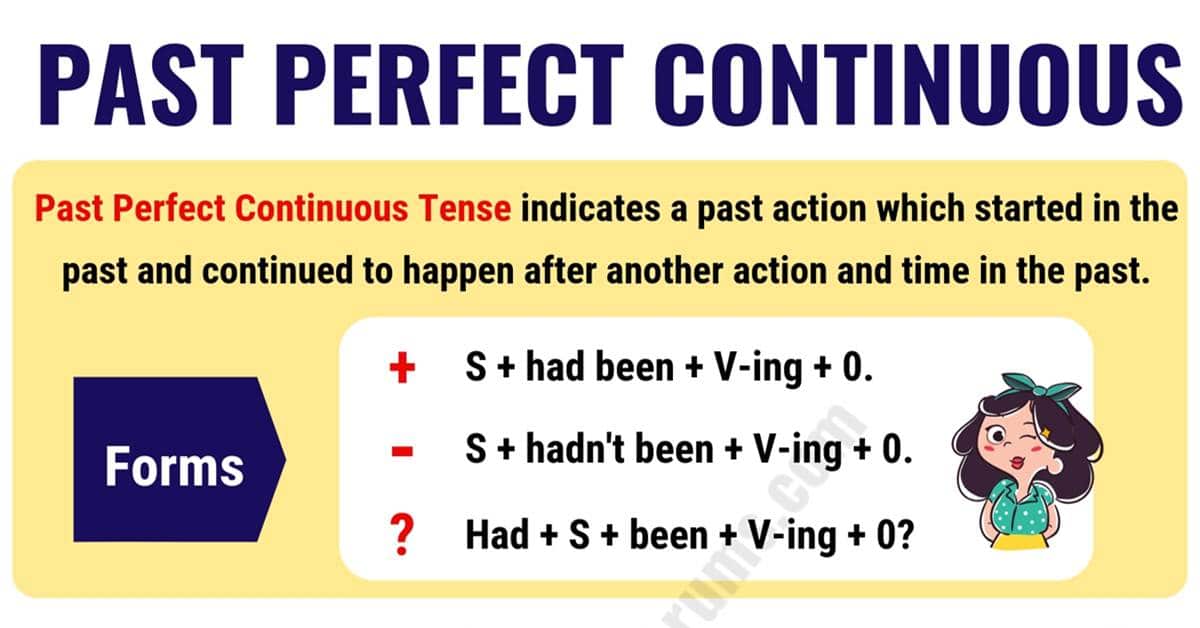
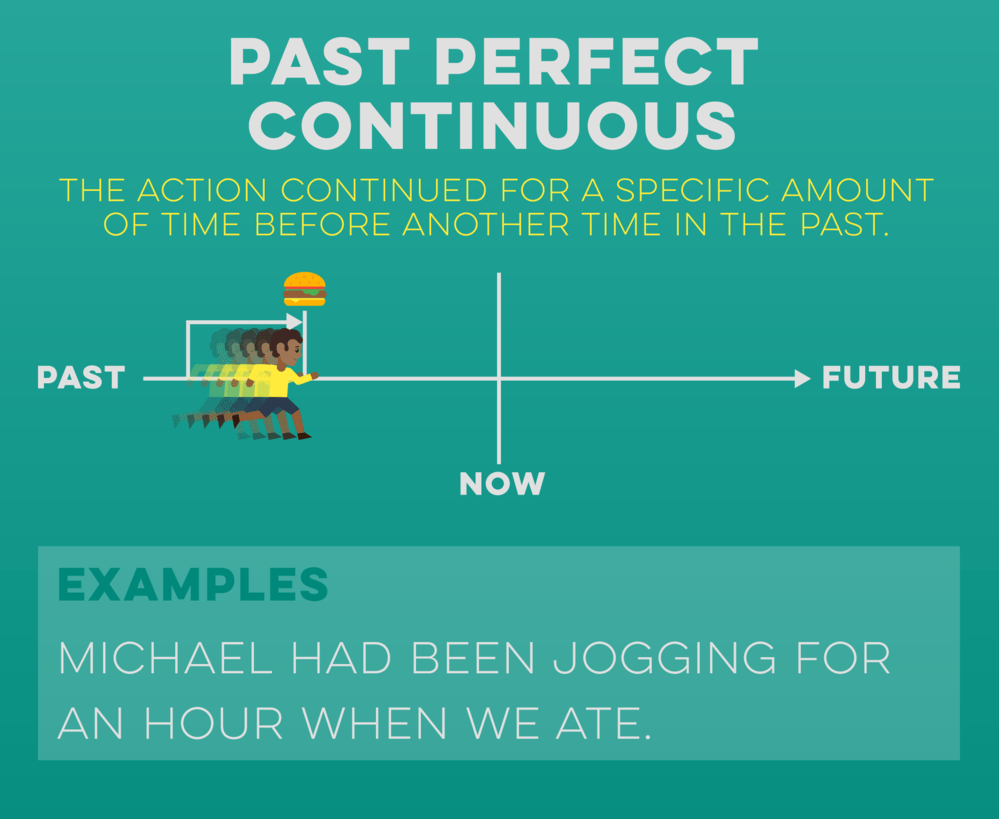
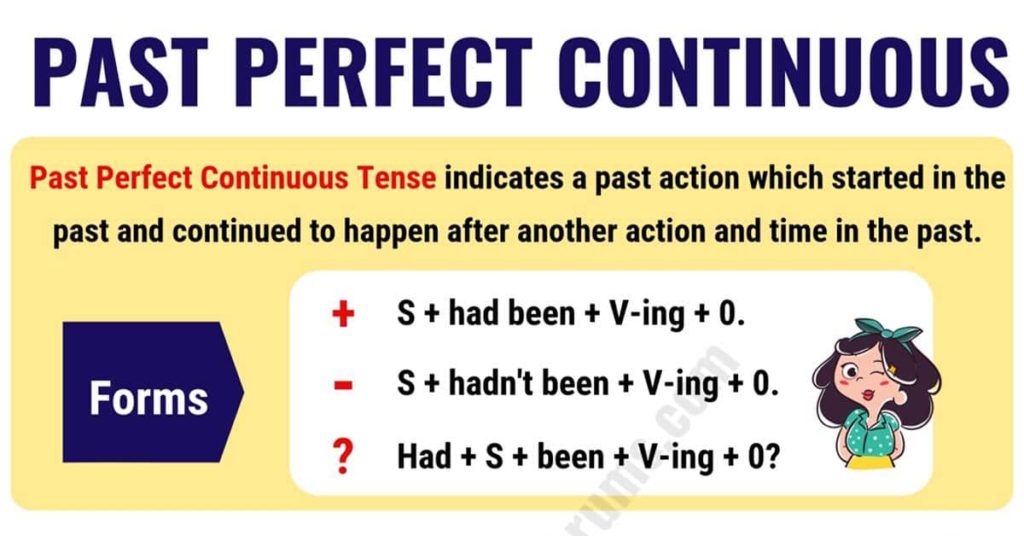
The past perfect continuous tense (also known as the past perfect progressive tense) shows that an action that started in the past continued up until another time in the past.
Unlike the present perfect continuous, which indicates an action that began in the past and continued up to the present, the past perfect continuous is a verb tense that indicates something that began in the past, continued in the past, and also ended at a defined point in the past.
Past Perfect Continuous Tense के वाक्यो के अन्त मे हिन्दी मे “से रहा था”, “से रहे थे”, “से रही थी” आता है ।
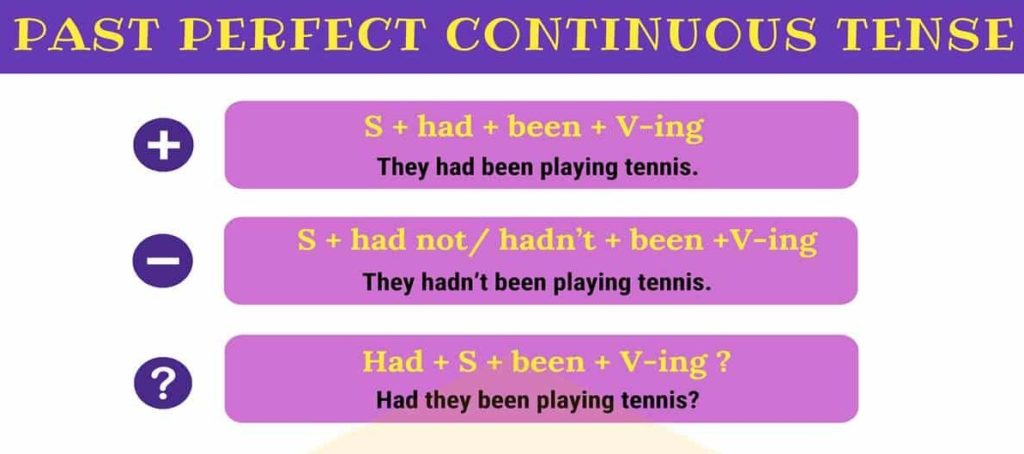
Structure of Sentence
Subject + had + been + First Form of verb + ing + Object+ since/for.
With He/She/It/I/We/You/They/Plural noun/Singular Noun need to use “had” along with First Form of verb + ing.
Since is used for definite time period for example with “Days of week“, “Month of year“, “Exact year“, “Exact Clock Timings“.
For is used for indefinite time period for example “2 hours“, “4 days“, “6 weeks“, “7 months“, “9 years“.
Examples
मै दो घण्टे से खेल रहा था।
I had been playing for two hours.
हम तीन बजे से फिल्म देख रहे थे।
We had been watching the film since three o’clock.
वह सुबह से बुन रही थी।
She had been knitting since morning.
Past Perfect Continuous Tense – Negative Sentence
For negative sentences we insert ‘not’ after the first auxiliary verb.
Structure of Sentence
Subject + had + not + been + First Form of verb + ing + Object+ since/for.
With He/She/It/I/We/You/They/Plural noun/Singular Noun need to use “had” along with First Form of verb + ing.
Since is used for definite time period for example with “Days of week“, “Month of year“, “Exact year“, “Exact Clock Timings“.
For is used for indefinite time period for example “2 hours“, “4 days“, “6 weeks“, “7 months“, “9 years“.
Examples
वह कल से नाच नही रही थी।
She had not been dancing since yesterday.
उसे सुबह से सर्दी नही लग रही थी।
He had not been feeling cold since morning.
भिखारी कई दिन से यहां पर नही खडा था।
He had not been feeling cold since morning.
Past Perfect Continuous Tense – Interrogative Sentence
For converting these sentences into interrogative sentences the formula is that you add have at the starting of the sentence followed by ‘Subject’ and then ‘been’. Rest of the rule remains the same.
Structure of Sentence
Had + ‘Subject’ + been + verb (1st form) with ‘ing’ + object (optional) + since / for + time duration?
With He/She/It/I/We/You/They/Plural noun/Singular Noun need to use “had” along with First Form of verb + ing.
Since is used for definite time period for example with “Days of week“, “Month of year“, “Exact year“, “Exact Clock Timings“.
For is used for indefinite time period for example “2 hours“, “4 days“, “6 weeks“, “7 months“, “9 years“.
Examples
क्या आप दोपहर से सो रहे थे?
Had you been sleeping since noon?
क्या वह 1991 से बूढा हो रहा था?
Had he been growing old since 1991?
क्या पिछले तीन वर्षो से किमतें बढ रही थी?
Had the prices been increasing for the last three years?
Past Perfect Continuous Tense – Interrogative Negative Sentence
In Past Perfect Continuous Tense, interrogative negative sentences are just like interrogative affirmative sentences with only use of “not” after subject.
Structure of Sentence
Had + ‘Subject’ + not + been + verb (1st form) with ‘ing’ + object (optional) + since / for + time duration?
With He/She/It/I/We/You/They/Plural noun/Singular Noun need to use “had” along with First Form of verb + ing.
Since is used for definite time period for example with “Days of week“, “Month of year“, “Exact year“, “Exact Clock Timings“.
For is used for indefinite time period for example “2 hours“, “4 days“, “6 weeks“, “7 months“, “9 years“.
Examples
क्या हम आपस मे तीन दिन से नही मिल रहे थे?
Had we not been meeting each other for three days?
क्या मै तीन वर्ष से कम्प्यूटर चलाना नही सिख रहा था?
Had I not been learning to operate computer for three years?
क्या आप पिछले तीन महीने से डाक्टर के पास नही जा रहे थे?
Had you not been going to the doctor for the last two months?
Past Perfect Continuous Tense (Passive Form)
Most reference books say that the past perfect continuous tense has no passive form.
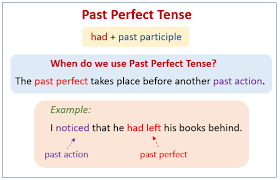
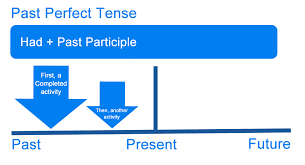
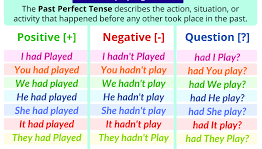
The past perfect is a verb tense used to talk about actions that were completed before some point in the past.
When to Use the Past Perfect
So what’s the difference between a past perfect and a simple past? When you’re talking about some point in the past and want to reference an event that happened even earlier, using the past perfect allows you to convey the sequence of the events. It’s also clearer and more specific.
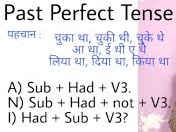
Past Perfect Tense के वाक्यो के अन्त मे हिन्दी मे “चुका था”, “चुके थे”, “चुकी थी”, “आ था”, “ई थी”, “ए थे” आता है ।
Structure of Sentence
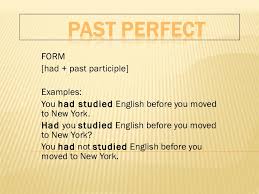
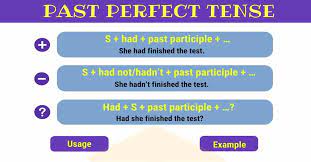
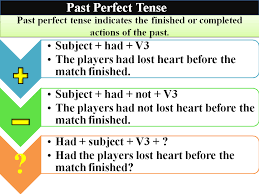
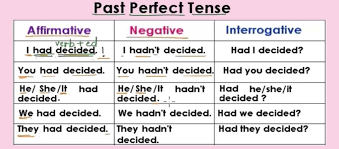
Subject + had + Past Participle + Object.
With He/She/It/I/We/You/They/Plural/Singular Noun need to use “had” along with Past Participle.
Examples
मै भोजन कर चुका था।
I had eaten food.
हम खेल चुके थे।
We had played.
वह सो चुका था।
He had slept.
Past Perfect Tense – Negative Sentence
Making the past perfect negative is simple! Just insert not between had and past participle.
Structure of Sentence
Subject + had + not + Past Participle + Object.
Examples
मैने यह नाटक नही देखा था।
I had not seen this play.
उसने नृत्य नही सीखा था।
She had not learnt to dance.
तुमने कभी शरारत नही की थी।
You had never made a mischief.
Past Perfect Tense – Interrogative Sentence
Auxiliary verb used remains same as in positive and negative sentences- i.e. ‘had’. Also, the past participle or third form of main verb is used and the sentences should start with the auxiliary verb in the beginning.
Structure of Sentence
Had +Subject + Past Participle + Object + ?.
Examples
क्या वह स्कूल से आ चुका था?
Had he come back from school?
क्या माली घास काट चुका था?
Had the gardener cut the grass?
क्या मै खेल चुका था?
Had I played?
Past Perfect Tense – Interrogative Negative Sentence
Auxiliary verb used remains same as in positive and negative sentences- i.e. ‘had’. Also, the past participle or third form of main verb is used along with ‘not’ and the sentences should start with the auxiliary verb in the beginning.
Had +Subject + not + Past Participle + Object + ?.
Examples
क्या मै खेल नही चुका था?
Had I not played?
क्या हमने उनसे बात नही की थी?
Had we not spoken to him?
क्या वह कुत्ते के काटने से नही मरा था?
Had he not died of a dog bite?
Past Perfect Tense (Passive Form)
In the past perfect form with the passive, we always use ‘had been’ + the past participle form.
Structure Of Sentence
Object + had + been + the Past Participle form of the verb+ by + Subject.
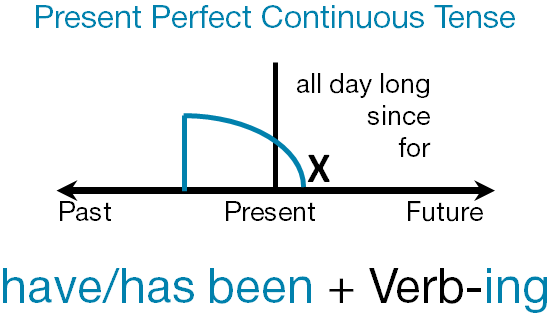
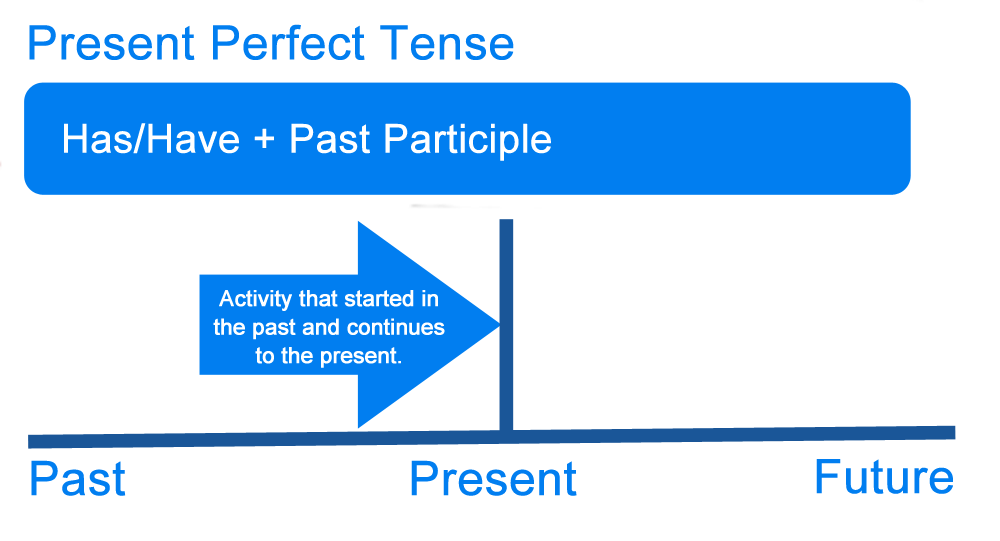
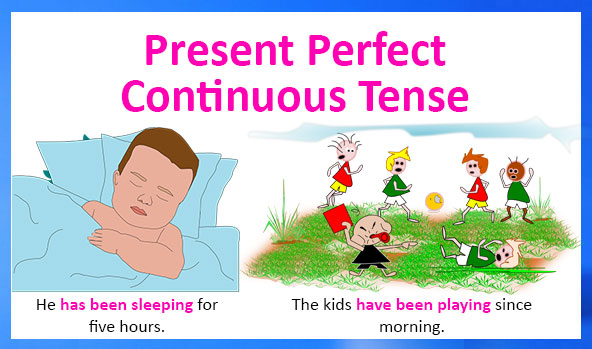
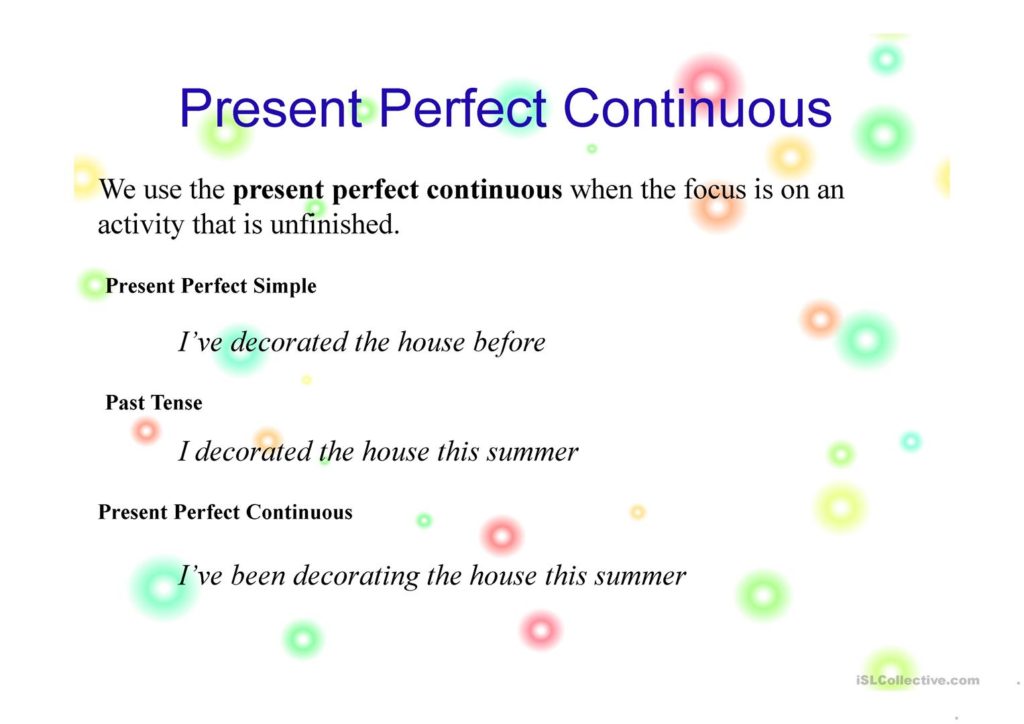
The present perfect continuous tense (also known as the present perfect progressive tense) shows that something started in the past and is continuing at the present time. The present perfect continuous is formed using the construction has/have been + the present participle (root + -ing).
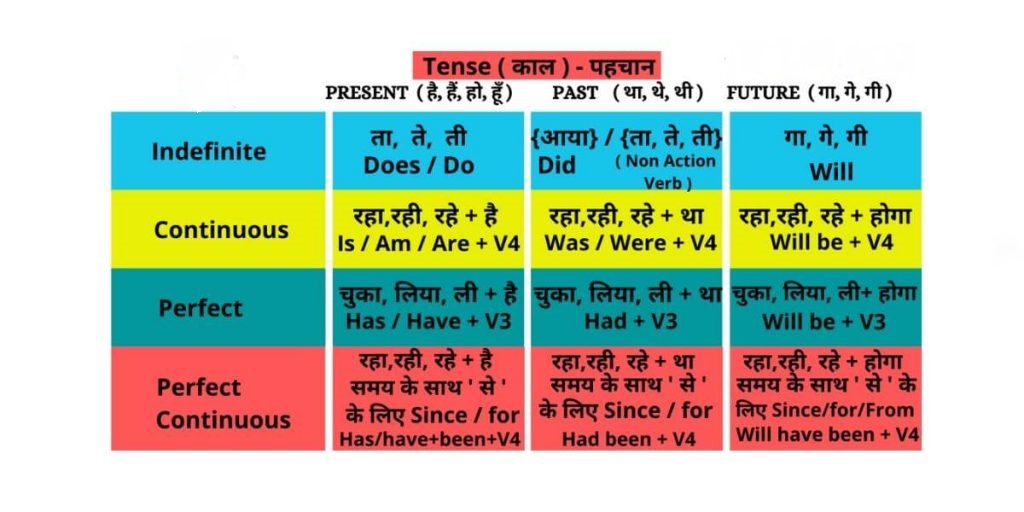
Present Perfect Continuous Tense के वाक्यो के अन्त मे हिन्दी मे “से रहा है”, “से रहे है”, “से रही है” आता है ।
Structure of Sentence
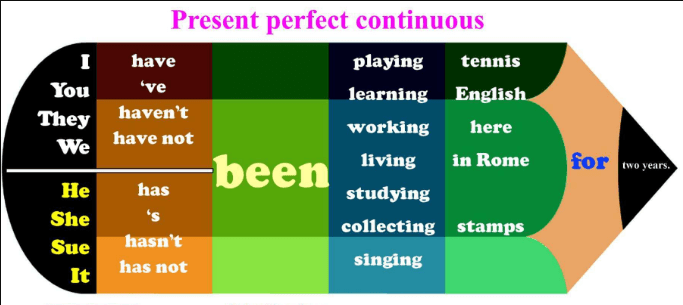
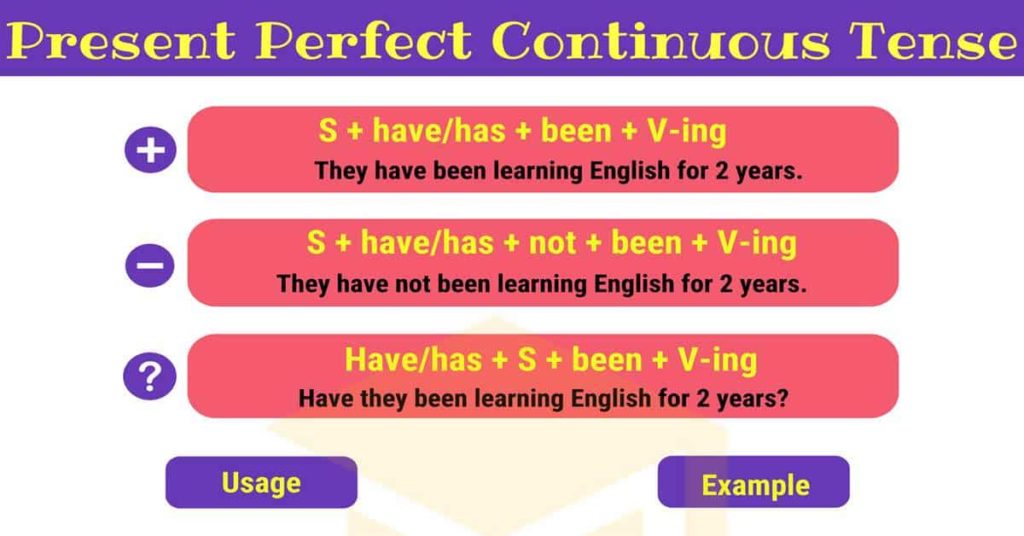
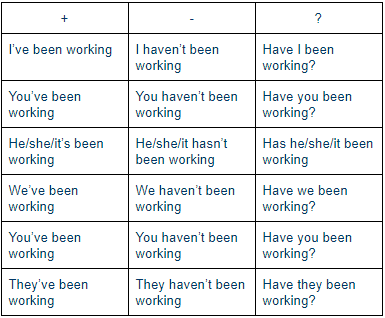
Subject + has/have + been + First Form of verb + ing + Object+ since/for.
With He/She/It/Singular Noun need to use “has” along with First Form of verb + ing.
With I/We/You/They/Plural nounneed to use “have” along with First Form of verb + ing.
Since is used for definite time period for example with “Days of week“, “Month of year“, “Exact year“, “Exact Clock Timings“.
For is used for indefinite time period for example “2 hours“, “4 days“, “6 weeks“, “7 months“, “9 years“.
Examples
मै दो घण्टे से खेल रहा हूं।
I have been playing for two hours.
हम तीन बजे से फिल्म देख रहे है।
We have been watching the film since three o’clock.
For converting these sentences into interrogative sentences the formula is that you add have at the starting of the sentence followed by ‘Subject’ and then ‘been’. Rest of the rule remains the same.
Structure of Sentence
Has/Have + ‘Subject’ + been + verb (1st form) with ‘ing’ + object (optional) + since / for + time duration?
With He/She/It/Singular Noun need to use “has” along with First Form of verb + ing.
With I/We/You/They/Plural nounneed to use “have” along with First Form of verb + ing.
Since is used for definite time period for example with “Days of week“, “Month of year“, “Exact year“, “Exact Clock Timings“.
For is used for indefinite time period for example “2 hours“, “4 days“, “6 weeks“, “7 months“, “9 years“.
Examples
क्या आप दोपहर से सो रहे है?
Have you been sleeping since noon?
क्या वह 1991 से बूढा हो रहा है?
Has he been growing old since 1991?
क्या पिछले तीन वर्षो से किमतें बढ रही है?
Have the prices been increasing for the last three years?
In Present Perfect Continuous Tense, interrogative negative sentences are just like interrogative affirmative sentences with only use of “not” after subject.
Structure of Sentence
Has/Have + ‘Subject’ + not + been + verb (1st form) with ‘ing’ + object (optional) + since / for + time duration?
With He/She/It/Singular Noun need to use “has” along with First Form of verb + ing.
With I/We/You/They/Plural nounneed to use “have” along with First Form of verb + ing.
Since is used for definite time period for example with “Days of week“, “Month of year“, “Exact year“, “Exact Clock Timings“.
For is used for indefinite time period for example “2 hours“, “4 days“, “6 weeks“, “7 months“, “9 years“.
Examples
क्या हम आपस मे तीन दिन से नही मिल रहे है?
Have we not been meeting each other for three days?
क्या मै तीन वर्ष से कम्प्यूटर चलाना नही सिख रहा हूं?
Have I not been learning to operate computer for three years?
क्या आप पिछले तीन महीने से डाक्टर के पास नही जा रहे है?
Have you not been going to the doctor for the last two months?
Present Perfect Continuous Tense (Passive Form)
Most reference books say that the present perfect continuous tense has no passive form.
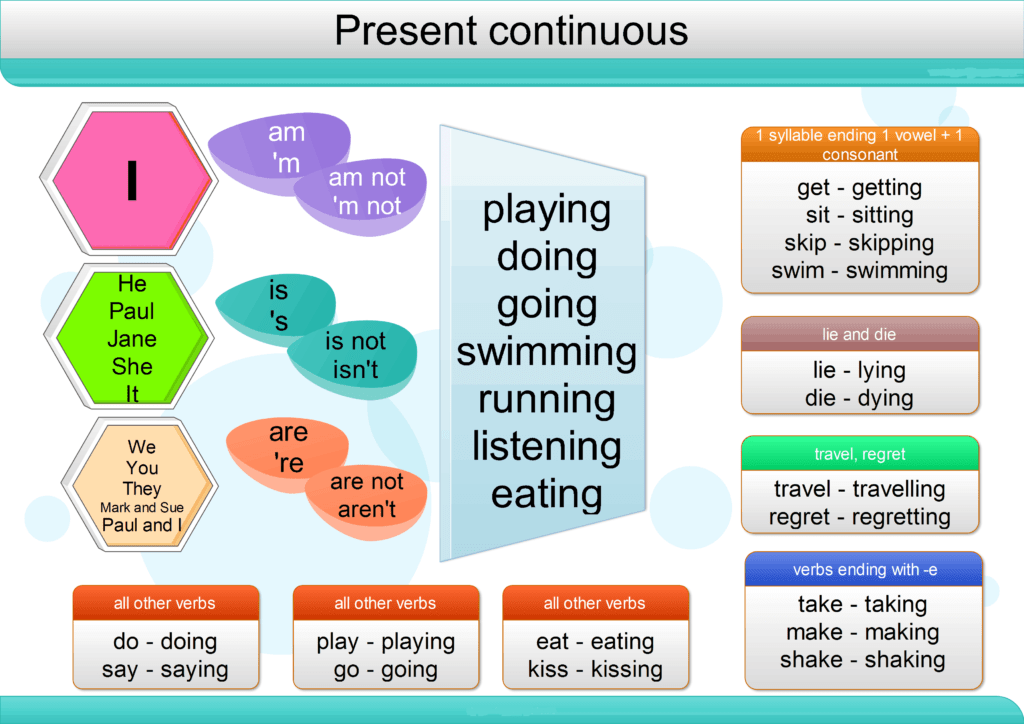
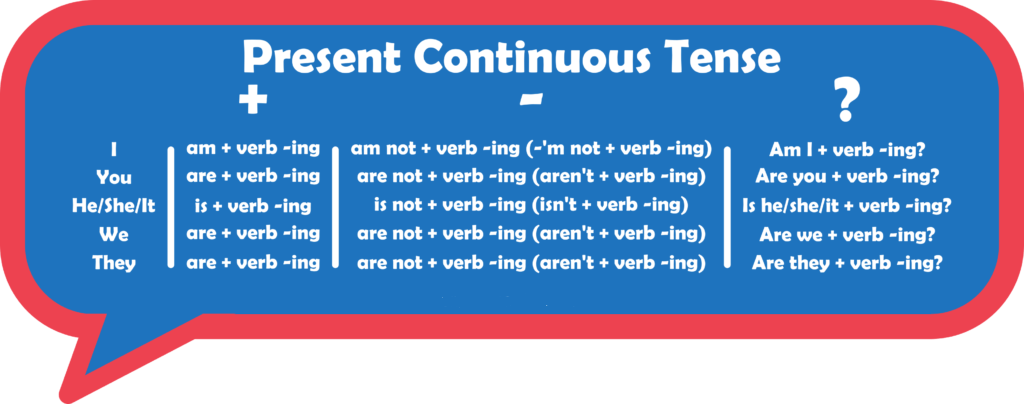
The present continuous verb tense indicates that an action or condition is happening now, frequently, and may continue into the future.
Present Continuous Tense के वाक्यो के अन्त मे हिन्दी मे “रहा है”, “रहे है”, “रही है” “रहे हो” आता है ।
Structure of Sentence
Subject + is/am/are + First Form Of Verb + ing + Object
With He/She/It/Singular Noun need to use “is” along with First Form of Verband “ing”.
With “I” need to use “am” along with First Form of Verband “ing”.
With We/You/They/Plural nounneed to use “are” along with First Form of Verband “ing”.
PRESENT CONTINUOUS TENSE – Examples
मै खाना खा रहा हूं।
I am eating food.
हम खेल रहे है।
We are playing.
चूहे दौड रहे है।
Rats are running.
Present Continuous Tense – Negative Sentence
The present continuous (or progressive) is the tense used to express situations that are happening now (before, during and after the moment of speaking). When expressed in its negative form, the verb denies that something is happening now.
Structure of Sentence
Subject + is/am/are + not + First Form Of Verb + ing + Object
With He/She/It/Singular Noun need to use “is” along with First Form of Verband “ing”.
With “I” need to use “am” along with First Form of Verband “ing”.
With We/You/They/Plural nounneed to use “are” along with First Form of Verband “ing”.
Examples
बच्चे सो नही रहे है।
Children are not sleeping.
हम स्नान नही कर रहे है।
We are not bathing.
मै आज स्कूल नही जा रहा हूं।
I am not going to school today.
Present Continuous Tense – Interrogative Sentence
The present continuous (or progressive) is the tense used to express situations that are happening now (before, during and after the moment of speaking). When expressed in its interrogative form, it is used to form questions about something that is happening now.
Structure of Sentence
Is/am/are +subject + First Form Of Verb + ing + Object+ ?
With He/She/It/Singular Noun need to use “is” along with First Form of Verband “ing”.
With “I” need to use “am” along with First Form of Verband “ing”.
With We/You/They/Plural nounneed to use “are” along with First Form of Verband “ing”.
The present continuous (or progressive) is the tense used to express situations that are happening now (before, during and after the moment of speaking). When expressed in its interrogative form, it is used to form questions about something that is not happening now.
Structure of Sentence
Is/am/are +subject + not + First Form Of Verb + ing + Object+ ?
With He/She/It/Singular Noun need to use “is” along with First Form of Verband “ing”.
With “I” need to use “am” along with First Form of Verband “ing”.
With We/You/They/Plural nounneed to use “are” along with First Form of Verband “ing”.
Examples
क्या वे जन्म दिन नही रहे है?
Are they not celebrating their birthday?
क्या बच्चे फूल नही रहे है?
Are children not plucking flowers?
क्या वह कपडे नही घो रही है?
Is she not washing clothes?
Present Continuous Tense (Passive Form)
The structure for the present continuous passive is: subject + is/are + BEING + the past participle. Note that the person who is fixing the car is not mentioned in the sentence “My car is being fixed.” Leaving out the person or thing doing the action is common in passive statements.
Structure Of Sentence
Object + am/is/are + being + the Past Participle form of the verb+ by + Subject.
How to structure for IELTS Essay causes and solution ?
IELTS causes and solutions Essay – Band 9 Guide
IELTS examiners want you to discuss the causes or reasons for the problem in one paragraph and the possible solutions to eradicate that problem in the second paragraph separately and at the end, you can provide suggestions or advice on the problem. Therefore, it is important that you find out relevant points of causes (reasons) and solutions respectively after reading the question for IELTS Writing.
The essay of IELTS Writing can be structured mainly in 4 paragraphs as follows:
1: Introduction
2: Causes & Reasons
3: Solutions
4: Conclusion
Further structuring of the paragraphs can be done as follows:
a. – Introduction
1- Paraphrase the Question
2-Outline the sentence
b. 2- 1 (Causes (reasons))
1- State the cause (reason)
2- Now, Explain how it is the cause (reason)
3-Write an example
c. 3- Body Paragraph 2 (Solutions)
1- State the solution
2-Explain how this solution can resolve the problem
3- Write an example
d. 4 – Conclusion
1- Write summary of the main points
2 – Provide suggestion or recommendation Four paragraphs are sufficient to explain your point of view. You may use any other structure you are comfortable with but this structure is approved by the IELTS examiners to help the students write in an effective and cohesive manner.
For example, this is the question you’ve got for IELTS writing task 2:
Influence of human beings on the world’s ecosystem is leading to the extinction of species and loss of bio-diversity.
What are the primary causes of loss of bio-diversity?
What solutions can you suggest?
Of course, the topics for causes & solutions essay may vary, but the answering strategy is pretty much the same for all essays of causes/solutions type.
Producing ideas
As you know, it’s recommended to spend about 40 minutes on IELTS Writing task 2. But before starting to write your essay, it’s a good idea to dedicate 2-4 minutes to producing some ideas for your essay. This way you’ll know what to write about and your essay will be more structured.
To produce ideas for causes and solutions essay, you have to determine 3 things:
Problem
Causes of this problem
Solutions to this problem
The problem is already given: loss of bio-diversity (in other words, some animals and plants are dying out).
Now let’s think about its causes and solutions. Don’t be afraid of simple ideas! Remember: getting a high score means writing simple things well. Here are some ideas that may come to your mind:
Causes:
change of the natural habitats When humans artificially transform the environment (build roads, houses etc.), they destroy animals’ natural habitat.
pollution Pollution negatively changes the flow of energy, the chemical constitution of the environment and the climate in general, so a lot of species cannot live under such conditions and die out.
overexploitation of resources When the activities connected with capturing and harvesting a natural resource are too intense in a particular area, the resource becomes exhausted. Example: too intense farming exhausts the soil; too frequent fishing, which doesn’t leave enough time for fish to reproduce, makes fish disappear.
After you’ve though of the possible causes, you can use them in your writing. You can invent more reasons of this problem, but usually, it’s enough to give 1-2 causes in your writing.
Possible solutions:
protect areas
promote awarenessInforming the general population about the disadvantages of loss of biodiversity will encourage people to be more conscious of the environment.
1-2 solutions are enough for a good essay. Now, after we’ve collected some ideas, it’s time to structure our thoughts into an essay.
Vocabulary:
Useful vocabulary for Causes (Reasons)
Introducing the cause(s)
A major cause of …….. is ….
· One of the causes/The reason is that
· Because/Since
· Due to this/Because of/Owing to
· As a result/Lead to the problem/Can attribute to
Perhaps the major cause of this is …
The main/ primary cause of this is …
A further cause of this is …
An additional cause of …. is
…. also plays a role in …
…… is (often/ usually) responsible for …
If you are uncertain of the cause you can add the modal verbs may / might, which are used to give more information about the main verb and are used for suggestions
For example:
Another cause may / might be …
Introducing the result(s)
For example:
More vehicles in city centers have resulted in poorer air quality
Poorer air quality results from the high number of vehicles on our roads.
Poorer air quality leads to an increased number of residents in the city who suffer from respiratory conditions such as asthma and bronchitis. (lead to is used with results that happened after some time)
How to introduce and propose possible solutions
The question usually asks you to suggest solutions – not just one solution. Therefore, you will need to use linking words to propose other solutions such as:
First and foremost,
Another possible solution is
In addition, Moreover,
Finally,
· As a result/Lead to the problem/Can attribute to
· To overcome/deal with/handle the situation/Resolve the issue
· Mitigate the problem/Notable way to solve
· Can be implemented/Steps can be taken/Measures can be taken
Tip: Checking your work.
Candidates often forget or run out of time and don’t edit their writing carefully which can result in a lower band.
Make sure you:
Check for mistakes in spelling
Subject + verb agreement
Capitalisation i.e. using capital letters on proper nouns
Grammar – Especially the use of the definite and indefinite articles a/an/ the
Writing the introduction of a Problem/ Solution Essay
In the introduction, you should first make a general statement related to the problem.
Band 9 Answer : Structure for Causes & Solutions Essay
There may be many possible answering strategies, but we’ll use this good and time-tested essay structure:
Introduction
Body paragraph 1 – causes
Body paragraph 2 – solutions
Conclusion
Introduction
Write the introduction in 2 sentences:
Sentence 1 – paraphrase the question (restate the problem): “Despite knowing about biodiversity’s importance for a long time, human activity has been causing massive extinctions of different species.”
Sentence 2 – tell the examiner what you’re going to describe in your essay: “This essay will examine the main causes of loss of biodiversity and possible solutions of this problem.”
Body paragraph 1 – causes
Sentence 1 – state 2 main causes: “The two main causes of species extinction are change of their habitats and overexploitation of natural resources.”
Sentences 2-4 – explain the first cause + give an example: “When humans artificially transform the environment, they destroy vegetation and animals’ natural habitat. For instance, to build new roads people are cutting down the trees and cementing the soil, altering the environment. Because of that, a lot of species are dying out.”
Sentences 5-7 – explain the second cause + give an example: “Also, when the activities connected with capturing and harvesting a natural resource are too intense in a particular area, the resource becomes exhausted. For example, too frequent fishing doesn’t leave enough time for fish to reproduce and makes them disappear.“
The last sentence – give a short summary (if needed) “In other words, human activities often deplete local flora and fauna and cause loss of bio-diversity.”
Body paragraph 2 – solutions
Sentence 1 – give 1-2 possible solutions: “Some possible solutions to this problem are protecting natural areas and promoting awareness among people.“
Sentences 2-4 – explain how each of the solutions solves the problem (you may give an example if you wish): “By protecting areas where human activity is limited and avoiding overexploitation of its resources, we can save the untouched environment and prevent species from dying out. Moreover, the next step in fighting bio-diversity loss is informing the general population about the dangers of this problem. This way, people will be more conscious of the environment and won’t overuse or destroy its resources.“
Conclusion
Sentence 1 – restate the causes of the problem: “To conclude, people’s activities that change the environment have a negative impact on the world’s ecosystem.”
Sentence 2 – remind the reader of possible solutions: “However, we can significantly lessen the extinction of species by protecting natural areas and enlightening people as to this problem.”
Model essay for IELTS Writing causes/solutions question
The model band-9 essay for this question will look as follows:
Despite knowing about biodiversity’s importance for a long time, human activity has been causing massive extinctions of different species. This essay will examine the main causes of loss of biodiversity and possible solutions of this problem.
The two main causes of species extinction are change of their habitats and overexploitation of natural resources. When humans artificially transform the environment, they destroy vegetation and animals’ natural habitat. For instance, to build new roads people are cutting down the trees and cementing the soil, altering the environment. Because of that, a lot of species are dying out. Also, when the activities connected with capturing and harvesting a natural resource are too intense in a particular area, the resource becomes exhausted. For example, too frequent fishing doesn’t leave enough time for fish to reproduce and makes them disappear. In other words, human activities often deplete local flora and fauna and cause loss of bio-diversity.
Some possible solutions to this problem are protecting natural areas and promoting awareness among people. By protecting areas where human activity is limited and avoiding overexploitation of its resources, we can save the untouched environment and prevent species from dying out. Moreover, the next step in fighting bio-diversity loss is informing the general population about the dangers of this problem. This way, people will be more conscious of the environment and won’t overuse or destroy its resources.
To conclude, people’s activities that change the environment have negative impact on the world’s ecosystem. However, we can significantly lessen the extinction of species by protecting natural areas and enlightening people as to this problem.
(263 words)
Exercise:
Write an essay of minimum 250 words. Use the vocabulary mentioned above. 1. Global warming has become one of the major issues the world is facing today. What are its causes? solutions.
2. In recent times, stress has emerged out to be the major challenge faced by people nowadays. What are the causes of this problem? Suggest some effective solutions for the same.
3. Furthermore, Many youngsters find it difficult to pay attention and concentrate in their classes. What are the reasons behind this? How this problem can be dealt with?
4. Also, the Crime rate against women is increasing day by day. What are the reasons for this? Discuss some possible solutions for dealing with this problem.
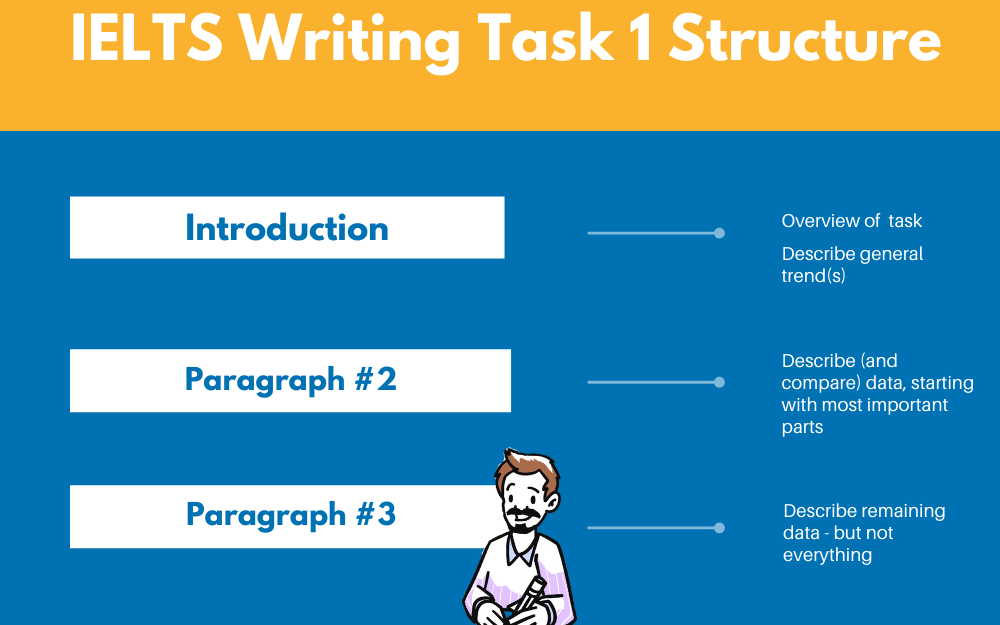
In this lesson, we’re going to learn how to tackle bar charts in IELTS Writing task 1 questionsto get the highest score. To get a band 9 in IELTS Writing task 1, you should follow this answer structure:
Introduction
General overview
Specific features
IELTS Bar chart answering strategy:
1. Introduction
You should start your answer by writing an introduction. The introduction is 1 or 2 sentences, where you paraphrase the information from your question. You should mention two things in your introduction:
what your graph shows
for what period of time
2. General Overview
The second paragraph of your answer is a general overview, where you briefly describe major trends on your graph. Ideally, you should describe 2-4 key features.
3. Specific details
After we’ve written the introduction and general overview, it’s time to give the specific details. You should describe the specific features in 2 or 3 (sometimes more) paragraphs.
When you have two countries (or two cities or any other two things depicted on the graph). The simplest way of grouping data is to describe each country’s trend in a separate paragraph.
When giving specific features, you have to write exact numbers/percentages and include as much details as you can.
How to choose information from the Bar chart?
Assuming one sentence contains around 10 to 15 words. We can estimate that your description of the Bar Chart will be made out of 10 to 12 sentences, we can now assign each sentence for a specific task:
One sentence for the introduction.
Two sentences with the superlative(usually marked by the suffix -est).
A sentence with a comparison. Make comparisons where relevant.
A sentence grouping two data points because they are similar..
A sentence noting an exception.
A sentence describing some data in an advanced manner.
A sentence describing the data in a normal fashion.
Two sentences for the summary.
Note that these sentences don’t necessarily need to go in this particular order. You must write them in a way that makes your Bar Chart description flow naturally. You may also have to repeat a few sentences with different data if you find your graphic contains more information. The structure above is a rough guide to get you started, once you are comfortable with it you can start experimenting. Just remember to get feedback while you are testing your ideas, otherwise, it’s quite difficult to improve.
Final tips on describing a Bar chart
Avoid listing every single data point by grouping the data together.
Avoid mixing formats, for example, don’t mix decimals with estimations in the same sentence.
After you have successfully written out your description with all of the information you wanted to include, go over it and replace some simpler words with more academic ones – this will get you more marks. For example, change “big” to “most significant”.
Check that the whole text is free of errors and mistakes.
Practice with different Bar Charts to improve.
Review the superlatives -these are essential if you want to effectively describe the chart.
The fastest way to improve is to get feedback on your work.
When analyzing a bar-chart, we cannot always give exact details (due to inaccuracies of the chart), so use words around, about, and approximately when giving inexact data.
Give data for each year shown on the chart
Look for the key data and make sure that you are comparing and contrasting the data, NOT just listing the data from one section to the next. If you just write about what happened to X, what happened to Y, and what happened to Z, without showing any relationship between them, you will not get a high score.
You will need to look for similarities and differences when you first analyze the chart and you will need to decide what can logically be put together or not. This means that you don’t have to describe everything that you see in the bar chart, just the key points!
Group the data together so that you have a well-organized and coherent answer. It is a good idea to divide your answer into two or three paragraphs so it is well organized. To do this, you should group similar ideas together into paragraphs or sections.
Use a wide variety of sentence structures. Include complex sentences and simple sentences.
Bonus tip: Try copying out sample bar charts with pen and paper. You will start to understand what information to select. Also, your confidence will improve when it comes to writing your next essay.
IELTS bar chart Question:
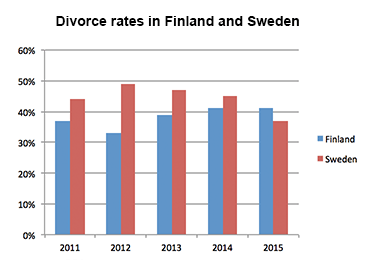
The bar chart shows the divorce rates in two European countries from 2011 to 2015.
Summarise the information by selecting and reporting the main features, and make comparisons where relevant.
Sample Answer
The bar graph provides information about the percentages of divorces in Finland and Sweden between 2011 and 2015.
Overall, Sweden experienced a downward trend, while Finland showed an upward trend throughout the period. Both countries’ divorce rates had some fluctuations. Although Finland initially had a lower rate, it outraced Sweden at the end of the period.
Sweden’s divorce rate was about 45% in 2011, being higher than Finland’s rate by approximately 8%. Then, it rose to almost fifty percent in 2012. However, the figure showed a gradual decrease to about 47% in 2013 and continued to decline steadily to the end of the period, reaching around 45% in 2014 and hitting a low point of about 37% in 2015.
The percentage of divorces in Finland was less than 40% in 2011, and it decreased in 2012, when about one third of marriages in Finland ended with a divorce (as opposed to almost a half in Sweden). However, the figure experienced a steady growth during the next two years. It rose to approximately 39% in 2013, then increased by around 3% in 2014, and remained steady for the next year, outracing the rate of Sweden.
IELTS PIE CHART: OVERVIEW, WRITING STRATEGIES, TIPS AND SAMPLES
IELTS PIE CHART: OVERVIEW, WRITING STRATEGIES, TIPS AND SAMPLES
Here is a post for the IELTS PIE CHART: OVERVIEW, WRITING STRATEGIES, TIPS AND SAMPLES
IELTS PIE CHART: OVERVIEW, WRITING STRATEGIES, TIPS AND SAMPLES
IELTS PIE CHART: OVERVIEW, WRITING STRATEGIES, TIPS AND SAMPLES
In writing module, task 1, of the academic section there will be a visual representation or a diagram on which you have to write a paragraph. One of these visual representations may be pie charts.
Pie Charts are the circular charts that are divided into sections or pie slices usually representing the percentages. Each section of the pie chart shows the percentage of data that it represents. When you put all the sections together it forms a circle.
The Pie charts are most commonly used in multimedia and business world and less commonly used in scientific and technical publications.
Pie chart in IELTS is one of the major question types in IELTS academic writing task 1 that are asked frequently. You are expected to write a response describing the given Pie chart.
Moreover, you are expected to write a report in a minimum of 150 words in 20 minutes . To score band 8 and more, it is essential to examine the question well and find out key features that can be written.
IELTS task 1 Pie charts are the best way to organize data in order to see the size of components relative to the whole, and especially at showing percentage or proportional data.
Now, let’s see what we are going to cover in this article.
What is the IELTS Pie Chart?
Steps to write a Pie Chart
Strategies to Score High in IELTS task 1 Pie chart
Tips for describing Pie chart in IELTS Writing Task 1
Sample IELTS Pie chart with answer
IELTS Pie chart Vocabulary
FAQs about Pie chart in IELTS
What is the IELTS Pie Chart?
Pie Chart in IELTS is a type of graph in which a circle is divided into sectors representing a proportion of the whole.
Moreover, in the Pie chart of IELTS academic writing task1, you are expected to write a short descriptive report based on the given visual data or information.
As mentioned earlier, the Pie charts are divided into ‘pie slices’ to illustrate the percentages.
The size of each pie slice displays the relative data quantity it represents. These slices together create a full circle.
Besides, these are used commonly in the mass media and business world, but less common in technical and scientific publications.
Steps to write a Pie Chart
There are certain steps that you need to follow while describing the Pie Chart. You can follow the below steps:
Introduction
You have to begin the chart with an introduction. The introduction can go up to 2 sentences and while introducing you can paraphrase the sentence that is already there in the question. You need to include two points. Firstly, what is your graph showing and secondly, the time period?
General Overview
In the second paragraph, you need to write a general overview of the graph. You need to pick some main features from the chart and explain it. Firstly, you can take the biggest or the smallest sections from the pie chart and explain it. Secondly, identify the ones that didn’t change over time. You can choose to write on any one of the options, but do not write both.
Specific Details
In the last paragraph, you have to write about the specific details. You can split the group of specific details into two or three paragraphs. You can group the specific details in the following manner:
Firstly based on the sectors that have increased and secondly based on the factors that have decreased or didn’t change.
Strategies to Score High in IELTS Task 1 Pie Chart
Read the Question Properly to Select Information
In order to properly display the information in the Pie Chart, read the given information before you proceed.
Follow the right structure
A proper Pie chart structure should include:
Introduction, body paragraphs, and conclusion
Connective words to make the writing cohesive within sentences and paragraphs.
Meet the requirements of the task
Make sure that the Pie chart has enough grammar
Describing the whole graph adequately
Meeting the word limit requirements
Focusing on the important trends presented in the Pie chart
Focus on the Vocabulary
Vocabulary for IELTS pie chart plays a crucial role in achieving a good score. Moreover, to score high within the limited instructions is a bit challenging.
To prove that your report has a great vocabulary for IELTS, maintain the following:
Use a wide vocabulary range
Avoid repeated phrases and words
Use words precisely
Use Synonyms
Enriching vocabulary can help you hit a high band score as it holds 25% of the score.
You have seen about the describing a Pie chart in IELTS writing task 1 and the major strategies to follow. Now, let’s look into some tips that help in effective report generation.
Tips for Describing Pie Chart in IELTS Writing Task 1
Follow the below tips to crack the Pie chart in IELTS academic writing task 1
Read the given question and identify the key information.
Pay attention to your Pie chart time-frame and use appropriate tense.
Paraphrasing the given question using proper grammar and vocabulary
Use Transition Words to maintain continuity and keep a count on the word count.
Focus on acquiring the appropriate data from the Pie charts into your writing.
Compare the information on your Pie chart, do not panic. In such cases, give a summary of each picture.
Do not give personal opinions at any cost.
Let’s implement our Pie chart describing strategies of IELTS in the below sample and generate a report:
Sample IELTS Pie Chart with Answer
You should spend about 20 minutes on this task. Moreover, write at least 150 words.
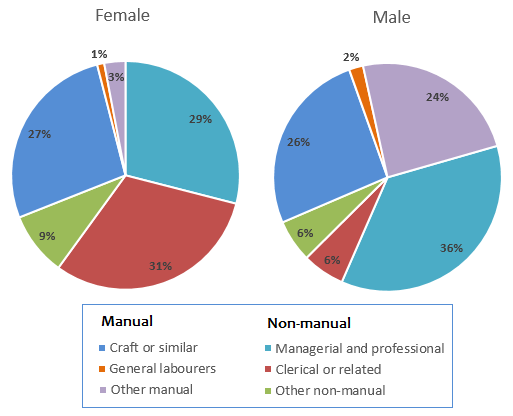
The two pie charts below show some employment patterns in Great Britain in 1992.
Summarize the information by selecting and reporting the main features, and make comparisons where relevant.
IELTS PIE CHART: OVERVIEW, WRITING STRATEGIES, TIPS AND SAMPLES
The pie charts outline employment scenario of British males and females in six job sectors in 1992. It is obvious that manual jobs were predominantly done by males whereas a higher percentage of females did clerical jobs. Moreover, managerial and craft related jobs were engaged by a higher proportion of both genders.
As the illustration indicates, more percentages of British males worked in manual sectors, except in craft-related industries, compared to their female counterparts. For instance, 2% general labourers in Great Britain were men while the female labourers’ ratio was half of that. Moreover, 24% males worked in numerous other manual jobs while this was only 3% for females. Nevertheless, 27% females in craft-related industries marginally exceeded the ratio of males in the same sector.
Looking further into the data, non-manual professions included managerial & professional, clerical and other non-manual jobs. Interestingly, employment rates of females in clerical was five times higher than that of males. This is the job category that many females (31%) we engaged in. Besides, over one-third males were in managerial and professional jobs while almost 30% females were in these positions as well.
IELTS PIE CHART: OVERVIEW, WRITING STRATEGIES, TIPS AND SAMPLES
IELTS Pie chart Vocabulary :
In writing task 1 of Academic module, there is a dedicated vocabulary for pie chart. IELTS pie chart description must be done accordingly. Here are some sample vocabulary:
You can also use other words and fractions.
A large number of people
over a quarter of people
a small minority
A significant number of people
less than a fifth
This table presents some examples of how you can change percentages to fractions or ratios:
Percentage
Fraction
80%
four-fifth
75%
third quarter
60%
three-fifth
55%
more than half
40%
two-fifth
35%
more than a third
20%
a fifth
15%
less than a fifth
10%
one in ten
5%
one in twenty
IELTS PIE CHART: OVERVIEW, WRITING STRATEGIES, TIPS AND SAMPLES
If the percentages are not exact as above, then you can use qualifiers to make sure your description remains accurate. Here are some examples:
Percentage
Qualifier
77%
just over three quarters
77%
approximately three quarter
49%
just under a half
49%
near a half
32%
almost a third
This table presents some examples of how you can change percentages to other phrases:
Percentage
proportion / number / amount / majority / minority
75% – 85%
a very large majority
65% – 75%
a significant proportion
10% – 15%
a minority
5%
a very small number
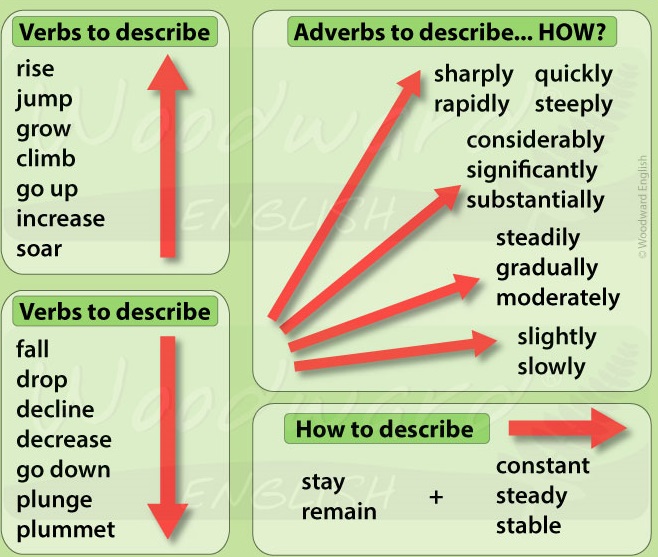
When describing increases/decreases, use words given below:
Noun phrase + verb + adverb Eg : The price of tomatoes fell sharply.
There + be + noun + in + noun phrase Eg: There has been a sharp decrease in the price of leather goods.
IELTS PIE CHART: OVERVIEW, WRITING STRATEGIES, TIPS AND SAMPLES
Frequently Asked Questions on IELTS Pie Chart
1) How many words should we use to describe Pie Chart graphs in IELTS?
You have to write a minimum of 150 words or a bit more. The ideal word length is 160-180 words.
2) What are the basic elements of the Pie chart?
The basic elements of the Pie chart in task 1 include an introduction, overview, and body paragraphs.
3) Where to note the key features of Pie chart?
You will be provided with a paper and you can use a pen or pencil to note the key features in the IELTS Writing test.
4) What tense should we use while describing the Pie chart?
You have to use the right tense according to the context. Crucially the usage of tense depends on the time frame of the graph.
5) Should we conclude or give an opinion on Pie chart data?
No, you are not supposed to give any opinion on the Pie chart. It is statistics and needs to be interpreted not evaluated. In addition, the graders consider your task achievement (not task response).
6) By concluding the data can we get high marks?
Of course not! Besides, it is a waste of time. The conclusion is another form of overview relatively short. An overview is important for a good score.
IELTS PIE CHART: OVERVIEW, WRITING STRATEGIES, TIPS AND SAMPLES